


Key Takeaways
- •The U.S. introduced the GENIUS Act in July 2025, establishing the first federal stablecoin legislation.
- •The act mandates that stablecoin reserves be backed by U.S. Treasuries, potentially shifting bondholder demand.
- •Wall Street strategists are divided on the economic impact and potential for stablecoins to significantly enhance dollar demand.
Legislative Milestone and Market Dynamics
The U.S. Government has passed the GENIUS Act, marking a noteworthy regulatory milestone. Key figures in this legislative process include Senator Hagerty and President Trump. As a result of this act, stablecoin issuers are now limited to federally approved entities, a measure intended to ensure compliance and boost market trust.
Market dynamics could shift significantly due to the Act's mandate that stablecoin reserves must be backed by U.S. Treasuries. An increased demand for these securities is anticipated, although some experts suggest this may result in a mere reallocation of existing funds rather than the creation of true new demand.
Wall Street strategists from major financial institutions express caution regarding the potential impact of the GENIUS Act. They cite insufficient evidence to suggest that stablecoins can significantly enhance dollar demand. Skepticism remains about whether these digital assets can fundamentally alter financial landscapes, despite ambitious projections from government officials.
Economic Projections and Wall Street's Perspective
The GENIUS Act represents the first U.S. federal law to create a nationwide framework for stablecoin regulation. This legislation aims to standardize an industry that was previously governed by a patchwork of state laws.
As of December 4, 2025, Tether USDt (USDT) trades at $1.00 with a market capitalization of $185.35 billion. The stablecoin has shown minor price fluctuations, reflecting a 0.01% change over the past 24 hours and a 0.02% change in the past week.
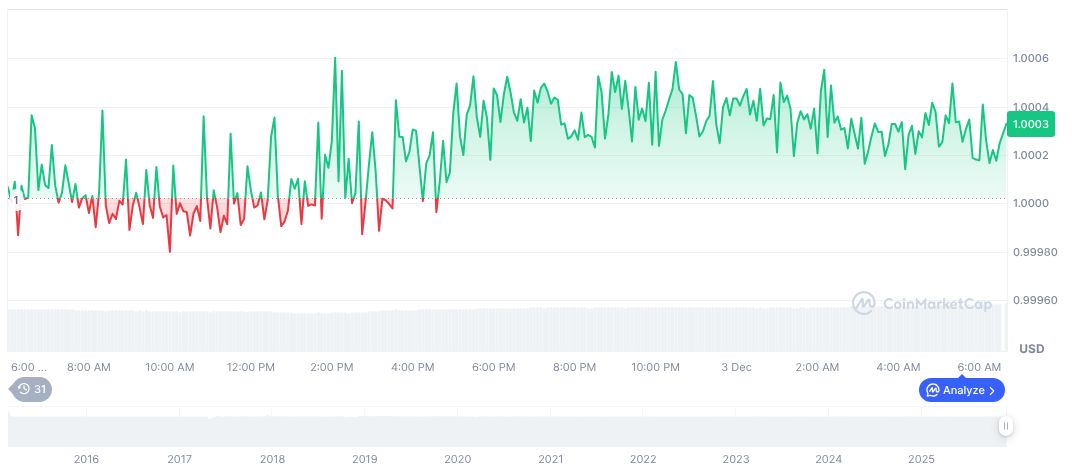
Insights from research teams suggest that while stablecoins might bolster short-term Treasury demand, the broader economic implications are contingent upon adoption rates and the evolution of regulatory frameworks. Enhanced compliance mandates are expected to cultivate a more trusted marketplace for digital payments.