



Key Economic Data Releases on January 13
The U.S. Bureau of Labor Statistics is scheduled to release crucial economic data, including the December Consumer Price Index (CPI) and real income figures, on January 13. These releases are highly anticipated as they directly influence the Federal Reserve's decisions regarding interest rates, which in turn have a significant impact on cryptocurrency markets such as Bitcoin and Ethereum.
Impact of CPI and Income Data on Crypto Markets
The forthcoming data release from the U.S. Bureau of Labor Statistics represents a critical juncture for economic assessments. The Consumer Price Index, alongside real income statistics, directly informs Federal Reserve policies, thereby shaping the economic climate that influences both traditional and global crypto markets. The immediate implications of these releases involve potential shifts in interest rates determined by the Federal Reserve. Macroeconomic indicators, including employment statistics and consumer prices, form the bedrock for these pivotal fiscal decisions. Consequently, these announcements are essential benchmarks for forecasting investment climates.
Market analysts are expecting strong reactions from the investment community. Leading macroeconomists assert that the interrelationship between these indicators and Federal Reserve decisions substantially governs market liquidity. Prominent crypto influencers are closely monitoring these developments, emphasizing the integral role these data points play in determining market trends.
Historical Data and Bitcoin, Ethereum Volatility
Historically, monthly CPI and employment data releases have been among the most influential macroeconomic events affecting Bitcoin and Ethereum prices. These releases have often correlated with significant market volatility, occurring during both inflationary and deflationary trends.
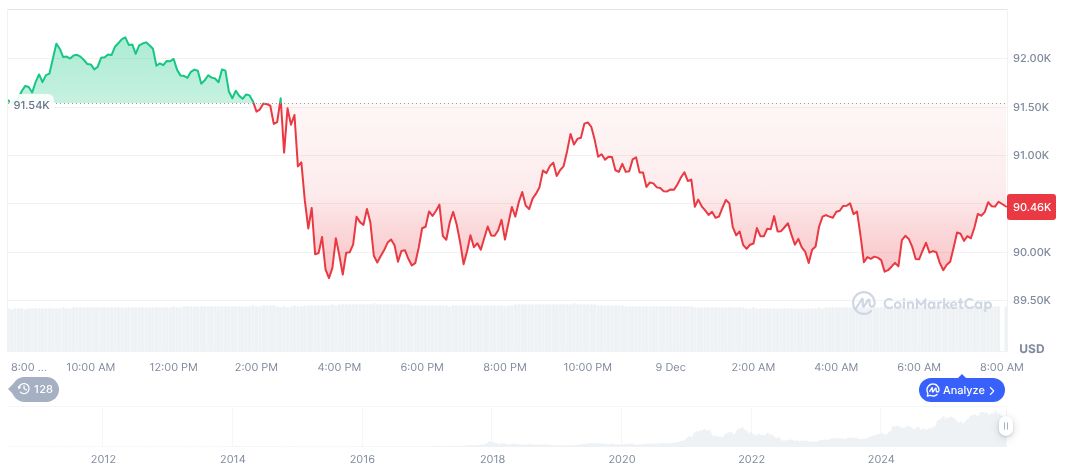
As of December 9, 2025, Bitcoin (BTC) was trading at $93,484.89 with a market capitalization of 1,865,938,713,522.12. The 24-hour trading volume was 59,213,604,395.02, indicating a decrease of 1.23%. Recent price movements showed a 3.48% increase over the preceding 24 hours, though a decline of 9.64% was observed over 30 days, according to CoinMarketCap data.
Researchers suggest that these macroeconomic indicators could guide future technological investments in blockchain technology and potentially influence regulatory frameworks. Ongoing analysis by experts indicates that sustained inflation data may lead to more comprehensive regulatory scrutiny within the cryptocurrency sector.
"CPI and labor data are the key inputs into the liquidity cycle, and crypto is purely a liquidity proxy in this regime."