Key Regulatory Changes and Effective Date
The United Arab Emirates has enacted Federal Decree No. 6 of 2025, a significant piece of legislation that will bring Decentralized Finance (DeFi) and Web3 activities under the direct oversight of the central bank. This new decree is set to take effect from September 16, 2025.
This regulation mandates licensing for various DeFi and Web3 services, including payments, lending, trading, and custody services. A critical aspect of this decree is the elimination of the 'pure code' defense, meaning that entities operating in these sectors must achieve full compliance with the new regulations by September 2026.
Penalties for Non-Compliance
Unlicensed activities operating within the scope of Federal Decree No. 6 of 2025 will face substantial financial penalties. Fines can reach up to 1 billion dirhams, which is equivalent to approximately $272 million. This stringent penalty structure underscores the UAE's commitment to ensuring regulatory adherence.
While the decree does not impose a ban on self-custodial wallets, any services that involve payment functionalities will require appropriate licensing. This distinction is crucial for companies operating within the UAE's evolving digital asset landscape.
Industry Reactions and Expert Opinions
The introduction of this new regulatory framework has elicited varied reactions from the industry. While many experts have welcomed the increased clarity and regulatory certainty, some have also expressed concerns about the potential compliance burden for existing businesses.
Irina Heaver, Founder of NeosLegal, described the law as one of the most impactful regulatory changes for the crypto industry in the region. She noted that the decree brings protocols, DeFi platforms, middleware, and even infrastructure providers involved in payments, exchange, lending, custody, or investment services under direct regulation.
"The UAE's new central bank law, Federal Decree Law No. 6 of 2025, is one of the most impactful regulatory changes for the crypto industry in the region. It brings protocols, DeFi platforms, middleware, and even infrastructure providers involved in payments, exchange, lending, custody, or investment services under regulation." - Irina Heaver, Founder, NeosLegal
Major leaders of prominent DeFi projects have yet to issue public comments regarding the new regulations.
Broader Implications for the UAE's Digital Asset Sector
The UAE's regulatory approach mirrors historical trends observed in other major financial jurisdictions, such as the United States and the European Union. In these regions, the implementation of increased regulation has often led to an initial period of compliance uncertainty, followed by a gradual migration towards more regulated and structured solutions.
Coincu researchers suggest that these new rules are likely to steer the DeFi sector in the UAE towards developing more robust compliance infrastructure. While the immediate response may involve significant reevaluation efforts from existing entities, this regulatory shift could ultimately foster technological advancements aimed at meeting both regulatory requirements and supporting sustained industry growth.
Market Data Snapshot
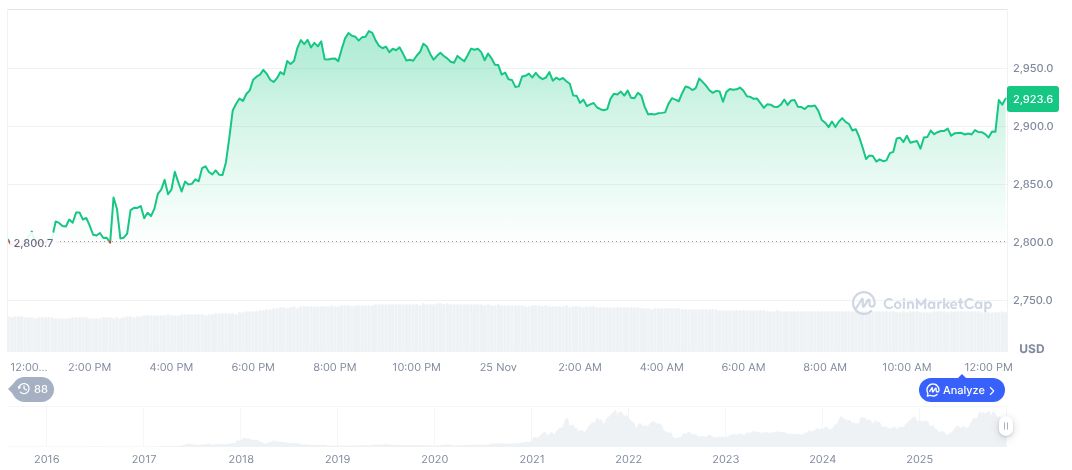
As of November 25, 2025, Ethereum (ETH) was trading at $2,917.27, with a market capitalization of $352,101,267,863. The cryptocurrency saw a 2.34% increase over the preceding 24 hours. However, over a 90-day period, its price had decreased by 37.25%, according to data from CoinMarketCap.