Key Policy Announcements and Market Reactions
President Trump has introduced new policies that are significantly impacting U.S. markets as the fall congressional elections approach. These maneuvers, described by Ed Clissold of Ned Davis Research as part of a 'Big MAC Trade,' are creating policy-driven market volatility and uncertainty in hedging strategies. The focus of these policy shifts includes interest rates, defense stock dividends, and the independence of the Federal Reserve.
Interest Rate Caps and Banking Sector Impact
Donald Trump's directive to cap credit card interest rates at 10% has led to a substantial market reaction, with bank stocks experiencing a sharp decline. Concurrently, he mandated that defense companies redirect their dividends towards production, contributing to instability within that sector. These actions have intensified concerns regarding the independence of the Federal Reserve, adding to the tension in financial markets.
The rapid implementation of these policy changes is actively reshaping market dynamics. The banking sector has been particularly affected, witnessing a significant drop in stock prices. The defense sector is facing similar pressures as dividend payouts are being reallocated to investments in production capabilities. These strategic moves are being viewed as pre-election tactics with potentially lasting consequences.
Market responses have been diverse. Ed Clissold of Ned Davis Research has highlighted the challenges in hedging against these new forms of risk, stating, "Policy adjustments targeting specific industries will pose a significant risk." Meanwhile, Wall Street is expressing increased apprehension about potential limitations being placed on the Federal Reserve's operational autonomy.
Federal Reserve Independence and Market Volatility
Historical data indicates that changes in Federal Reserve leadership often precede market corrections. Stocks have historically seen an average decline of 15% in the six months following such shifts, underscoring a consistent investor anxiety regarding alterations to central bank authority.
Research from Coincu suggests that potential regulatory changes could lead to wider credit spreads and elevated inflation expectations. Despite these regulatory challenges, market returns have historically shown resilience, maintaining growth over 6-7-year periods.
Ed Clissold, Chief U.S. Strategist at Ned Davis Research, commented on the prevailing concerns, noting, "Top of the list is what could go on with the Fed... we have a readymade concern with Fed independence."
Market Data and Context
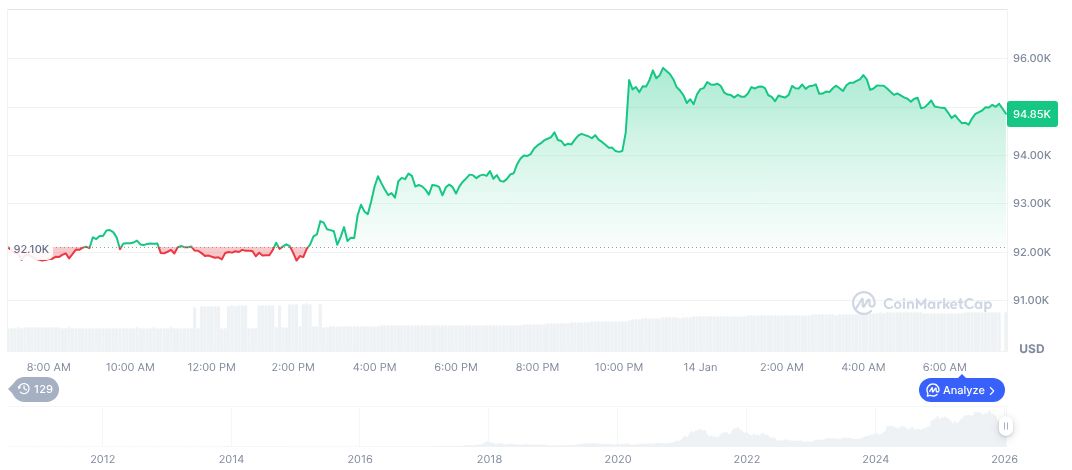
Bitcoin (BTC) is currently trading at $95,030.93, according to CoinMarketCap. The cryptocurrency's market capitalization is $1.9 trillion, representing 58.73% of the total cryptocurrency market dominance. Despite recent market fluctuations, Bitcoin has demonstrated positive price momentum, with a monthly gain of 5.95%.