


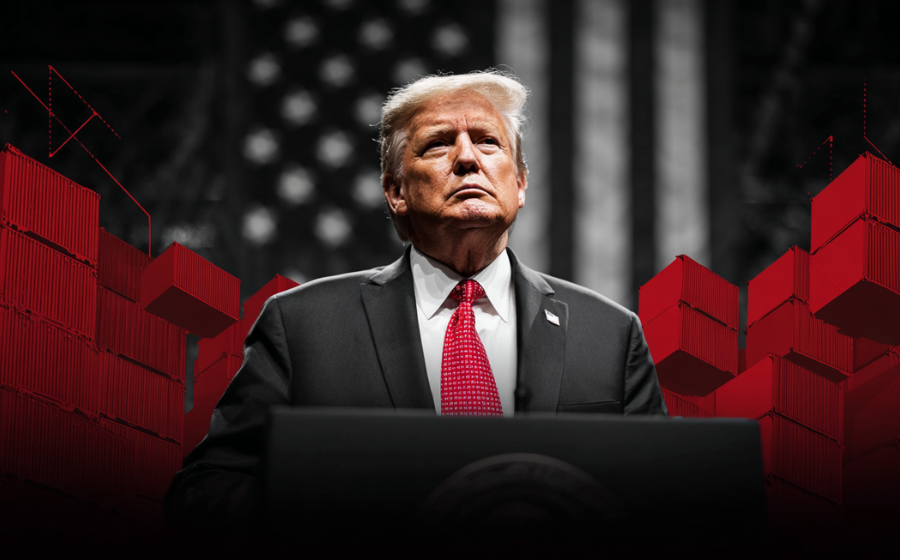
EVENT ORIGIN: THE SPARK OF THE TRADE WAR
Trump’s post did not come from nowhere. It was a direct response to recent moves by China. Earlier on October 10, China announced tighter controls on rare‑earth exports to protect national resources. The U.S. quickly called this “hostile” and an attempt at “market monopoly.” In his post, Trump said: “China is acting in an extremely hostile way. From November 1 — or earlier — we will levy a 100% tariff on all Chinese goods.
We will also impose controls on key software exports. I no longer wish to meet with Chinese leaders.” The post hit at 8:00 p.m. ET like a bomb. Nasdaq and S&P 500 futures instantly fell 2%–3%. Crypto moved into “risk‑off” mode. By 10:00 p.m., Bitcoin had slid from its $112,500 high to $108,000, down 7.6% in 24 hours. ETH fell to $3,500. Solana slipped below $140, down as much as 14%. One hour later, liquidations surged.
More than $6 billion in leveraged positions were closed in a single hour. The total quickly climbed to $19 billion, not only the third‑largest “wipeout” in crypto history, but also far above the $1.2 billion on “Black Thursday” in 2020 and the $1.6 billion during the FTX collapse in 2022. In the early hours, a small rebound came. Bitcoin barely moved back above $110,000, but volatility stayed high.
CRASH MOMENT: THE MARKET’S INSTANT REACTION
The immediate reaction was most violent in crypto. As a high‑risk asset, crypto moves with stocks. A trade war raises inflation fears — JPMorgan projects tariffs could lift CPI by 2% — which may make the Fed delay rate cuts and drain liquidity further.
The Dow closed down more than 2%, led by tech stocks. The total crypto market cap shrank fast from $4.25 trillion to $4.05 trillion. Bitcoin fell 10%–15% in 24 hours, with a low near $102,000 and about $7 billion in liquidations. Ethereum dropped 12%–17% to a low of $3,500, with about $3 billion liquidated.
Solana fell 14% to $140, with about $1 billion in liquidations. XRP fell more than 30%, with about $500 million liquidated. These numbers reflect the broad sell‑off. Total liquidations in the past 24 hours exceeded $19 billion. On X, traders showed deep gloom, but a quick consensus formed: high‑leverage perpetual futures triggered a chain reaction during the panic.
HISTORICAL ECHOES: THE GHOST OF TRADE TENSIONS
U.S.–China trade frictions are not new. They are a hidden fuse that often sets off global market swings. In 2018 during Trump’s first term, the tariff war caused sharp stock moves, and crypto fell 30%. In 2025, “Trump 2.0” turned more aggressive: in February he set 10%–25% tariffs on China, Canada, and Mexico; on “Liberation Day” in April he announced a 10% universal tariff plus an extra 34% on China (total 54%); in August he expanded to global reciprocal tariffs.
After each notice, crypto went risk‑off. April’s crash erased $320 billion in market cap. In August, Bitcoin even broke below $90,000. This new 100% tariff means full‑scale confrontation. It covers all goods and adds software controls, hitting semiconductors and AI supply chains, which are core to blockchain infrastructure. China‑led Bitcoin mining rig makers — companies like Bitmain, which hold about 70% of the market — will face hardware cost pressure of more than 8%. A JPMorgan survey shows 51% of institutions see tariffs as the key force in 2025. This is not empty talk. It reflects how trade wars amplify global uncertainty.
FRAGILE CHAIN: WHY CRYPTO IS SO SENSITIVE
This event exposed crypto’s fragility. Crypto is not directly taxed by tariffs, but the indirect links are clear and harsh. First, as a risk asset, crypto moves with stocks. A trade war raises inflation fears — JPMorgan projects tariffs could lift CPI by 2% — which may make the Fed delay rate cuts and drain liquidity further.
Looking ahead, this drop may be only a “shakeout.” History shows Bitcoin’s average return in October is 20.14%, so a short‑term bounce is possible. But if the trade war turns into a global recession, crypto market cap may shrink another 20%–30%. On the positive side, Trump’s pro‑crypto stance — such as building a Bitcoin reserve — could offset some damage, as seen when markets rose 5%–9% after the tariff pause in April. But China may hit back with 125% retaliatory tariffs, which would add more supply‑chain stress. Polymarket odds suggest the trade war may last into next year. Investors should stay alert and separate noise from signal in this uncertainty.
Trump’s 100% tariff was like a sudden storm that tore the fragile balance of the crypto market. As one user said: “History repeats. This time it is the ‘10/11 Tariff Crash’.” In the wake of fear, HODLers may be seeing a chance to build a bottom. Markets often rise again from valleys. The key is what happens in U.S–China talks in the coming weeks — will it be a plunge into a full trade war, or another strategic “pause”? The crypto world is holding its breath.