


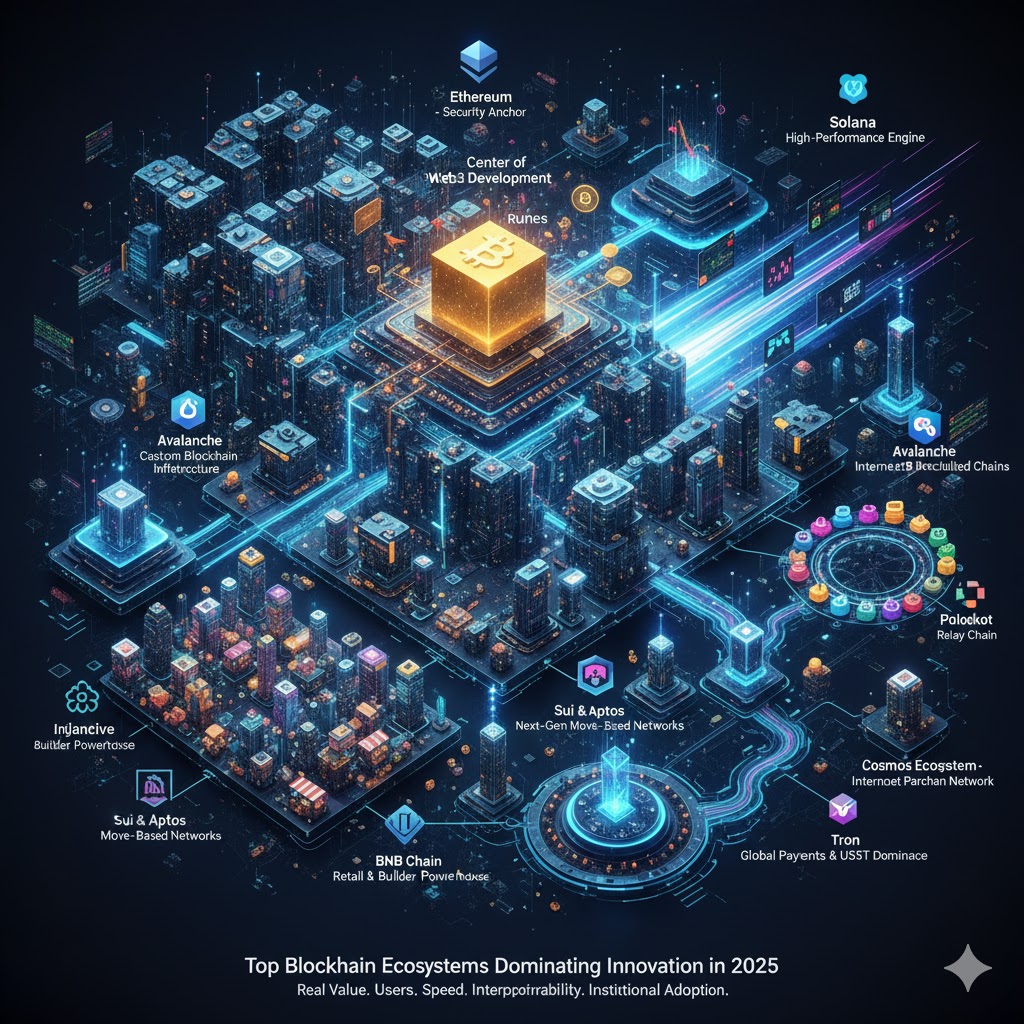
Blockchain in 2025 isn’t defined by hype; it’s defined by ecosystems that have matured, scaled, and proven real value. As adoption accelerates across DeFi, real-world assets, gaming, AI, and cross-chain infrastructure, a handful of networks are clearly leading the innovation cycle. These ecosystems combine strong developer activity, robust security, fast execution, and growing user demand.
Below are the top blockchain ecosystems shaping the industry’s direction in 2025.
Bitcoin: Security Anchor & Hardest Settlement Layer
Bitcoin remains the strongest and most secure chain, backed by the world’s largest decentralized network. With new layers like Bitcoin L2s, Runes, and BitVM, an entire developer economy is now emerging on top of Bitcoin’s immovable security foundation.
Why it leads: unmatched security, strongest decentralization, growing L2 innovation.
Ethereum: The Center of Web3 Development
Ethereum continues to dominate developer activity, powering the largest DeFi, NFT, and smart contract ecosystem. With rollups, data availability layers, and EIP-4844 driving down costs, Ethereum remains the most flexible and production-ready smart-contract environment.
Why it leads: largest builder community, modular scaling, enterprise trust.
Solana: High Performance Engine for Consumer Crypto
Solana’s parallel execution and subsecond finality make it ideal for high-throughput apps like payments, trading, and consumer products. With its exploding app ecosystem DePIN, memecoins, and gaming, Solana is the chain where users are most active.
Why it leads: unmatched speed, low fees, fast-growing user ecosystem.
BNB Chain: The Retail & Builder Powerhouse
BNB Chain retains one of the largest user bases thanks to its low-cost environment, global accessibility, and strong exchange-backed infrastructure. Its modular 2025 roadmap further expands scaling and interoperability.
Why it leads: massive user base, easy onboarding, strong app diversity.
Avalanche: Custom Blockchain Infrastructure
Avalanche’s Subnet architecture allows institutions, enterprises, and advanced DeFi teams to deploy custom chains optimized for their use cases. Its growth in RWAs and institutional adoption makes it a standout.
Why it leads: customizable chains, strong institutional traction, fast settlement.
Injective: Purpose Built for Finance
Injective is now a leading finance-focused L1 with ultra-fast execution, orderbook infrastructure, and a strong app ecosystem across trading, derivatives, and AI-powered DeFi. Its interoperability and performance make it attractive for advanced financial builders.
Why it leads: finance-optimized architecture, cross-chain capability, rising ecosystem maturity.
Sui & Aptos: Next Gen Move Based Networks
Move-based chains bring a new programming paradigm emphasizing safety and performance. Sui focuses on parallel execution and gaming, while Aptos targets enterprise-grade scalability.
Why they lead: developer-friendly Move language, high throughput, rapid ecosystem growth.
Cosmos Ecosystem: The Internet of Specialized Chains
Cosmos enables independent blockchains to communicate via IBC, powering major chains like Injective, Celestia, Osmosis, and dYdX. This modular architecture is becoming central to next-generation app design.
Why it leads: sovereignty, interoperability, modular innovation.
Polkadot: Interconnected Parachain Network
With its shared security model and cross-chain messaging, Polkadot continues to strengthen its position as a network of interconnected chains optimized for specialized use cases.
Why it leads: shared security, robust cross-chain design.
Tron (TRX): Global Payments & USDT Dominance
Tron remains one of the most used networks globally due to its low fees and massive share of stablecoin transactions. It plays a central role in emerging market digital finance.
Why it leads: huge stablecoin flow, strong global usage.
Final Thoughts
2025 is the year blockchain ecosystems stop competing on narratives and start competing on real value to users, speed, interoperability, and institutional adoption. These leading chains are not just surviving the cycle; they’re shaping what Web3 will look like for the next decade.