


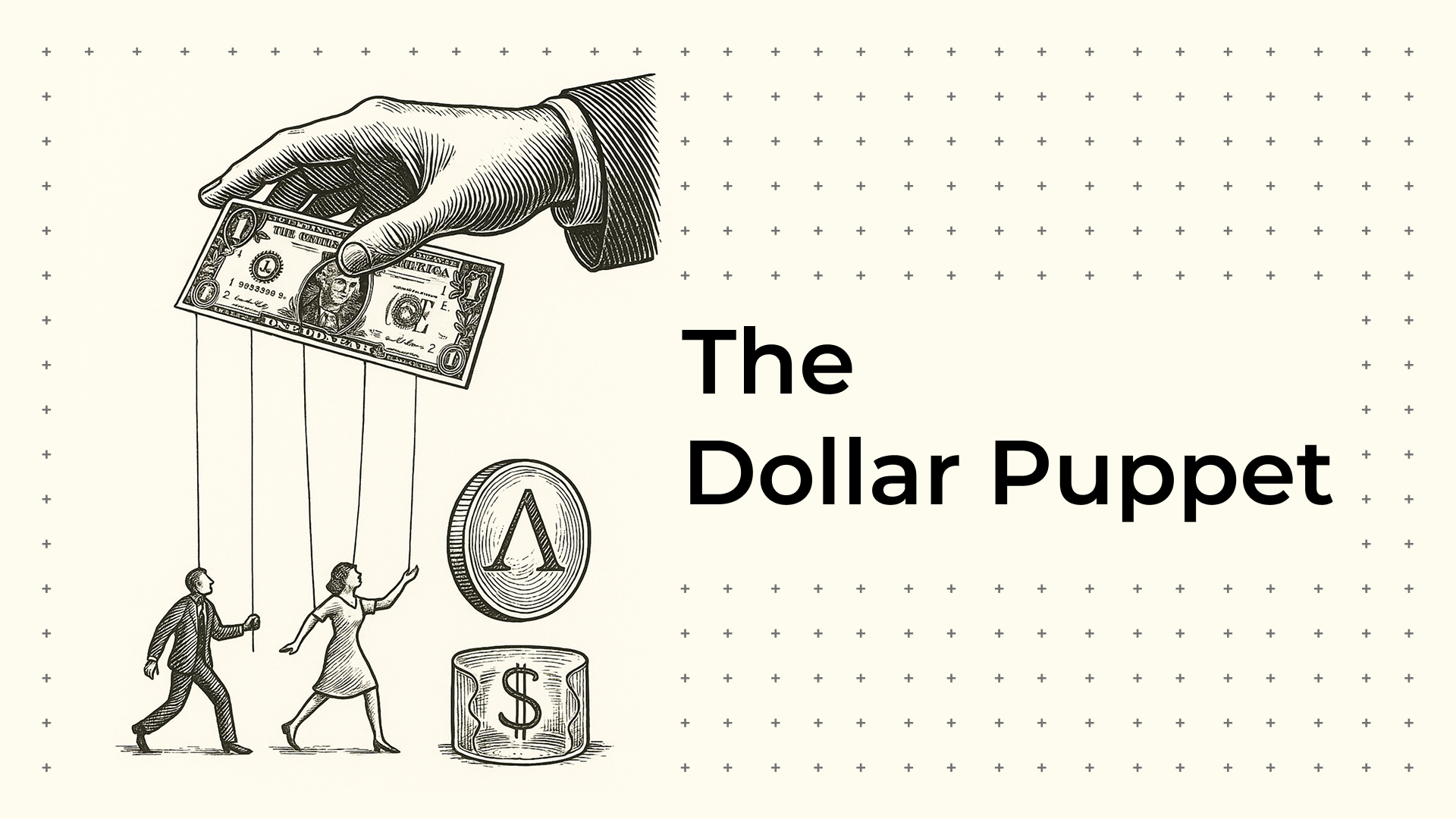
Money is supposed to be stable. It is meant to hold value over time so that what you earn today can still buy something tomorrow. But that idea is starting to fall apart. The U.S. dollar, the base of the global financial system, is slowly losing its strength. Gold is now worth more than 4,300 dollars per ounce for the first time ever. Bitcoin has passed 126,000 dollars and keeps climbing. At the same time, stablecoins like USDC and USDT still show one dollar on your screen, but they are quietly losing real-world value. What looks stable in numbers is not stable in power. In this article, we’ll look at how the dollar’s decline affects all fiat-backed stablecoins, why their promise of safety is breaking down, and how new systems like Ampleforth and SPOT are trying to build a better kind of stability for the future of money.
Gold has crossed +4,300 dollars per ounce for the first time in history.

Bitcoin reached new all-time highs above 126,000 dollars.

Meanwhile, the dollar’s credibility is breaking in real time.
Your stablecoins are down almost 50 percent against gold over the last two years.
They stay perfectly pegged to one dollar while losing purchasing power every day. Stability tied to a failing currency is not real stability.
The Illusion of Safety
USDC and USDT look solid on the screen. One dollar, maybe 0.998, maybe 1.002. The number barely moves. But that number is measured in dollars, and the dollar itself is melting.
Since early 2024, gold climbed from about 1,950 to over 4,300 dollars, more than doubling in value. Bitcoin jumped from 40,000 to above 126,000 dollars. Stablecoins stayed flat, losing half of their real value.
If you held 100,000 USDC in January 2024, you still have 100,000 USDC today. But what it buys now tells a very different story.
The Two Assumptions Breaking Down
Every fiat-pegged stablecoin rests on two promises.
- •First, the issuer can always redeem one token for one dollar.
- •Second, the dollar system stays solvent, liquid, and neutral.
Both are under pressure right now.
Assumption One: Redemption Guarantee
In March 2023, Silicon Valley Bank collapsed. Circle, the issuer of USDC, had 3.3 billion dollars trapped in SVB. USDC briefly de-pegged to 0.87 dollars, a 13 percent crash in something called a stablecoin. For 48 hours, nobody knew if they would get their dollars back.

The Federal Reserve stepped in with emergency measures. Circle was rescued and the crisis was contained.
But here is the real problem.
That bailout only works if the U.S. government still has credibility and the capacity to rescue institutions. What happens when that assumption fails?
Assumption Two: Dollar Stability
The Dollar Index (DXY) has been sliding through 2025. Several emerging markets are reducing their holdings of U.S. Treasuries. China has cut to its lowest levels since 2009, while others diversify into gold and yuan. U.S. national debt just passed 38 trillion dollars. Annual deficits now exceed two trillion dollars. Interest payments are approaching one trillion dollars per year.
The Federal Reserve is trapped. It can raise rates and risk crashing the economy, or keep printing and let inflation rise. Either way, the dollar’s purchasing power erodes.
Stablecoins inherit all of this. They are not escaping the dollar system. They are tokenized exposure to it.
The Circular Trap
To maintain their peg, USDC and USDT hold a mix of U.S. assets:
- •Cash deposits in banks (counterparty risk)
- •Treasury bills (government debt risk)
- •Commercial paper (corporate IOUs)
Stablecoin demand actually helps fund the deficits that weaken the currency they represent. It is a self-reinforcing loop. Tether alone holds around 120 billion dollars in the U.S. Treasuries, making it one of the largest non-sovereign holders of American debt.
Circle holds tens of billions more. When the dollar loses value, their “stable” backing loses value with it. There is no escape.
Real Cases of Fragility
- •
Case 1: Terra UST Collapse (May 2022).
UST had an 18 billion dollar market cap and went to zero in three days. An algorithmic peg failed, destroying over 40 billion dollars of value.

- •
Case 2: USDC Depeg (March 2023).
When Silicon Valley Bank collapsed, Circle had 3.3 billion dollars stuck in the bank. USDC fell to 0.87 dollars. More than ten billion dollars in market cap vanished overnight. DeFi protocols using USDC as collateral suddenly had massive holes. Aave, Compound, and Curve all scrambled to manage risk. If the Federal Reserve had not intervened, the contagion could have been catastrophic.
- •
Case 3: Tether audit concerns (ongoing)
Tether's been promising a full audit for years. Still hasn't delivered one. Instead, they release "attestations" from small accounting firms. Their backing includes Chinese commercial paper, crypto loans, and "other investments" never fully disclosed. Market cap: $140+ billion. Every few months, rumors surface about insolvency. The peg wobbles, people panic, then it stabilizes. But the underlying uncertainty never goes away. What happens if tether actually can't redeem 1:1? With $140 billion in circulation, it would make terra's collapse look tiny.
- •
Case 4: Regulatory Weaponization.
In 2023, Paxos was ordered to stop minting BUSD, and its supply fell from 16 billion to under one billion. In 2022, Circle froze 75,000 USDC linked to Tornado Cash after U.S. sanctions. A system that can freeze your money on command is not decentralized.
The Collapse of Purchasing Power
Let’s use real numbers.
In January 2020, gold traded around 1,550 dollars per ounce. In October 2025, gold trades above 4,300 dollars per ounce.
If you held 100,000 dollars in USDC since 2020:
- •In 2020, that could buy about 64 ounces of gold.
- •In 2025, it buys about 23 to 25 ounces.
You lost around 60 percent of your purchasing power while your stablecoin stayed perfectly stable at one dollar.

The same thing happened with real estate, high-quality stocks, and commodities. The dollar buys less. Stablecoins are simply digital dollars, and they buy less too.
When the Base Layer Fails
Here is the core problem. Stablecoins cannot be more stable than what they are pegged to. If the dollar loses 5 percent of its purchasing power this year, USDC loses 5 percent too.
There is no upside protection.
Real inflation, not the official CPI, is running closer to 8 to 15 percent depending on what you buy. Rent is up more than 30 percent since 2020.
- •Groceries are up about 25 percent.
- •Healthcare costs are up around 20 percent.
- •Energy prices remain volatile.

And yet, your stablecoin is still worth one dollar.
The Geopolitical Angle
The dollar’s dominance is being actively challenged. BRICS nations are building alternative payment systems. Russia and China are settling trade in yuan and rubles. Saudi Arabia is now accepting non-dollar payments for oil. The United States weaponized the dollar through sanctions against Russia, Iran, and Venezuela.
Now, countries are diversifying away from it as a form of self-defense. As the reserve currency status of the dollar erodes, global demand for dollars falls. That means dollar value drops. Stablecoins backed by dollars fall in real terms with it.
The False Choice
For years, crypto investors have faced a false choice. They could hold volatile assets such as Bitcoin, Ethereum, and altcoins, with potential upside but severe drawdown risk. Or they could hold stablecoins such as USDC and USDT, with no volatility but counterparty risk and exposure to fiat debasement.
Neither option solves the real problem. How do you preserve purchasing power without trusting centralized intermediaries or being tied to a currency that constantly loses value?
What Real Stability Looks Like
Real stability is not pegging to a number. It is maintaining purchasing power over time.
Gold has held value for more than 5,000 years because it is scarce, independent, and has no counterparty risk. But it is not easily usable in DeFi. Bitcoin is decentralized and scarce, but it is too volatile for daily use or treasury management.
Elastic-supply systems like Ampleforth were built to solve that. AMPL targets the purchasing power of a 2019 CPI-adjusted dollar, not a fixed one-dollar peg. When demand rises, supply expands. When demand falls, supply contracts. The price moves around a constant purchasing-power reference, not an arbitrary peg.
SPOT takes that further. It creates low volatility from AMPL’s elastic base. It has no custodian, no peg to defend, and relies purely on algorithmic rebalancing through open market mechanics.
The Numbers Do Not Lie

Holding 100,000 Dollars in USDC:
- •Start: 100,000 dollars.
- •End: 100,000 dollars.
- •Real value vs gold: down 40 to 60 percent.
- •Counterparty risk: yes (Circle, banks, government).
- •Censorship risk: yes (can be frozen).
Holding 100,000 Dollars in Gold:
- •Start: 100,000 dollars.
- •End: about 160,000 dollars or more.
- •Real value: maintained or increased.
- •Counterparty risk: none.
- •Censorship risk: none.
Holding Elastic Supply Assets:
- •Exposure to purchasing-power target instead of fiat.
- •Fully decentralized (no issuer to collapse).
- •Algorithmic rebalancing (no peg to defend).
- •Composable in DeFi and usable on-chain.
What Happens Next
If the dollar keeps weakening, stablecoins will keep losing purchasing power. Redemption stress could expose fragile issuers during market panic. Regulatory risk will increase as governments face growing deficits. DeFi protocols built on stablecoin collateral will face systemic risk. The so-called bridge to traditional finance could become the anchor that drags DeFi down with it.
The Hard Truth
Stablecoins are not protecting you from volatility. They give you perfect exposure to dollar debasement with extra counterparty risk on top. When gold is rising, Bitcoin is breaking records, and the dollar’s credibility is fading, being “stable” to the dollar becomes the riskiest trade on the table.
You are not in a safe harbor. You are chained to a sinking ship.
The fragility was always there. Now it is visible in real time. Real stability means adapting to market conditions, not clinging to a failing benchmark. The future of money will not be about better pegs. It will be about better systems.
Resources
Learn more about Ampleforth here
Learn More about Ampleforth and its ecosystem via the Resources Below:
- •
- •
- •
- •
- •
- •
- •
- •
- •
- •
- •
Disclaimer
This article is provided for educational and informational purposes only. It does not constitute financial, investment, or trading advice, and should not be interpreted as a recommendation to buy, sell, or hold any asset mentioned. All data, figures, and examples are based on publicly available information and market observations as of October 2025.
While every effort has been made to ensure accuracy, the cryptocurrency market is highly volatile, and conditions can change rapidly. Readers are encouraged to conduct their own research (DYOR) and consult with a qualified financial advisor before making any investment decisions. Neither the author nor any affiliated organization assumes responsibility for financial losses arising from the use of this information. The opinions expressed are solely those of the author and do not represent the views of Ampleforth, the SPOT team, or any other entity mentioned.