


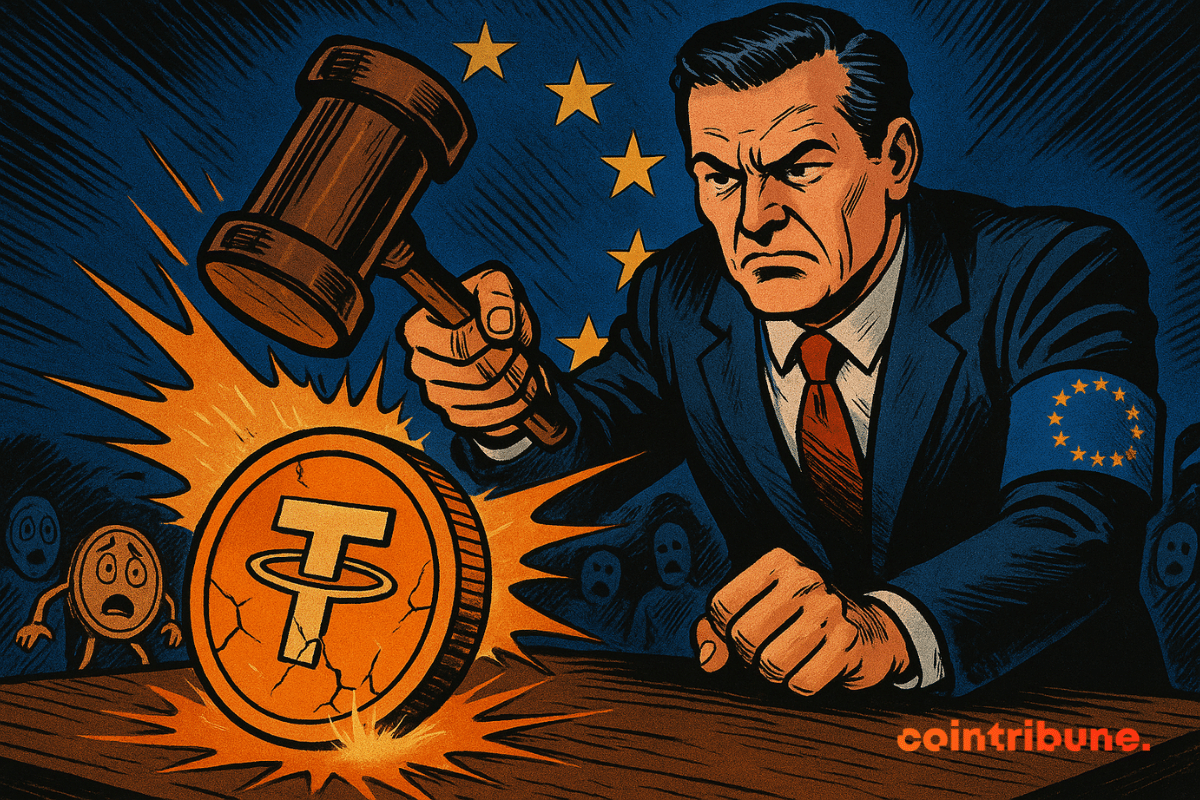
An uneasy EU facing the invasion of dollar stablecoins
The European Union, not very comfortable with foreign stablecoins, is tightening the noose on multi-jurisdictional stablecoins. The warning comes from the ESRB, the body responsible for preventing financial crises. It calls to ban these tokens issued simultaneously in multiple geographic areas. The risk? A potential imbalance for the European economic system.
The target is dollar-indexed stablecoins, which dominate crypto exchanges by far. The United States do not complain. But Europe sees a threat.
Circle’s USDC, although compliant with the MiCA regulation, is the typical example. Officially welcome, it is now becoming suspect. Bloomberg on September 30 reveals that the ECB actively supports the ESRB’s recommendations. Multi-issuance stablecoins therefore risk a straightforward ban.
Although this architecture may improve global liquidity and scalability, it poses significant legal, operational, liquidity, and financial stability risks at the EU level, especially if at least one issuer is located outside the European Union.
Chiara Scotti, Deputy Governor of the Bank of Italy – Source: Cointelegraph
In summary, the EU wants to regulate more strictly to avoid depending on foreign stable currencies, especially if they are managed from across the Atlantic.
Deutsche Börse and Circle, a crypto partnership in the EU’s sights
While Brussels worries, Circle multiplies agreements. The latest: a strategic pact with Deutsche Börse, a giant of European financial markets. Objective? To integrate USDC and EURC into traditional infrastructures, via the 3DX and Clearstream platforms. For Jeremy Allaire, CEO of Circle, the stakes are clear:
We want to align our regulated stablecoins with European institutions to reduce costs and improve settlements.
But the regulatory atmosphere spoils the party. Because even though Circle was the first MiCA-compliant stablecoin issuer, this transatlantic alliance poses a problem for some regulators. It illustrates the tension between openness to crypto innovations and the desire to regain control.
On one side, Europe wants to build an attractive market. On the other, it fears seeing its continental currency cannibalized by financial tools backed by the dollar.
Some European regulators fear that stablecoins issued by American giants become a Trojan horse in European financial systems, facilitating the entry of foreign interests into the EU’s banking machinery.
Europe is therefore seeking balance between integration and protection.
Digital sovereignty: European banks play their trump card
The EU no longer wants to remain a bystander. It is launching its made-in-Europe response. Nine major banks, including ING, UniCredit, and CaixaBank, have joined forces to create a stablecoin backed by the euro, supervised by the Dutch Central Bank. The ambition? To deploy a token by 2026, MiCA-compliant, capable of competing with American giants.
Key facts to remember
- •The global stablecoin market approaches 300 billion dollars; only 620 million are denominated in euros;
- •The European banks’ stablecoin aims for near-instantaneous and programmable settlement;
- •This project will be launched from Amsterdam, under the guidance of the Dutch central bank;
- •The ECB is simultaneously preparing a digital euro for 2029, in a public version;
- •European banks thus want to reclaim sovereignty over digital payments.
This dual initiative – private and public – aims to stem the dominance of the dollar in digital payments. In an economy where crypto is gaining ground, Europe intends to defend its place. Not only with rules, but also with products stemming from its own financial ecosystem.
As the ECB hardens its stance against foreign stablecoins, Christine Lagarde seems to aim higher. In a recent statement, she mentioned her desire to see the euro rival the dollar as the global reference currency. Between monetary ambitions and crypto showdowns, the future of the European financial system could very well be played… in the code.