



Key Developments
The Balancer protocol, a prominent decentralized finance (DeFi) market maker, has experienced a significant cross-chain exploit. As of November 3, 2025, the estimated losses from this security breach have reached $88 million, according to monitoring by PeckShield.
This ongoing exploit highlights substantial vulnerabilities within DeFi ecosystems. It is prompting urgent attention from stakeholders and is anticipated to have broader impacts on market sentiment and liquidity.
Details of the Balancer Attack
The attack on Balancer has resulted in approximately $88 million in losses across various blockchains. PeckShield, a recognized blockchain security firm, confirmed the incident through its monitoring services, noting that the exploit remains active and affects multiple assets.
The exploit primarily targets Ether and ERC-20 tokens held within Balancer's multi-chain pools. Consequently, Balancer's total value locked (TVL) has experienced a notable decline, reflecting the immediate impact on the platform's secured value.
Xuxian Jiang, CEO of PeckShield, stated, "The Balancer attack is still ongoing, with estimated losses across multiple blockchains reaching $88 million."
Impact on DeFi Security and Market Sentiment
The exploit has intensified concerns regarding DeFi security and is likely to attract increased regulatory scrutiny. Balancer previously experienced a comparable exploit in 2021, though it did not reach the current scale, making this incident particularly prominent in DeFi security history.
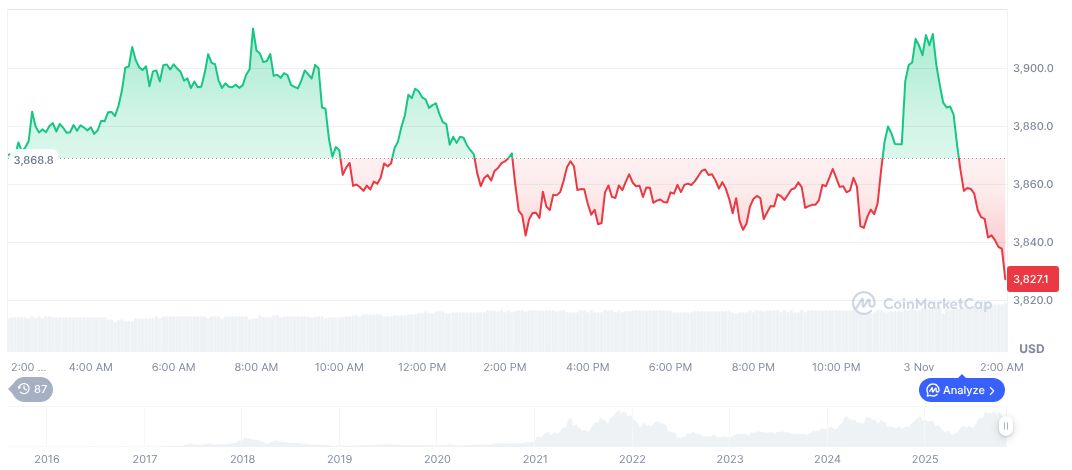
In parallel, Ethereum's market price is noted at $3,714.47, reflecting a 4.63% decline over the preceding 24 hours. Despite recent market fluctuations, Ethereum maintains a robust market capitalization of approximately $448.33 billion, according to CoinMarketCap, and holds a market dominance of 12.46%.
The Coincu research team points to potential regulatory oversight and technological challenges within DeFi operations as a consequence of such events. The recurring nature of these exploits underscores the critical need for enhanced security protocols and greater industry collaboration to effectively mitigate vulnerabilities.