


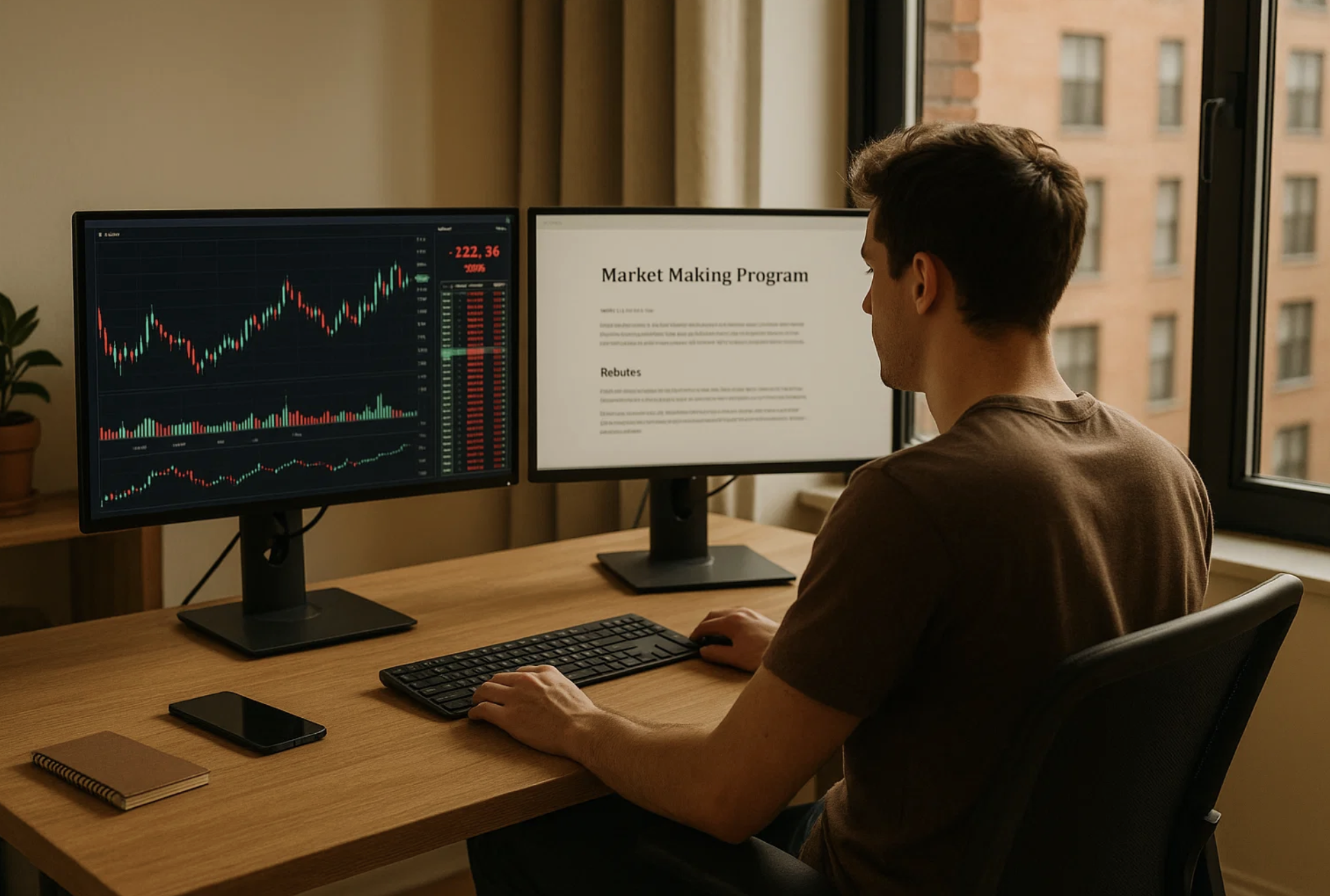
When I first started trading, one thing constantly annoyed me - fees. I executed trades, earned on the spread, but after paying commissions, it felt like part of my profit simply evaporated. Sometimes it seemed like: you trade well, but earn far less than expected.
That’s when I turned my attention to Market Making. It’s not just a strategy - it’s a way to not only reduce costs but turn providing liquidity into a source of income.
Trading Fees
Most exchanges today use the maker/taker model.
Taker fees are a charge for “taking” liquidity when you place a market order.
Maker fees are reduced fees or even rebates for adding liquidity by placing limit orders.
According to Cryptowisser, the average taker fee on spot exchanges is around 0.213%, while the average maker fee is roughly 0.16%. On paper it’s a small difference. At scale, it changes everything.
On WhiteBIT, this difference becomes even more significant. By joining their Market Making Program, you can earn rebates of up to −0.012% on maker orders - which not only cuts your costs, but basically turns liquidity provision into an independent revenue stream.
And what’s most interesting - the benefit of Market Making is noticeable even with small volumes. Every $10K in trading volume improves my economics by $22.5 compared to what I would pay as a taker. Scale that to larger volumes, and it stops being “fee optimization” - it becomes a structural improvement in profitability.
Liquidity and Slippage
Another major takeaway from that period was just how much execution quality matters. Thin liquidity can quietly ruin even well-designed strategies: wider spreads, inconsistent fills, increased slippage - all of it reduces profitability long before you notice it.
In the WhiteBIT Market Making Program, I get stable quotes and the ability to execute orders faster and with lower slippage. On top of that, the exchange offers several key advantages that make trading more efficient and profitable:
- •API, Webhook, and WebSocket support that allows programmatic adjustment of orders, risk control, and reduced manual work.
- •All tools for trading, analytics, and rebates are gathered in one convenient interface.
- •WhiteBIT operates with VASP licenses in various jurisdictions, ensuring regulatory compliance and the security of your assets.
These aren’t just technical perks - they support the entire liquidity-providing workflow.
Manual Order Management vs. Automated Market Making
Before adopting market making, I manually placed and adjusted most orders. It took a lot of time and inevitably left room for missed opportunities, especially during volatile periods. With automation the entire process became more structured. I could focus on strategy design while the system handled execution with precision.
For traders who aim to minimize fees, improve liquidity conditions, and create more predictable execution environments, market making can be the key missing piece.