


When Bujeti made it into Y Combinator’s Winter 2023 cohort, it joined a rare club, one of just a handful of African startups to break through that year, even as the famed accelerator quietly scaled back its presence in emerging markets.
For founders Cossi Achille Arouko (CEO) and Samy Paul Chiba (COO), it wasn’t just a badge of honour; it was proof that Africa’s next big fintech story wouldn’t be about payments or digital wallets, but about powering how businesses run.
This is particularly interesting because in Africa, most financial tools often stop at “send” and “receive”, yet Bujeti is taking a bigger swing. The Lagos-based startup calls itself a financial control centre, a cockpit where every financial operation, from payroll and invoicing to taxes and compliance, happens in one place.
“Think of it as a cockpit,” Arouko said during my interview with the co-founders. “But instead of flying a plane, you’re steering your company’s finances, with automation helping you every step of the way.”

The vision is to give African founders, CFOs, and finance teams the kind of financial intelligence and control that global enterprises take for granted.
From expense tracker to financial co-pilot
Like many great products, Bujeti didn’t start as a super app.
“We started with an expense management tool,” Chiba recalled. “But the more we spoke to customers, the clearer it became that expense management alone wasn’t enough. Corporate finance customers always ask for more; you can’t stop there. You have to cover everything: payroll, invoicing, inventory, treasury.”
That realisation gave birth to what Bujeti now calls its financial co-pilot, a system that doesn’t just record transactions but helps businesses run smarter.
Arouko likens it to a space shuttle’s control panel:
“You sit down, give your inputs, and the system takes you where you need to go. That’s what Bujeti does for your finances. It enforces your company rules, automates workflows, flags risks, and even tells you when to delay or accelerate payments based on cash flow.”
Today, the platform handles everything from issuing cards and processing payroll to automating payments and managing compliance.
Solving Africa’s fragmentation problem
African SMEs waste hours every week juggling disconnected systems, spreadsheets, bank portals, HR tools, and tax dashboards just to stay afloat.
“The problem is fragmentation,” Chiba said. “People have tools for payroll, others for invoicing, and others for taxes. None of them talks to each other. We’re solving that.”
He added that Bujeti’s goal is to make financial management boring again, a single, integrated system that “just works”.

“Instead of ten people in your finance team,” Arouko explained, “you can hire five and add Bujeti as the sixth seat. It performs the same work, only faster, more accurately, and without complaining.”
Currency agnosticism and borderless business
Cross-border trade is booming across Africa, but moving money between countries remains painfully complex.
Bujeti’s answer is currency agnosticism, a feature that lets businesses operate seamlessly across borders.
“We built the platform to be ready for any currency,” Arouko said. “Right now, you can open USD, Naira, or Kenyan Shilling accounts. Soon, we’ll add more currencies so you can send, receive, and hold funds without switching platforms.”
AI as Africa’s financial brain
Artificial intelligence is at the heart of Bujeti’s vision for smarter business finance.

“Imagine you’re about to pay a vendor,” Arouko said. “Our system instantly checks if the account is legitimate and flags suspicious ones before you send the money. It’s about protecting your business.”
Bujeti turns data into trust
African companies often underestimate the value of their financial data.
“They keep it scattered across banks, spreadsheets, and apps,” said Arouko. “We bring it all under one roof and turn that data into a goldmine for smarter decisions.”
Beyond software: A partner in growth
For Bujeti, success isn’t just about building tools; it’s about building stronger businesses.
“Running a business isn’t just banking or getting paid,” Arouko said. “After you start earning, you start hiring, paying taxes, and expanding. That’s where Bujeti helps you grow.”
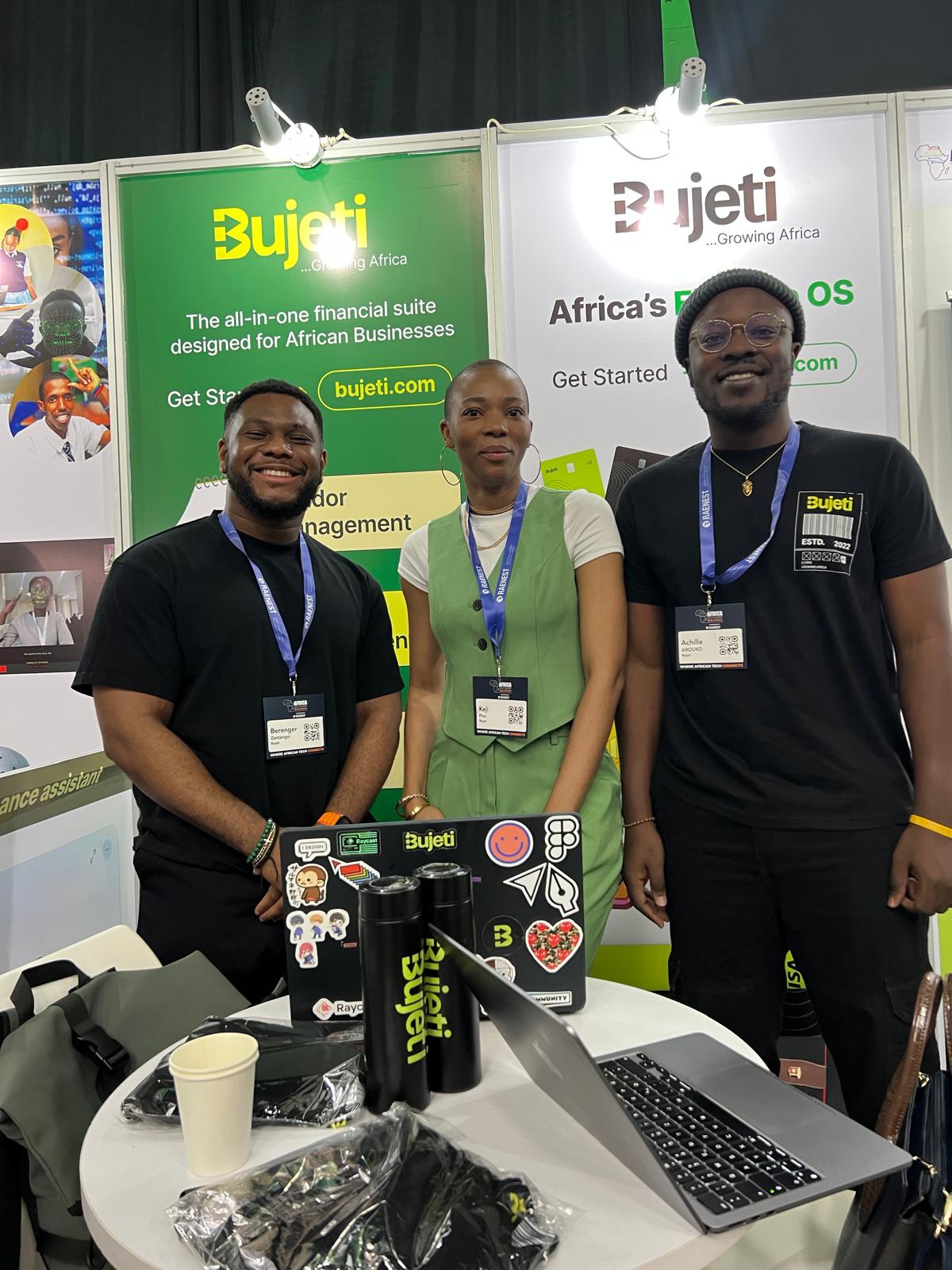
“We’re not just a fintech app,” Chiba said. “We’re a growth partner for African businesses.”
For years, Africa’s fintech story has been centred on consumer payments. But as Arouko and Chiba see it, the next big wave is B2B financial infrastructure, the invisible plumbing that powers how companies actually operate.
“The first frontier of fintech was payments,” Arouko said. “The next frontier is operations, helping businesses run better. That’s where we come in.”
By combining automation, AI, and deep financial intelligence, Bujeti is quietly positioning itself as the operating system for African business finance.
“Our mission is simple,” Arouko concluded. “Help African businesses grow. Because when they grow, Africa grows.”