


SEC's Regulatory Focus on Tokenized Securities
SEC Chairman Paul Atkins announced at the Blockchain Association's policy summit that certain Initial Coin Offerings (ICOs) might not fall under the SEC's regulatory scope, emphasizing alternative regulatory domains. This statement could shift the regulatory landscape for ICOs, impacting investor strategies and compliance practices within the cryptocurrency market.
Paul Atkins refuted claims of a new token classification framework during the Blockchain Association's annual summit. The SEC remains committed to regulating tokenized securities, explicitly excluding other ICO classifications from its scope. Such a move was necessary after reports inaccurately suggested a policy shift towards non-securities categorization.
By refocusing on tokenized securities, Atkins aims to prevent misunderstandings about the SEC's jurisdiction and the types of ICOs under its purview. In his own words:
"A key priority of my Chairmanship is clear rules of the road for the issuance, custody, and trading of crypto assets while continuing to discourage bad actors from violating the law."
This announcement potentially impacts regulatory clarity and investor confidence, without substantial changes to existing rules.
Industry reactions have been mixed, with some stakeholders urging for detailed regulatory frameworks across all token classes. The clarity brought to tokenized securities regulation, however, is supported by key figures advocating for reduced market confusion.
ICOs and ETH Price Movements: An Analytical View
ICOs and tokenized securities have been central to SEC regulatory discussions since 2017, shaping enduring debates over crypto-asset classification.
Ethereum (ETH) has seen a 5.95% price increase over the last 24 hours, trading at $3,321.40. ETH's market cap stands at $400.88 billion, dominating 12.69% of the market. Volumes surged 28.99% recently, despite a 23.59% decrease over 90 days.
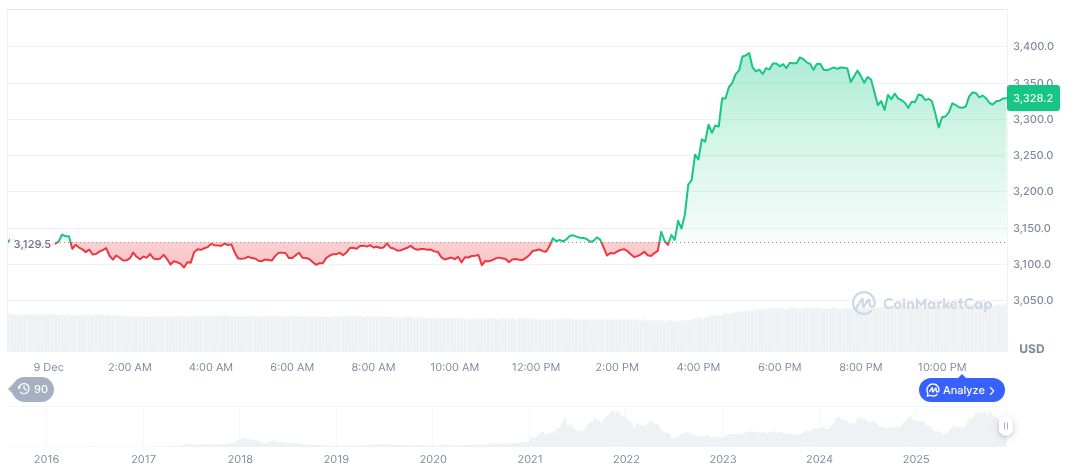
Insights from the Coincu research team suggest that clearer regulations on tokenized securities could foster financial innovation but cloud investment in broader ICOs. The focus on reducing uncertainty can enhance investor protection, boosting legitimate capital formation in crypto markets.