


Key Takeaways
- •Senate Majority Leader Chuck Schumer opposes a Republican-led government funding bill, raising concerns about fiscal implications and market stability.
- •Bitcoin (BTC) and Ethereum (ETH) are showing volatility due to fiscal uncertainty, a common trend during such periods.
- •Stablecoins and cryptocurrency exchanges are observing increased activity, indicating a defensive market posture and potential interest in decentralized finance.
Schumer's Opposition to the Republican Funding Bill
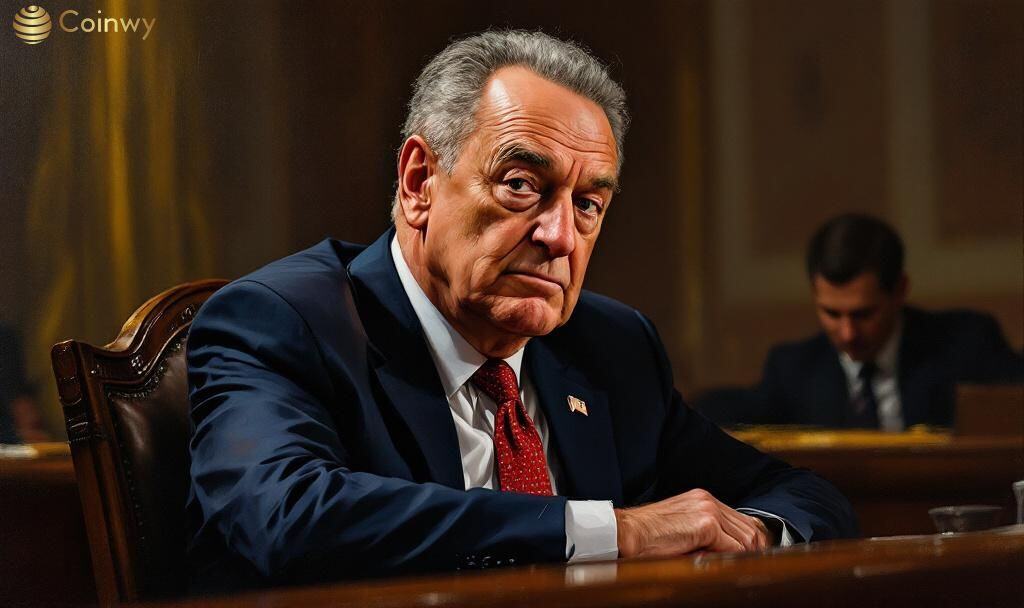
Senate Majority Leader Chuck Schumer has opposed the Republican-led funding bill, citing concerns over partisan amendments that might risk government default. The move has intensified debates in Congress and added pressure on fiscal negotiations.
"Republicans have presented a funding bill filled with partisan amendments. Democrats will stand united against proposals that hurt Americans or risk default."
Republicans have presented a funding bill filled with partisan amendments. Democrats will stand united against proposals that hurt Americans or risk default.
Key political figures involved in these negotiations include Senator Schumer, who leads the Democratic opposition, and House Speaker Mike Johnson, who advocates for fiscal responsibility from the Republican perspective. The White House has cautioned against the inclusion of partisan riders, urging for a clean funding bill to ensure the continuity of government operations.
Impact on Cryptocurrency Markets
Schumer's opposition is likely to contribute to increased market volatility within the cryptocurrency sector. Historical data indicates that Bitcoin (BTC) and Ethereum (ETH) often experience significant fluctuations during periods of government funding crises. These conditions may also attract global investors to non-sovereign digital assets as they seek alternatives to traditional financial systems.
The ongoing political deadlock also has broader implications for fiscal policies and government operations. Institutions such as the Securities and Exchange Commission (SEC) and the Commodity Futures Trading Commission (CFTC) have reported potential delays in their activities. Financial markets are reacting with caution to these developments, and the overall impact on cryptocurrency adoption remains under close scrutiny.
Potential for Increased Digital Asset Adoption
The current economic and political scenario is fueling narratives that favor decentralized financial systems. Key opinion leaders in the crypto space suggest that these fiscal disagreements will ultimately spur long-term digital asset adoption. Historical data from similar past events shows an increase in stablecoin activity, suggesting that market participants are adopting a more defensive investment strategy.
Analysts have observed that on-chain metrics such as Total Value Locked (TVL) experience slight declines during fiscal crises, while centralized cryptocurrency exchanges tend to see higher inflows of assets. Brian Armstrong, CEO of Coinbase, stated, "Periods of uncertainty show why open, global crypto infrastructure is essential. We’re watching U.S. fiscal negotiations closely." These trends align with the arguments supporting the robustness and necessity of decentralized crypto infrastructures, particularly during times of government uncertainty.