


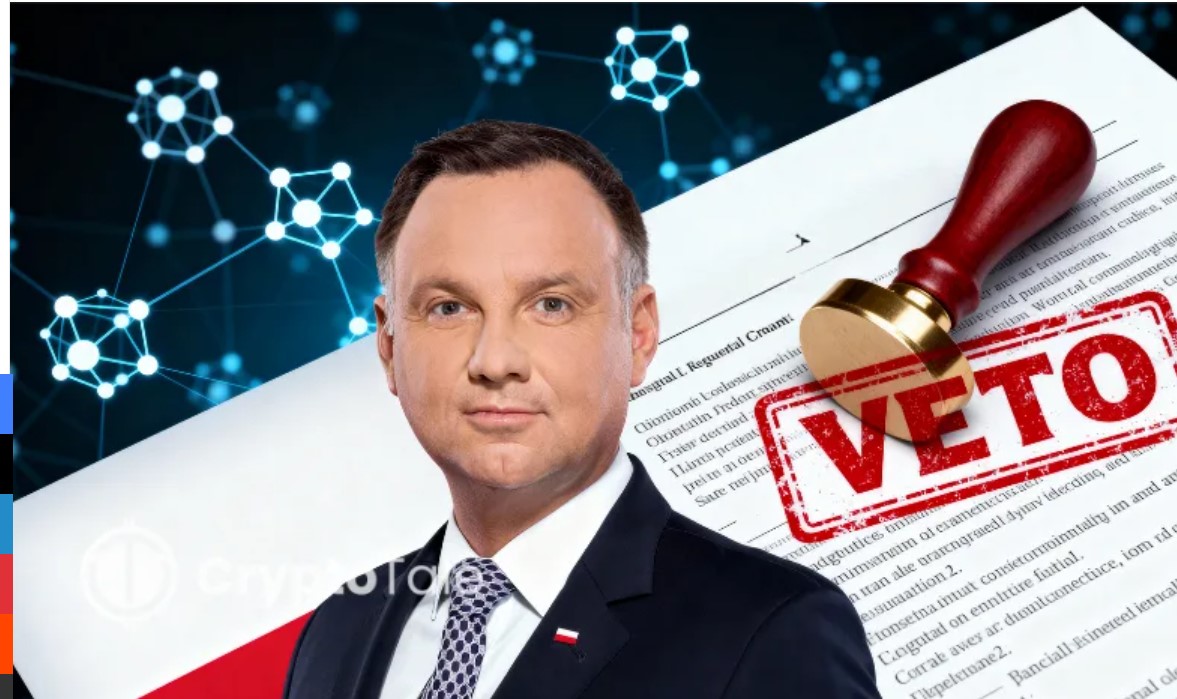
Poland's President Karol Nawrocki has vetoed the proposed Crypto-Asset Market Act, a decision announced by his office on Monday following weeks of debate. The bill, introduced in June, aimed to implement strict controls on cryptocurrency activities within the country. This move has garnered support from many crypto advocates while drawing strong criticism from several government officials who had championed tighter regulations and expedited oversight.
President Nawrocki stated that the act posed significant risks to the freedoms of Polish citizens, threatened property rights, and endangered the stability of the state. His office affirmed that these concerns were sufficient justification for the veto. The bill had already successfully passed through the parliament before reaching the president's desk.
Early Warnings and Key Objections to the Crypto Bill
Industry figures had voiced concerns about the bill since its initial introduction. Polish politician Tomasz Mentzen had argued that the proposed legislation created excessive obligations and anticipated the president's rejection once it cleared the legislature. Crypto supporters, conversely, viewed the veto as a positive development for the market.
A primary point of contention was a provision that would have granted authorities the power to block websites associated with crypto activities. The president's office expressed reservations, citing a lack of clear safeguards and warning that such domain blocking mechanisms could be opaque and easily expanded beyond their intended scope.
Another significant objection pertained to the bill's considerable length and complexity. The president's office noted that this structure could diminish transparency and that the bill's extensive nature might lead to overregulation. It was also observed that other countries in the region, including the Czech Republic, Slovakia, and Hungary, employ simpler regulatory approaches.
President Nawrocki cautioned that overly stringent regulations could prompt crypto firms to depart from Poland. He suggested that companies might opt to relocate to neighboring countries if the requirements became excessively burdensome. He warned that such an exodus would result in a reduction of tax revenue and economic activity, thereby weakening Poland's standing in the regional market.
He also criticized the proposed supervisory fees within the bill, stating that these costs could impede startup activity. Nawrocki expressed concern that these fees might inadvertently favor large foreign corporations and banks, which he characterized as a threat to innovation and competition within the crypto sector.
Government Backlash and Crypto Camp Pushback after the Veto
The president's veto triggered strong reactions from senior government officials. Finance Minister Andrzej Domański asserted that the president had opted for chaos and declared that the president must assume full responsibility for any ensuing consequences.
Domański also stated that existing market abuses were already impacting investors, claiming that 20% of clients were losing money due to these issues. He used this statistic to underscore the urgency for rapid regulation.
Deputy Prime Minister and Foreign Minister Radosław Sikorski echoed these warnings, emphasizing that the act was designed to bring order to the crypto sector. He cautioned that a future market collapse could lead to widespread financial losses, and that many Poles could suffer if prices plummeted and scams persisted.
Sikorski's comments on X (formerly Twitter) addressed the potential political ramifications, suggesting that individuals would remember who was responsible for halting the bill if losses increased. His message framed the veto as a direct decision to delay consumer protection measures.
Crypto advocates, in response, disputed these claims. Polish economist Krzysztof Piech argued that the president should not be held accountable for failures in pursuing scammers, suggesting that enforcement agencies should instead concentrate on fraud cases. He contended that overly restrictive regulations could harm legitimate businesses rather than enhance safety.
Piech also highlighted the forthcoming European Union regulations. He pointed out that the Markets in Crypto-Assets Regulation (MiCA) would introduce investor protections across the EU, and according to him, this regulation is scheduled to become applicable from July 1, 2026.
The presidential veto leaves the future of the Crypto-Asset Market Act uncertain. Lawmakers have the option to revise the bill and attempt to pass it again, or they could decide to abandon the measure altogether. The ongoing debate now centers on whether Poland should implement strict national rules in the near future or allow the upcoming EU measures to guide future oversight.