



Pendle's price is exhibiting signs of recovery, trading above a critical resistance level as the protocol introduces a new staking model. The token was trading at $2.07 at press time, marking a 9% increase over the past 24 hours. This upward movement coincides with rising open interest and a significant overhaul of the tokenomics, bringing the $2.35 resistance level back into focus.
The Pendle token has been trading within a seven-day range of $1.86 to $2.31 and is down 2.9% over the past week. Despite this recent dip, it remains 9% higher on a 30-day basis, indicating a steady recovery following a pullback experienced last month.
Trading activity has notably increased alongside the price action. Pendle's (PENDLE) 24-hour spot volume saw a 34% rise, reaching $63 million. This suggests renewed market participation rather than gains driven by low liquidity.
Derivatives data from CoinGlass provides further context to this market movement. Although the overall derivatives trading volume decreased by approximately 9% to $67 million, the open interest saw a nearly 10% increase, reaching $45 million. This combination typically indicates that traders are opening new positions rather than exiting existing ones, signaling growing confidence in the current price trend.
Drivers Behind the Recent Price Surge
The current rally is being fueled by a substantial update to Pendle's staking and governance model. On January 20, the protocol announced the replacement of vePENDLE with sPENDLE, a liquid staking token designed to eliminate the need for multi-year token lockups. The new sPENDLE model introduces a 14-day withdrawal period, with an option for instant redemption available at a fee.
Under this revised structure, protocol revenue will be utilized for PENDLE buybacks and subsequently distributed to eligible sPENDLE holders. Furthermore, the manual gauge voting system is being replaced by an algorithmic emissions model. Pendle anticipates that this change will lead to a reduction in token emissions by approximately 30% while simultaneously improving capital efficiency.
Existing vePENDLE holders are being accommodated in this transition. They will receive a boosted sPENDLE balance, potentially up to 4x, depending on their remaining lock duration. This will be determined via a snapshot scheduled for January 29, after which new vePENDLE locks will be paused.
Pendle has stated that these adjustments are intended to address long-standing issues associated with vePENDLE, including low participation rates, capital inefficiency, and a complex weekly voting process that historically favored a select group of advanced users.
Pendle Price Technical Analysis
From a technical perspective, Pendle appears to be consolidating within a broader range following a significant earlier sell-off. The price has found support above the $2.00 mark, with consistent buy-the-dip activity suggesting the development of a short-term base.
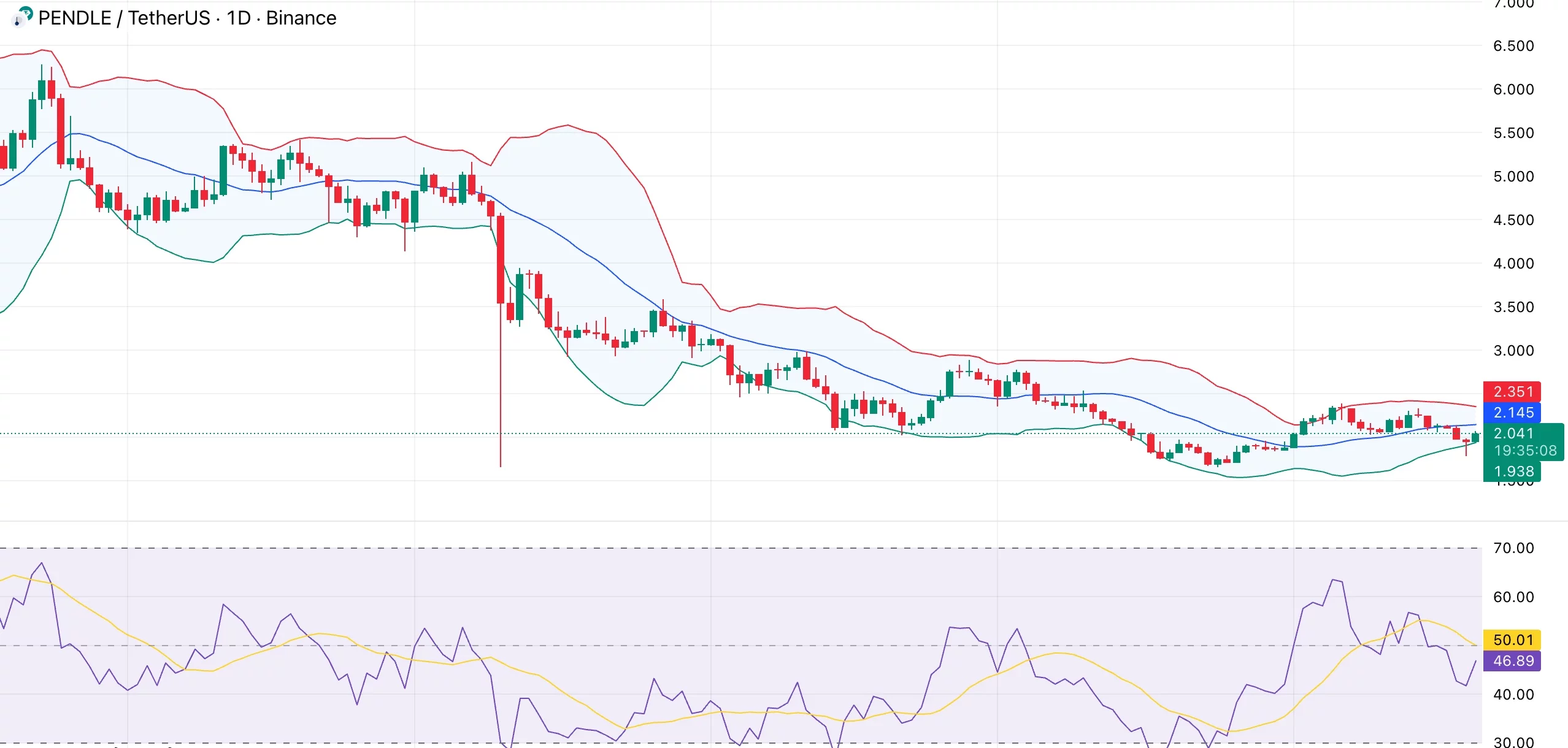
Currently, the token is attempting to maintain its position above its 20-day moving average, a level that previously capped recent gains during the pullback. The Bollinger Bands are showing signs of tightening, which often precedes a period of increased volatility and a significant price move.
Momentum indicators are also showing signs of stabilization. The relative strength index (RSI) has recovered from oversold territory and is currently hovering near the neutral 45-50 zone. A sustained move above 50 on the RSI would further strengthen the bullish outlook.
The former breakdown zone, located between $2.30 and $2.35, which has repeatedly acted as resistance during recent rally attempts, is a key area to monitor. A decisive daily close above this range could potentially drive the price towards $2.60, signaling a substantial shift in momentum.
Conversely, a prolonged period below $1.95 would diminish the likelihood of a recovery and suggest that sellers are regaining control of the market. Until either of these key levels is decisively breached, Pendle is expected to trade sideways.