


Analysts Express Concerns Over PayPal's Growth Prospects
PayPal's stock price has continued its significant decline, reaching its lowest level since April of the previous year. Technical indicators suggest that further downward movement is likely if the stock fails to hold a critical support level.
PayPal, a prominent fintech company, has fallen to a key support level at $56.3. This represents a 40% decrease from its December 2024 peak and an 80% drop from its all-time high.
A majority of Wall Street analysts who cover PayPal hold a bearish outlook on the company. Their concerns are rooted in the increasing competition within the branded checkout sector, the potential disruption posed by stablecoins, and broader growth challenges facing the fintech industry.
In a recent analysis, a JPMorgan analyst downgraded the stock and revised their price target downward from $80 to $70. The analyst highlighted that PayPal is encountering significant obstacles as its management team works to implement a turnaround strategy.
Analysts at Bank of America also downgraded the company, citing persistent weakness in its branded checkout business. The analysts stated:
“We had expected product innovation and the upgraded checkout experience to drive increased usage of the PayPal button at checkout. Instead, 4Q will see a step down in branded checkout growth and 2026 will be an investment year.”
Morgan Stanley analysts have also lowered their assessment of the company, cautioning that improvements in branded checkout integration are taking longer and proving to be more resource-intensive than initially anticipated. Other financial institutions that have recently downgraded PayPal stock include Mizuho, UBS, Goldman Sachs, and Piper Sandler.
PayPal's business operations have encountered numerous challenges over the past few years, impacting its growth trajectory and profitability. The company's revenue growth has decelerated from double-digit percentages during the pandemic to low single digits. This slowdown is attributed to heightened competition in both its branded and unbranded payment services.
For instance, PayPal's checkout business faces considerable competition from companies in the buy now, pay later sector, such as Klarna and Affirm. Its broader payment processing services are also challenged by competitors like Wise and Remitly, which often offer more competitive pricing.
Furthermore, Honey, a coupon aggregation service acquired by PayPal for over $4 billion, has been involved in lawsuits. These legal actions allege deceptive practices concerning how the company manages affiliate commissions paid to creators.
Analysts project that PayPal's fourth-quarter revenue will reach $8.79 billion, reflecting a 5% year-over-year increase, which would bring the annual revenue figure to $33.2 billion.
Technical Analysis of PayPal Stock Price
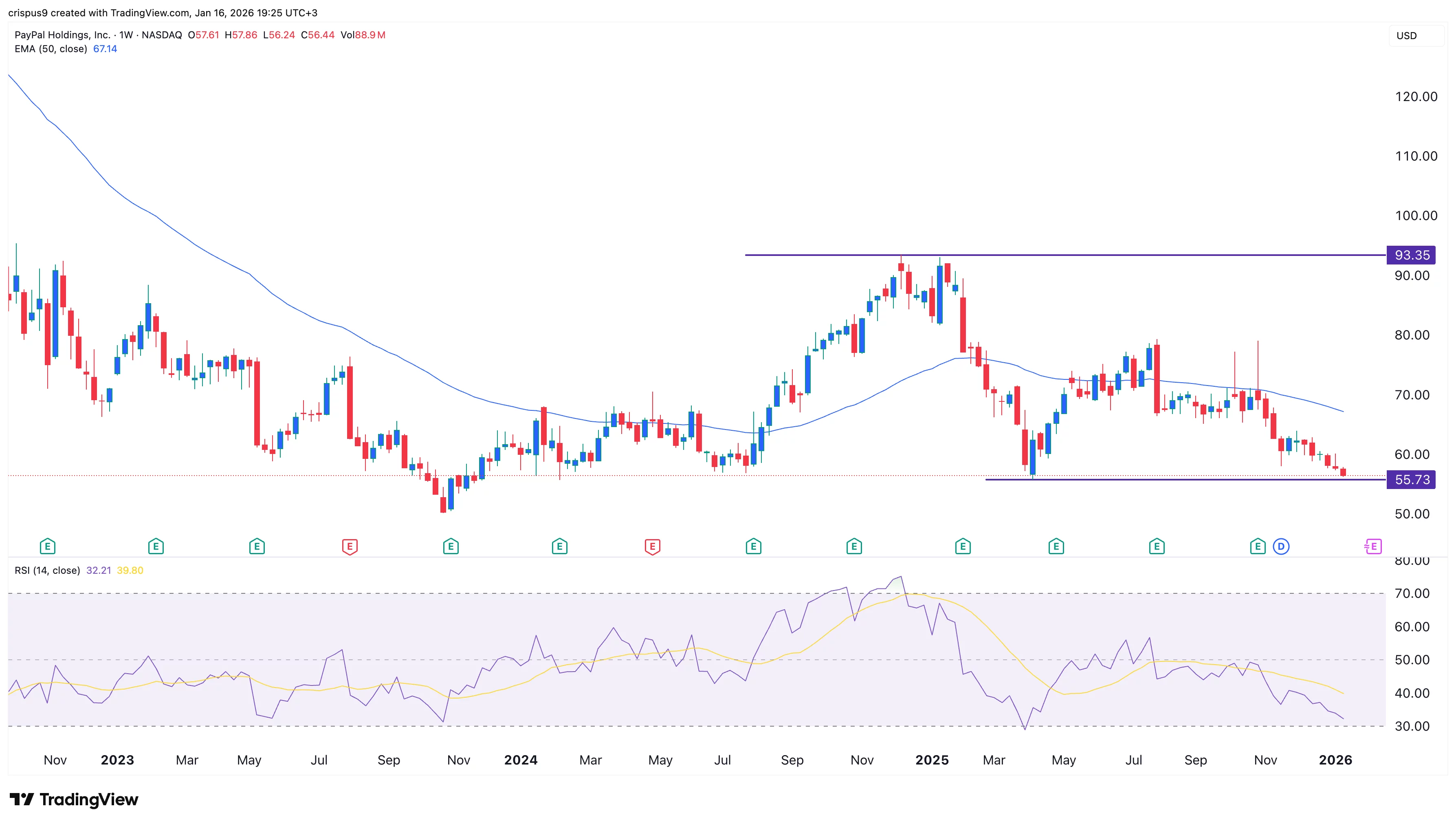
The chart analysis on a weekly timeframe indicates that the PYPL stock has been under consistent selling pressure for several months. The price has declined from a high of $93 in December 2024 to its current level of $56.3. The stock is approaching a critical make-or-break level at $55.7, which represents its lowest point recorded on April 7.
The stock's price has fallen below all its moving averages, signaling that bearish sentiment is currently dominating the market. Additionally, the Relative Strength Index (RSI) has dropped to 32, its lowest point since April of last year.
The stock chart is also forming an inverted cup-and-handle pattern, a recognized bearish continuation pattern. Consequently, a breach below the support level at $55.7 would likely indicate further downward movement, potentially leading the price towards the psychological threshold of $50.