


Jonathan Gould, Acting Comptroller of the Currency, announced equal treatment for cryptocurrency firms applying for federal bank charters, emphasizing the need for modernizing regulatory frameworks. This shift could drive significant interest in crypto-native banks, reflecting a growing demand for integrating digital assets within traditional financial systems, promoting innovation and regulatory clarity.
OCC Receives Record Number of Crypto-Related Bank Charter Applications
Jonathan Gould, Acting Comptroller of the Currency, asserted that cryptocurrency companies seeking federal bank charters should receive "equal treatment" as traditional banks. He emphasized the importance of removing artificial regulatory distinctions for institutions managing digital assets. As part of his congressional testimony, Gould revealed that the OCC has received 14 bank charter applications involving digital assets in 2025, matching the total from the previous four years combined.
Gould stated the banking sector's evolution is necessary to keep pace with technological advancements. The OCC aims to provide a framework in which banks can engage safely in digital asset activities, ensuring industry adaptability from the telegraph era to the blockchain era.
"Digital asset custody and secure storage are not new concepts. The electronic custody of securities and other financial assets has been ongoing for decades... The banking system has evolved from the telegraph era to the blockchain era." — Jonathan V. Gould, Comptroller of the Currency, OCC
Market Evolution Driven by Regulatory Shifts and Bitcoin's Performance
Gould's advocacy for crypto charters echoes a similar shift led by Brian Brooks in 2020–2021, when interpretive letters allowed national banks to engage in crypto services, including custody and stablecoin activities.
Bitcoin (BTC) currently trades at $90,066.53, boasting a market cap of $1.80 trillion. Dominating the cryptocurrency landscape by 58.53%, its trading volume reached $55.38 billion, marking a 9.87% change. BTC experienced a 4.22% rise over seven days, despite a 11.70% decline in 30 days, according to data as of December 9, 2025.
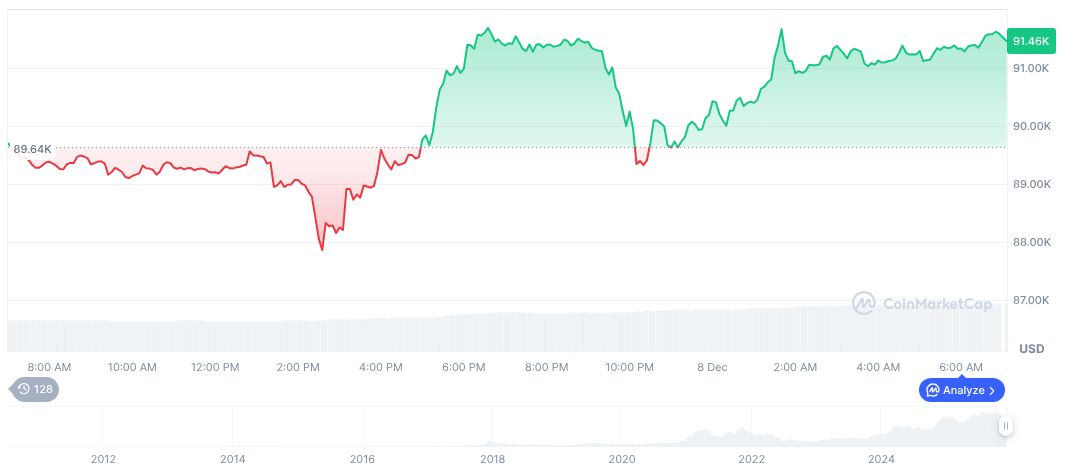
The regulatory openness towards cryptocurrency by authorities like the OCC is projected to enhance liquidity and institutional trust. Stablecoin regulations could further integrate blockchain solutions into the banking system, enhancing compliance, security, and system robustness.