


In Brief
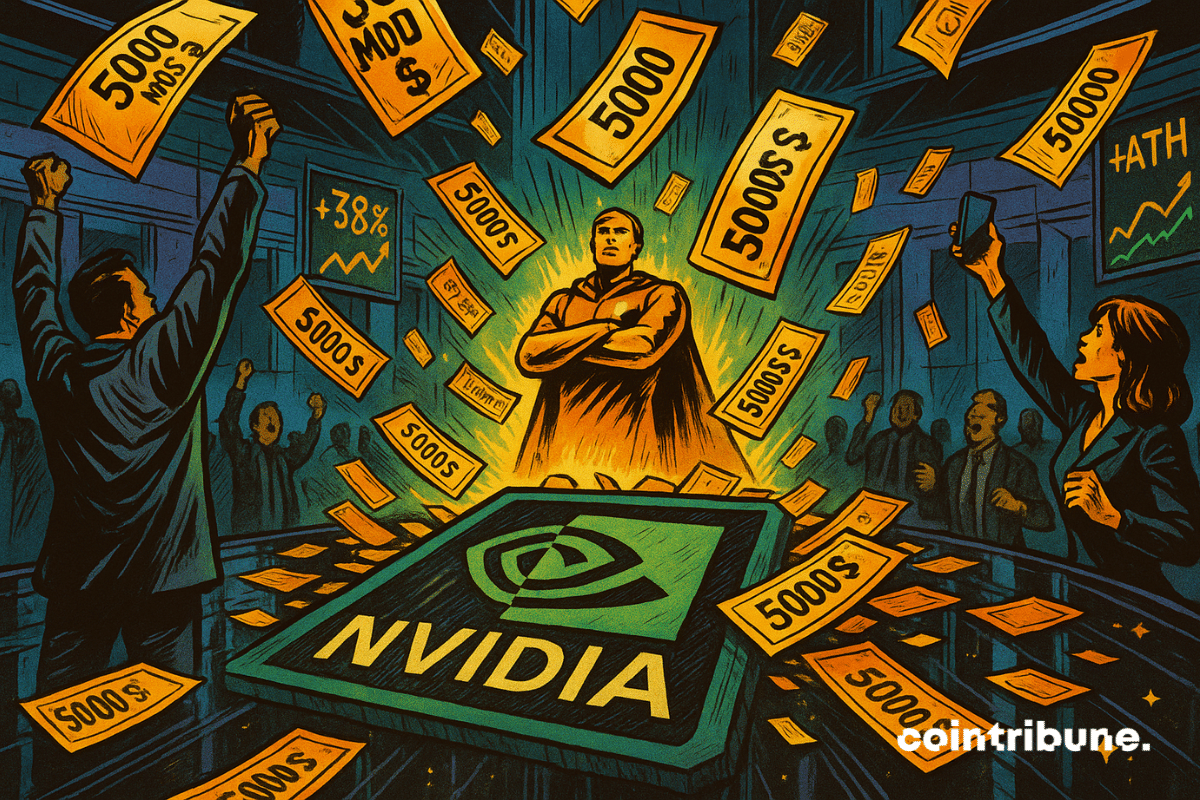
- •Nvidia has achieved a historic milestone, becoming the first company in the world to reach a market capitalization of 5,000 billion dollars.
- •This significant market performance follows a 5% surge in its stock price, largely attributed to announcements made at the GTC Event in Washington D.C.
- •The company is set to construct seven supercomputers, including one that will feature 10,000 Blackwell GPUs, in collaboration with the U.S. Department of Energy.
- •Nvidia's current strategic direction suggests a potential transformation in how computing power is accessed and a redefinition of Web3 infrastructures.
A March Toward Stock Market Peaks Driven by Artificial Intelligence
Following its previous achievement of a 4,680 billion dollar market capitalization, fueled by high demand for artificial intelligence and its global expansion efforts, Nvidia officially crossed a new historic milestone on October 29. The technology giant has now become the first company in history to reach a market capitalization of 5,000 billion dollars.
This record was attained subsequent to a remarkable 5% increase in the company's stock value within a single day. This surge was largely propelled by a series of significant announcements made by Jensen Huang, the CEO of the group, during the GTC Event held in Washington D.C.
Huang announced that Nvidia will collaborate with the United States Department of Energy to develop seven new supercomputers. One of these advanced systems is slated to be equipped with “10,000 Blackwell GPUs.”
Among the most notable announcements presented during the GTC event were:
- •National-scale projects, including the development of seven supercomputers, with partial leadership from the U.S. government.
- •Strategic industrial partnerships established with prominent companies such as Uber, Eli Lilly, Nokia, Palantir, Oracle, Cisco, and T-Mobile.
- •Ambitious financial projections, with Jensen Huang forecasting “500 billion dollars in GPU sales by the end of 2026.”
Nvidia is thus reinforcing its pivotal role within the global technology ecosystem, establishing itself as an indispensable provider of artificial intelligence infrastructure on an industrial scale. This sustained momentum, evidenced by over 50% stock price growth since the beginning of the year and a doubling of the stock price since April, underscores the group's dominance in the burgeoning economy of intensive computing.
Jensen Huang views the “AI factories” that Nvidia is constructing as the fundamental engine of a new industrial revolution, potentially surpassing the impact of previous technological cycles.
Towards an Inevitable Convergence Between AI and Tokenization
While the GTC Event primarily focused on industrial and technological initiatives, certain indirect signals captured the attention of analysts, particularly within the cryptocurrency ecosystem. It has been reported that Nvidia may invest up to 100 billion dollars in OpenAI, one of its key partners. This potential investment gains further significance considering OpenAI's active exploration of business models centered around the tokenization of computing power, notably through “compute credits” that can be utilized within its APIs.
Although Nvidia has not made explicit mentions of blockchain technology, this strategic direction suggests a possible indirect involvement in tokenized systems related to the allocation of GPU resources. Concurrently, Nvidia has unveiled NVQLink, a new open architecture engineered to expedite the development of quantum supercomputers. This project, undertaken in conjunction with industry players like Rigetti and IonQ, could potentially benefit from decentralized allocation mechanisms in the medium term. This approach aligns with the principles already being explored by several Web3 projects, such as Render Network and Gensyn, which aim to tokenize GPU computing power to ensure its accessible and decentralized distribution.
While Nvidia has not publicly declared its stance on this specific area, its de facto technological monopoly positions the company at the forefront of discussions concerning the tokenized infrastructure of AI. In the long term, this strategic direction raises significant questions. Could Nvidia eventually issue or endorse a token to facilitate access to its infrastructures? Might a secondary market emerge for computing power backed by its GPUs, mirroring predictions for blockchains like Ethereum or Solana? For the time being, these scenarios remain speculative. However, Nvidia's current trajectory, both financially and technologically, confirms that the distinctions between AI, cloud computing, Web3 infrastructure, and blockchain are progressively blurring.