Key Economic Forecasts
Economist Nouriel Roubini anticipates a strong U.S. economic rebound driven by technology, despite a brief downturn. His outlook challenges fears of a stock bubble, emphasizing technology's role in sustaining U.S. leadership and its potential market effects.
Roubini forecasts a temporary U.S. recession against the backdrop of tariff-induced inflation. He suggests a robust rebound fueled by innovations in AI and robotics. This prediction highlights the resilience of the U.S. economy and the role of market discipline in stabilizing financial activities.
The forecast suggests growth may double the current rate by the decade's end. Technological advancements are expected to drive a positive supply shock, potentially reducing inflation. Bond yield dynamics might stabilize as technological deflation counteracts tariff effects.
"Tech trumps tariffs. And what I mean is that the US is really No. 1 in many of the technologies of the future... So tech trumps tariffs. Tech trumps Trump, too."
Market experts and analysts emphasize the importance of market discipline and Federal Reserve independence. Roubini's view challenges concerns over medium-term economic risks, emphasizing the role of technology in shaping future economics.
Technological Impact on Economic Recovery
In past economic downturns, technology has often served as a catalyst for recovery, highlighting its critical role in overriding negative economic shifts.
The anticipated technological growth could alter market behaviors, influencing both traditional and emerging markets. This offers valuable guidance for investors navigating future economic conditions. Concerns over AI and its impact on U.S. tech stocks add another layer to the evolving economic landscape.
Bitcoin Price Trends Amid Economic Forecasts
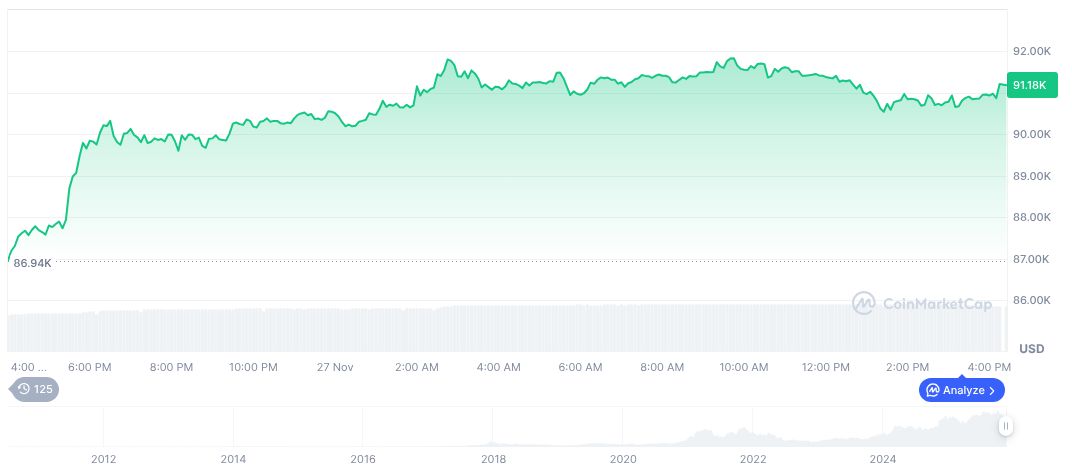
Bitcoin is currently valued at $91,523.34, with a market cap of $1.83 trillion. Despite a 19.06% price decrease over the past 30 days, its dominance remains at 58.47%. Recent 24-hour trading volume stands at $59.14 billion, reflecting a 10.75% decline.