


Tighter Standards Drive South Korea’s Crypto Regulation Push
South Korea is preparing a new wave of penalties for major virtual asset exchanges, marking a sharp escalation in the country’s crypto regulation efforts. Officials state that repeated failures in anti-money laundering systems threaten the stability of the nation’s fast-growing digital asset market. The Korea Financial Intelligence Unit, or FIU, is nearing the completion of its latest reviews, which followed months of field inspections at leading exchanges. Regulators are now poised to issue personal and institutional sanctions, and plan to impose fines on platforms that breach key rules. This stage of enforcement highlights how central crypto regulation has become in South Korea.
Crypto regulation in the country has tightened each year as trading volumes grow. Authorities are seeking stronger controls on Know Your Customer checks and suspicious transaction reporting, believing these steps will help reduce money laundering risks. The FIU has stated its commitment to ensuring each exchange meets the same standards, operating under a first-in, first-out system for decisions based on the order of inspections. This method has become a core feature of South Korea’s broader crypto regulation strategy, establishing a clear sequence for enforcement and avoiding sudden shifts in timing.
Inspections Completed at Major Exchanges
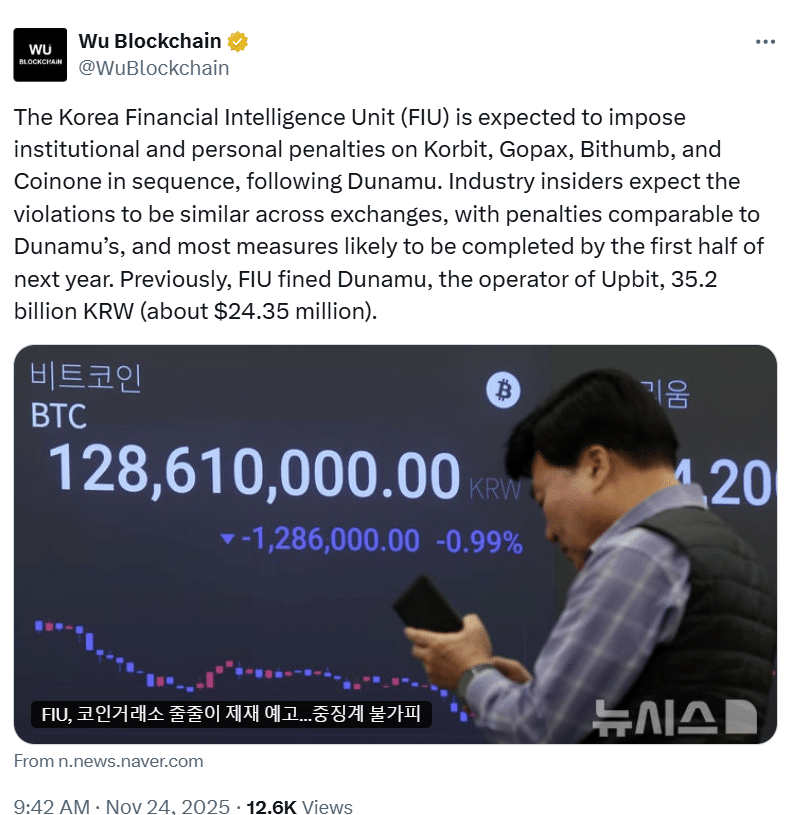
The FIU has already conducted inspections at Upbit, Bithumb, Coinone, Korbit, and GOPAX. These visits focused on KYC processes and reporting systems. With the fieldwork now concluded, legal reviews and sanctions committees are proceeding.
Dunamu Case Sets the Tone for Future Penalties
The FIU’s earlier action against Dunamu, the operator of Upbit, provides a clear preview of potential future penalties. Initially, officials issued personal and institutional sanctions, followed by limitations on new deposits and withdrawals. Subsequently, the FIU imposed a fine of 35.2 billion won. Market observers anticipate similar outcomes for other exchanges, with the Dunamu case serving as a key model in the current wave of crypto regulation.
More Sanctions Expected Across Major Platforms
Regulators are expected to issue more personal and institutional sanctions in the near future, potentially accompanied by significant fines. Some estimates suggest that total penalties could reach hundreds of billions of won, with the final amounts dependent on the severity of each violation. The current environment indicates that crypto regulation will remain strict and far-reaching.
Four exchanges are still awaiting final decisions, and officials have indicated that the FIU will not complete its sanctions schedule within the current year. Most remaining actions are likely to occur in the first half of next year, ensuring that pressure from crypto regulation remains high. This extended timeline coincides with a global trend of increasing regulatory controls on digital asset markets.
Crypto Tax Delay Adds More Uncertainty
South Korea is also navigating uncertainty surrounding its planned crypto tax, which is slated to take effect in January 2027. However, officials have recently expressed concerns about the country’s readiness, citing a lack of necessary infrastructure and unclear technical guidance. Some lawmakers believe another delay is probable, further intertwining debates on crypto regulation with the future of this tax policy.
Government Still Signals Support for Innovation
Despite the stringent enforcement measures, government leaders have expressed a desire for the sector to grow. The ruling Democratic Party has established a new task force aimed at supporting blockchain development, with the stated goal of fostering a safer yet more innovative market. This dual approach reflects South Korea's strategy to balance robust crypto regulation with long-term support for the industry.
Conclusion
South Korea’s latest enforcement campaign represents a significant development for crypto regulation within the country. The FIU is prepared to issue new sanctions, with further fines anticipated and several exchanges still under review. These decisions will shape the development of the crypto industry in the coming year, and many analysts believe the upcoming phase will set standards for the broader Asian market.
Appendix: Glossary of Key Terms
Crypto Regulation: The rules and policies governing digital asset trading, including compliance and consumer protection guidelines.
FIU: South Korea’s Financial Intelligence Unit, the authority responsible for enforcing AML rules in the crypto sector.
Virtual Asset Exchange: A platform that enables users to buy, sell, or store digital assets.
KYC: Know Your Customer processes that exchanges are required to maintain to prevent misuse.
STR: Suspicious Transaction Report, a mandatory report an exchange must submit upon identifying unusual or high-risk transactions.
AML: Anti-Money Laundering systems and rules designed to prevent illicit funds from entering legal financial channels.
Institutional Sanctions: Penalties imposed on an exchange or company for regulatory violations.
Personnel Sanctions: Punitive measures taken against executives and staff found responsible for compliance failures.
Frequently Asked Questions About Crypto Regulations
1- What is crypto regulation?
Crypto regulation refers to the laws and rules that govern digital asset trading, compliance, taxation, and consumer protection.
2- What is the FIU’s main focus?
The FIU is focusing on anti-money laundering failures and KYC compliance as part of broader crypto regulation efforts.
3- Which exchanges were reviewed?
Upbit, Bithumb, Coinone, Korbit, and GOPAX have completed inspections.
4- What penalties are expected?
Penalties are expected to include institutional sanctions, personal penalties, and significant fines.