



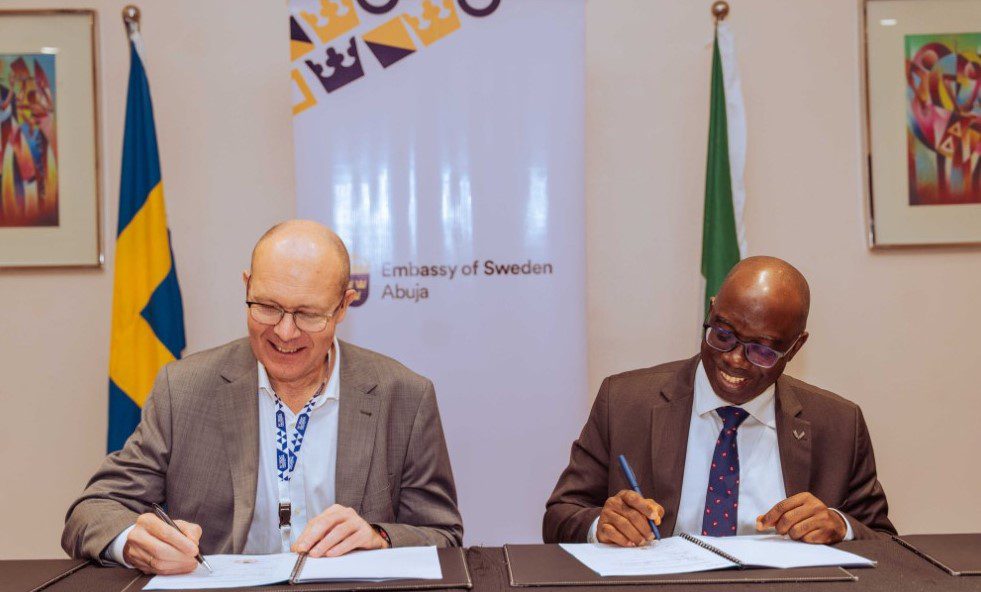
The Nigerian Communications Commission (NCC) has announced a partnership with Swedfund to facilitate a framework that ensures 5G networks are securely operated. This collaboration follows a previous initiative in February focused on crowdsourcing quality of experience projects.
According to a statement released on the NCC’s X (formerly Twitter) page, the commission highlighted that the grant agreement with Swedfund, Sweden’s Development Finance Institution, is designed to bolster the security and reliability of Nigeria’s fifth-generation (5G) networks. This initiative aims to proactively address associated risks and prevent the manipulation of 5G network deployments.
"Through this partnership, the NCC aims to develop a risk-based framework to ensure that 5G and future network systems are designed, deployed, and operated securely," the statement explained.
During the grant signing ceremony held at the Swedish embassy in Abuja, the NCC emphasized the necessity of this collaboration to maintain security and public trust amidst the ongoing growth in network adoption. The initiative is intended to protect national interests and strengthen confidence in Nigeria's expanding digital ecosystem.
While fifth-generation mobile technology offers significant advantages such as faster speeds, lower latency, and the capacity to support millions of connected devices, its upgrade also introduces new security challenges due to its complex infrastructure and the involvement of multiple network vendors.
Nevertheless, the NCC underscored the transformative potential of the 5G network in fostering a robust digital economy and enhancing performance across various sectors.
"Security and trust remain central to Nigeria’s digital future. As 5G supports key sectors such as power, healthcare, transport, and education, this initiative will help strengthen public confidence, protect national interests, and build a safer, more resilient digital economy," the commission stated.
The rollout of 5G in Nigeria began with MTN in September 2022, with commercial launches in Lagos and other cities. Airtel followed with its network launch in June 2023, and Mafab Communications launched its services in Abuja and Lagos in January 2023, though its operations had not yet commenced at the time of this report.
Challenges in 5G Network Affordability and Availability in Nigeria
A recent report, "Nigeria Network Performance & 5G Opportunity Analysis," conducted by Ookla in collaboration with the NCC, revealed that only approximately 3% of Nigeria's 170 million active mobile users, equating to about 5 million people, are currently utilizing fifth-generation services. The adoption is heavily concentrated in Lagos and the Federal Capital Territory (FCT) Abuja.
While some users overcome the affordability barrier by possessing 5G-enabled devices, they often encounter challenges with network infrastructure availability.
The report indicated that around 70.9% of 5G-capable devices in Lagos and 65.6% in Abuja are unable to connect to any 5G network. It further highlighted that despite the rapid adoption of 5G-ready smartphones by Nigerians, the supporting infrastructure is significantly lagging behind.
This situation points to a critical issue within the Nigerian telecommunications industry, demonstrating that the country's 5G rollout is considerably behind device readiness. It exposes a gap between user potential and network availability, particularly in the nation's major urban centers.
The report also shed light on network quality disparities. Lagos and the FCT exhibit superior network performance, scoring 40–50% above the national average. In contrast, many rural areas remain reliant on older 2G and 3G networks.
"This imbalance continues to limit digital inclusion and economic opportunity outside the major cities," the report observed.
Among the network operators, MTN Nigeria demonstrated leadership in performance, consistently providing the highest download and upload speeds, coupled with strong latency and jitter results. Airtel followed closely in download performance but faced challenges with latency.
Globacom and T2mobile (formerly 9mobile) lagged behind, with T2mobile registering the lowest overall quality of service, attributed to a slow 4G rollout and network stability issues.
In its ongoing efforts to expand network connectivity nationwide, the NCC reaffirmed its commitment to accelerating the deployment of both 4G and 5G technologies. The commission recognized that improving latency and extending next-generation coverage are essential steps toward bridging the country's growing digital divide.