


Hyperliquid has launched Monero (XMR)/USDC perpetual contracts, enabling up to 5x leverage through a permissionless HIP-3 deployment by Felix Protocol. This development was announced on January 15th.
Following the launch, Monero's price saw an increase of 6%, reaching approximately $431. The trading volume also rose by 13%, indicating renewed interest in the privacy-focused cryptocurrency, especially in light of previous delistings from centralized exchanges.
Hyperliquid Introduces Monero Perpetual Contracts
Hyperliquid has introduced a Monero XMR/USDC perpetual contract to facilitate perpetual swaps via a HIP-3 deployment by Felix Protocol. XBToshi, a notable contributor to the Monero community, shared the news on X, signaling an expansion in trading options for privacy-centric digital assets.
This new offering allows traders to participate in the market without the need for direct spot market access. This is particularly significant given Monero's delisting from several centralized exchanges. The contract provides leverage up to 5x, which has the potential to increase market participation and improve liquidity.
The market's reaction was swift, with Monero's price climbing by 6% to around $431 and trading volume experiencing a 13% surge. The ability for XMR to discover its price is further emphasized by XBToshi's statement that "they cannot block the price discovery."
"They can block the spot ramps, but they cannot block the price discovery." -- XBToshi, Monero Contributor
Trading Volumes Surge as Monero Gains Value
The introduction of these perpetual swaps has had a notable impact, contributing to a 13% increase in trading volume. This surge is comparable to the performance observed with previous LIT perpetual contract launches on Hyperliquid's platform.
Current trading data for Monero indicates a price of $697.06 with a 24-hour volume of $486.19 million, showing a recent change of -1.14%. Over the past 90 days, Monero's price has increased by 141.61%, according to CoinMarketCap.
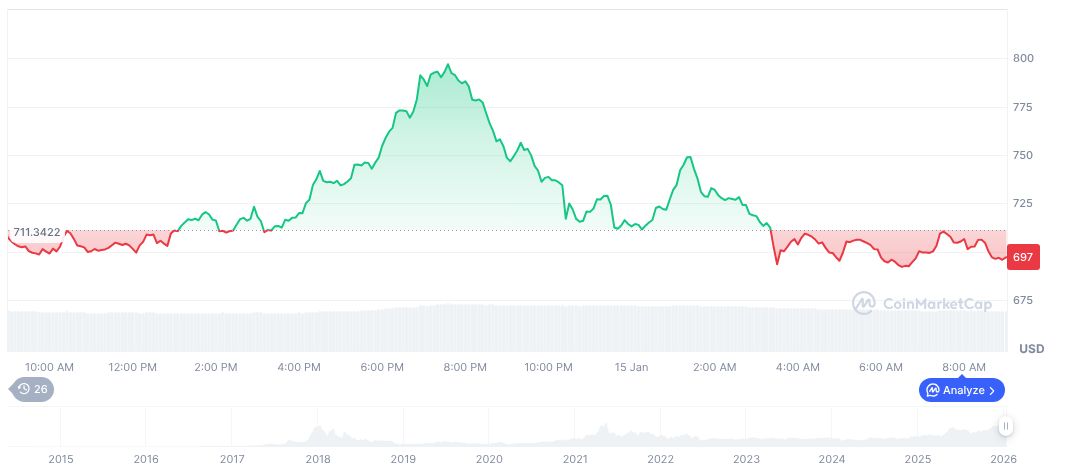
Research from the Coincu team suggests that the integration of perpetual swaps could lead to potential technological advancements. These instruments are capable of stimulating trading activity and fostering enhanced liquidity. Furthermore, they may serve to challenge traditional trading barriers by decoupling price discovery from the constraints of spot markets.