


The crypto market commenced 2026 with a total value exceeding $3 trillion, and daily trading volumes fluctuating near $150 billion as volatility re-emerged. Current analyses of the Monero (XMR) price indicate a resurgence in strength, while the most recent Solana (SOL) price prediction suggests continued upward movement. However, given that both of these assets are already well-established and widely held, the potential for substantial profit growth may be limited.

This question naturally draws attention to Zero Knowledge Proof (ZKP). Market analysts characterize its system as one where daily demand resets, driving prices upward through unprecedented participation levels. Researchers have noted that yesterday's entry point appeared inexpensive, today's seems reasonable, and tomorrow might exclude latecomers entirely.
Industry experts refer to this phenomenon as the "Green Staircase" for returns. When compared to Monero and Solana, Zero Knowledge Proof aligns with the profile of a top trending cryptocurrency poised for significant gains.
Zero Knowledge Proof and the Rising Entry Curve
Zero Knowledge Proof is being developed as a comprehensive blockchain network, supported by over $100 million in self-funded infrastructure, active testnets, and physical hardware. Analysts point out that very few projects enter the market with such a high degree of completion and financial commitment already established.
Current focus is shifting towards its auction structure, which features a fixed daily supply meeting increasing demand. Researchers monitoring wallet data report thousands of new participants joining each day, driving valuations higher in incremental steps. This has led to Zero Knowledge Proof receiving early recognition as a top trending crypto on a global scale.
Market observers describe a stair-step pattern driven by continuous repricing, rather than speculative trading. Each daily reset recalculates the value upward as capital enters the system, meaning that buyers acquire fewer tokens over time, even when investing the same amount, as participation expands relentlessly across various regions and platforms worldwide.
This dynamic has significant implications for investment timing. Analysts caution that early investors secured lower cost bases, while those entering later face diminishing allocations. Predictive models suggest the auction is approaching a permanent price floor that may never be revisited once demand peaks, given the current growth rate of participation.
This structural characteristic is why experts once again label Zero Knowledge Proof a top trending crypto. With consistent daily price pressure, capped participation, and projections indicating potential gains of up to 5000x, analysts argue that the risk-reward profile favors immediate action before affordability is permanently removed from the open market for late entrants.
Monero (XMR) Price Update: Privacy Coin Performance Check
The Monero (XMR) price update indicates strong momentum in mid-January 2026, with XMR trading between $698 and $715 following a significant breakout above $600. The privacy-focused coin now boasts a market capitalization close to $13 billion, with daily trading volumes around $450 million. The circulating supply remains near 18.4 million XMR, maintaining its scarcity. This price movement follows several weeks of consistent buying activity as demand for privacy-enhancing cryptocurrencies increases across global markets.
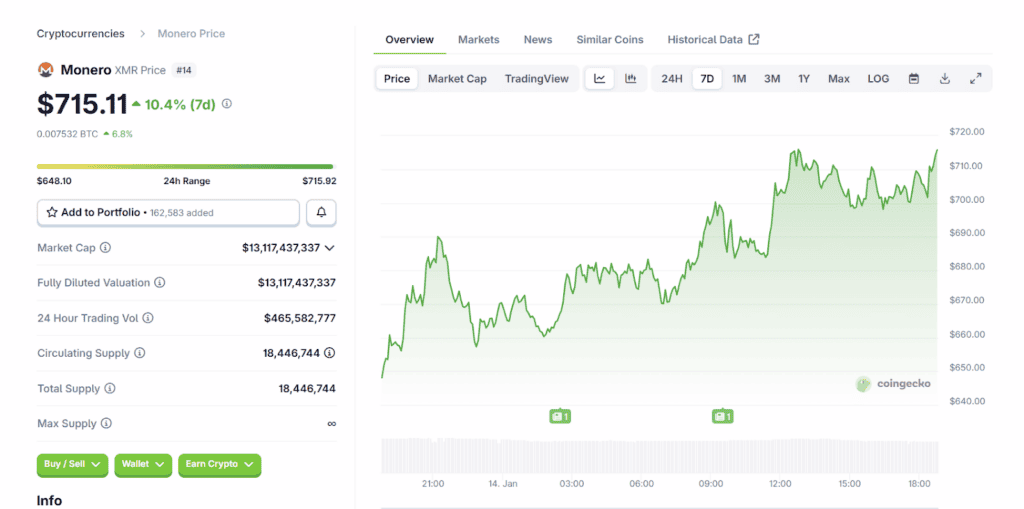
An additional aspect of the Monero (XMR) price update highlights the substantial gains XMR has already achieved. Price data reveals an increase of over 40 percent since the beginning of January, propelling Monero into the top 15 cryptocurrencies by market value. While analysts acknowledge its strength, they also point out that achieving significant further upside now necessitates substantial capital investment. In comparison to newer projects, Monero offers stability and established utility, but its mature market position may limit the potential for exponential returns. Consequently, careful timing and realistic expectations are crucial for investors closely observing its current price action.
Solana (SOL) Price Prediction: Network Outlook and Limits
The Solana (SOL) price prediction remains a focal point in January 2026, with SOL trading within the $140 to $150 range after a volatile start to the year. Market models suggest near-term resistance around $160, with some analysts forecasting a move towards $180 if trading volume remains robust. Longer-term forecasts for 2026 place potential average prices near $170, supported by strong network usage and consistent developer activity across the DeFi and NFT sectors.

A second perspective on the Solana (SOL) price prediction emphasizes the limitations associated with its current market size. With a market capitalization already exceeding $70 billion, substantial price increases now require massive capital inflows. Analysts view SOL as a reliable investment, but note that the pace of returns may be slower compared to smaller networks. For investors seeking stability with moderate upside potential, Solana continues to be a relevant option, provided their expectations align with its established position in the market. This context shapes realistic outlooks for potential buyers in 2026 and beyond.
How Zero Knowledge Proof Fits the Top Trending Crypto Narrative
Recent data from the Monero (XMR) price update demonstrates significant gains, but its substantial market capitalization now restricts the potential for extreme upside. Concurrently, the latest Solana (SOL) price prediction indicates steady growth rather than explosive returns. Both of these assets offer stability and proven functionality; however, their maturity implies that achieving substantial profits will require considerable capital and patience.
This contrast intensifies the focus on Zero Knowledge Proof, which analysts describe as being structured around persistent demand pressure. Researchers highlight its daily price resets and increasing wallet activity as indicators that timing is more critical than headlines, particularly as each new entry secures fewer tokens.
Industry experts now identify it as a top trending crypto, arguing that its current structure favors early investment before affordability further tightens in the future.