


Key Regulatory Developments
Kazakh President Kassym-Jomart Tokayev signed a law on January 17, integrating digital financial assets into banking regulations. This legislation aims to stimulate the fintech and crypto sectors by formalizing digital assets, bolstering investor protection, regulating exchanges, and monitoring financial activities, which may impact the broader cryptocurrency ecosystem.
Details of the New Law
The Law on Banking and Banking Activities and its amendments officially regulate digital financial assets (DFAs) in Kazakhstan. President Tokayev's signature introduces three categories of DFAs: stablecoins, tokens based on physical assets, and electronic financial instruments. This initiative follows previous reforms in the banking sector undertaken in 2022.
This regulation formalizes crypto trading activities. It mandates that exchanges must be licensed by the central bank and will disseminate a list of permissible cryptocurrencies. Furthermore, restrictions are imposed on cryptocurrency trading to ensure the safeguarding of investor rights.
Tokayev’s initiative strikes a crucial balance between regulation and industry support, aiming to protect interests without stifling innovation, underscoring the government's efforts.
Impact on Global Markets
Prior to this law, Kazakhstan permitted unlicensed digital asset circulation only within the Astana International Financial Center. The new regulation significantly broadens this scope.
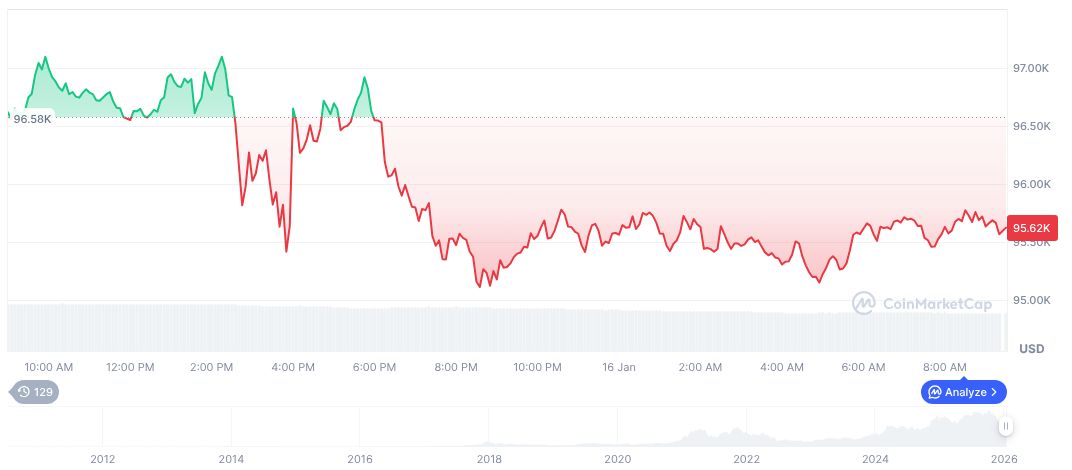
Bitcoin (BTC), now under Kazakhstan's regulatory oversight, is classified as an unsecured digital asset. As of January 17, 2026, BTC's price was $95,289.70 with a market capitalization of $1,903,582,381,068.24. The cryptocurrency has experienced recent price fluctuations, showing a 5.18% change over the past seven days.
Research indicates that this regulation could potentially enhance investor confidence and strengthen global fintech alliances. It reflects emerging trends towards regulated crypto environments and may influence regional regulatory frameworks.