



JD Vance's Political Strategy and Future Aspirations
JD Vance, the junior U.S. Senator from Ohio, has revealed in a recent Fox News interview that he is contemplating a presidential run in 2028. Vance emphasized that his immediate focus remains on the upcoming midterm elections and their outcomes. He also indicated a willingness to engage in post-election discussions with the sitting President regarding future political endeavors.
Despite Vance's stated intentions for a potential 2028 presidential campaign, this announcement has not resulted in any discernible changes to current market or economic conditions. There is no clear crypto-related policy or financial impact anticipated from his remarks. The conversation primarily centered on potential strategies for upcoming elections.
“We will do our best to win the midterm elections. After that, I will sit down with the President of the United States to discuss this.”
Limited Crypto Market Impact Amidst Political Developments
Past political announcements by prominent figures have historically had limited impact on the crypto markets unless significant policy changes or regulations are directly involved. This observation holds true in the current context, where Vance's statements are not directly tied to any immediate regulatory or fiscal policy shifts affecting digital assets.
Bitcoin (BTC) is currently trading at $96,040.59 with a market capitalization of $1.92 trillion, holding a 58.75% market dominance. Recent trading volumes have experienced a -46.09% change, totaling $65.68 billion. Over the past 90 days, BTC's price has decreased by 18.53%, reflecting broader market trends.
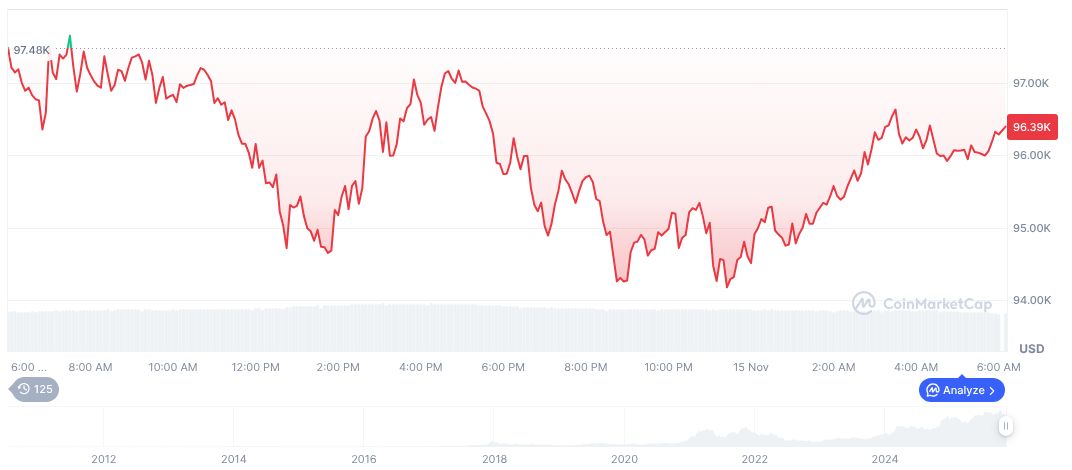
The Coincu research team highlights that while political developments can influence economic sentiment, the direct impact on cryptocurrency markets is often linked to explicit fiscal policies or regulations. Current discussions focus on broader economic trends and market stability, particularly concerning BTC's sustained value fluctuations. The recent volatility observed in BTC and ETH is primarily attributed to internal market dynamics rather than political news.