



The Pi Network price has experienced a significant decline, plummeting by over 90% from its all-time high. Despite this dramatic fall, each attempt at a rebound has encountered substantial resistance.
Pi Coin (PI) token reached its peak at $2.98 in February following its mainnet launch. Subsequently, it tumbled to a record low of $0.1465 in October. Its market capitalization has similarly contracted from nearly $20 billion to $1.97 billion.
Several factors are attributed to Pi Network’s sharp price crash. These include issues with centralization, a lack of major exchange listings, insufficient liquidity, an increase in token unlocks, and a perceived lack of utility and ecosystem development.
Many verified users, often referred to as pioneers, also sold off their tokens after the mainnet launch as the price continued its downward trend. The broader cryptocurrency market downturn has also played a role in this sell-off.
Recent Developments and Potential Catalysts
There are emerging signs that the Pi Network price crash might be nearing an end, particularly following recent announcements from the developers. The most noteworthy development occurred last week when the Pi Core Team announced an investment in OpeMind.
The collaboration between Pi Network and OpeMind has already seen the completion of a proof-of-concept. This initiative allows node operators to run AI models for OpenMind, demonstrating the capability of these operators to handle computations for third-party companies.
Furthermore, Pi Network has launched a testnet product designed to test decentralized exchanges (DEX), automated market makers (AMM), and liquidity providers. The objective behind this is to enhance the token's utility by enabling functionalities similar to those found on platforms like PancakeSwap and Raydium.
In addition to these advancements, Pi has introduced a new Know Your Customer (KYC) verification tool. This tool has significantly boosted the number of users successfully verified on the network, with millions of users now having completed the verification process. KYC verification is a crucial step that enables users to transfer their mined Pi tokens to the mainnet.
These collective events hold the potential to support a rebound in the Pi Network price over the long term. Other factors that could contribute to a price increase include securing listings on major exchanges, fostering greater real-world utility within the network, and implementing a token burn feature.
Pi Network Price Chart Analysis
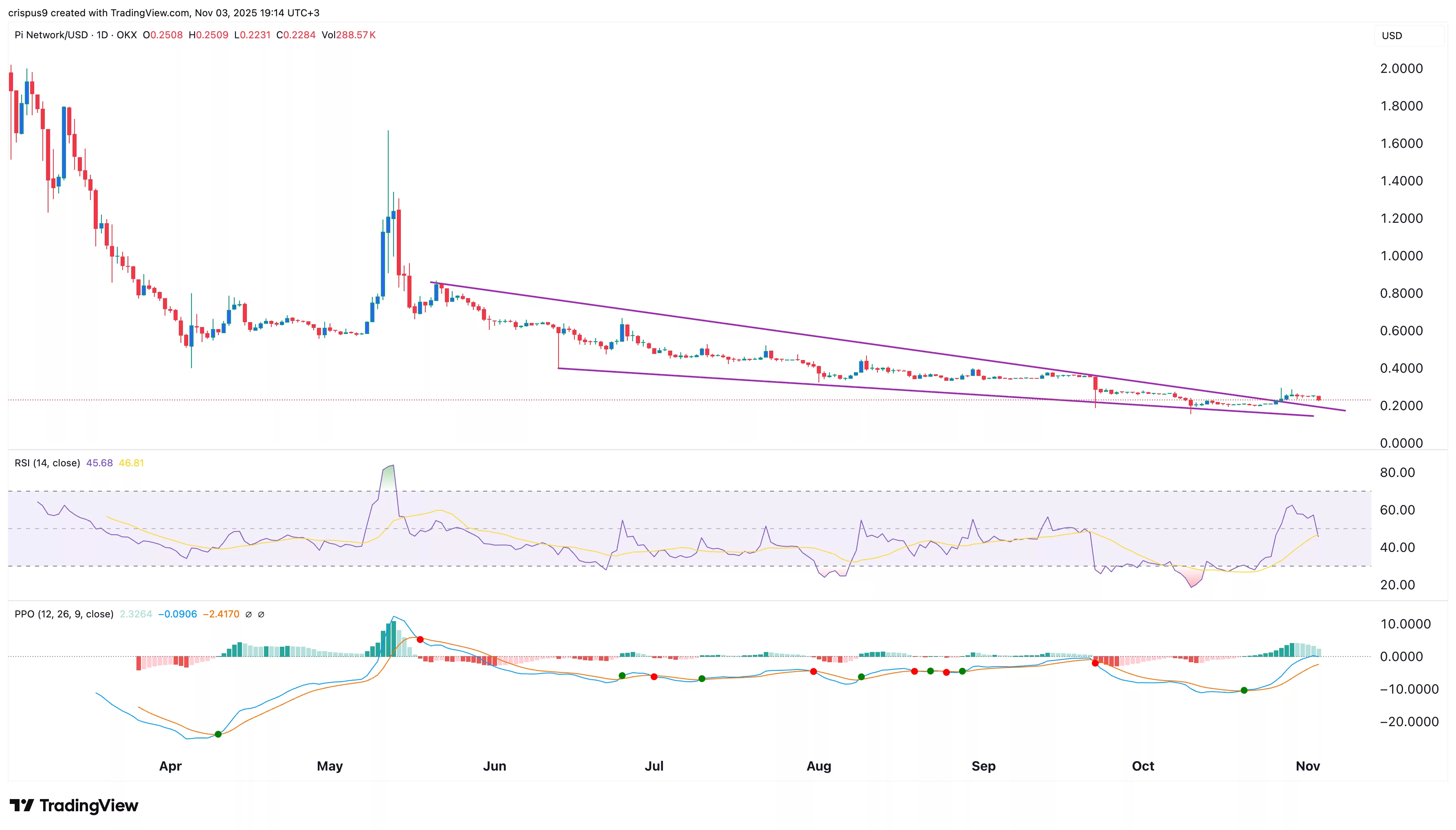
Technical analysis of the Pi Network price chart suggests that its value might be on the verge of a significant breakout in the near future. This outlook is primarily based on the formation of a large falling wedge pattern observed on the daily chart.
The price has already moved above the upper boundary of this pattern and is currently attempting to retest it. A successful retest would confirm a breakout from the pattern, potentially propelling the price towards the psychologically significant $0.50 level, representing a 120% increase from its current trading position.
In addition to the falling wedge, Pi has also formed other bullish technical indicators. For instance, a bullish divergence has emerged, indicated by the upward trend in top oscillators such as the Relative Strength Index (RSI) and the Percentage Price Oscillator (PPO), even as the price has fluctuated.