



Solana has consistently been a prominent blockchain, and as 2026 approaches, its visibility is set to increase. Following a significant surge earlier in the cycle, the SOL price has experienced a cooling-off period, but this pullback does not necessarily signal the end of its upward trajectory.
What the Chart Is Telling Us About the SOL Price
A closer examination of the 4-hour chart reveals that the SOL price recently encountered resistance around the $148 mark, leading to a swift and aggressive sell-off that pushed the price back towards the $133–$134 zone. This area is noteworthy as it corresponds to a previous breakout point, which is now being tested as support. The prompt appearance of buyers in this zone suggests persistent demand during dips. As long as the SOL price maintains its position above $130, the underlying structure is considered to be reset rather than broken.
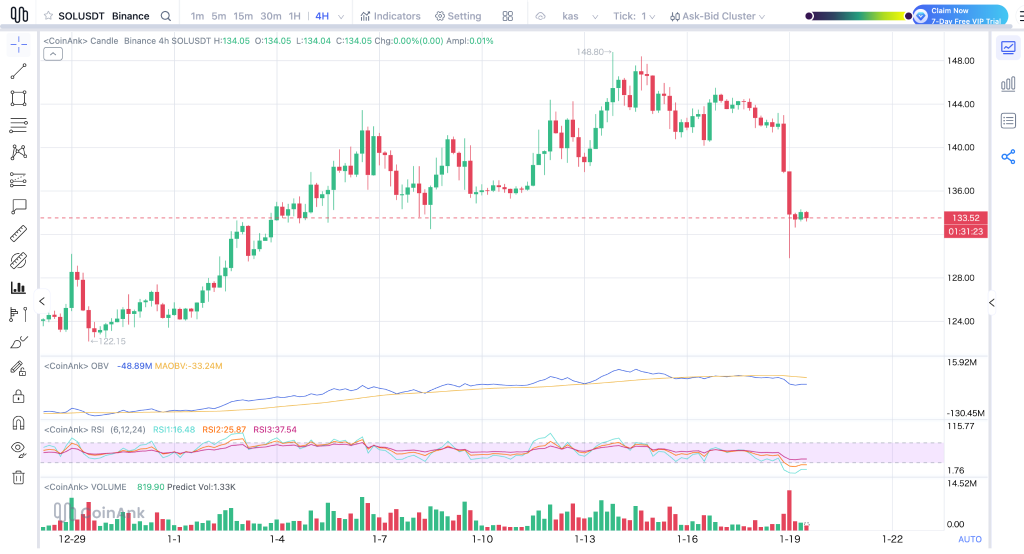
The current market action appears to be a pause following a substantial move, rather than an indication of a trend reversal. This consolidation phase is often where longer-term positions are established, particularly when trading volume does not confirm a widespread distribution event.
Why Alpenglow Could Matter More Than It Sounds
A key development on Solana's horizon for 2026 is the Alpenglow upgrade. This is not merely a routine update; it has the potential to significantly expand Solana's use cases by reducing transaction finality to approximately 150 milliseconds. Such speed makes Solana a viable candidate for applications requiring high-frequency trading, instant settlements, and payment flows that are not practical on slower blockchain networks.
If the Alpenglow upgrade is implemented successfully and validators adopt it without major complications, it could provide the SOL price with a more robust foundation, moving beyond mere speculative interest.
However, significant upgrades inherently carry risks. Delays or technical issues could negatively impact market perception. Conversely, if the upgrade functions as intended, it could position Solana in a competitive niche currently inaccessible to many other blockchains.
Institutional Liquidity Is Starting to Feel Real
Another significant development is State Street's selection of Solana for its SWEEP tokenized liquidity product. This partnership signifies more than just a headline-grabbing announcement. The involvement of a $5 trillion asset manager in building on the Solana blockchain lends a substantial degree of credibility.
If institutional capital begins to flow into Solana-based decentralized finance (DeFi) as a result, it could directly influence network activity, stablecoin utilization, and, consequently, long-term demand for SOL.
The exact pace of this adoption remains uncertain, influenced by regulatory landscapes and macroeconomic conditions. Nevertheless, this development represents a meaningful directional signal.
So, What Does This Mean for the SOL Price in 2026?
Solana's strategic roadmap leading into 2026 encompasses a combination of speed enhancements, increased institutional engagement, and expansion into consumer-facing applications. From a technical analysis standpoint, the SOL price appears to be consolidating, which is generally a healthy indicator following a period of strong gains.
Should Solana effectively execute its development plans and continue to attract both users and capital, the future trajectory of the SOL price may be increasingly shaped by tangible utility rather than solely by speculation.
At this juncture, Solana's focus should be on consistent execution rather than making grander promises. Successful delivery on its development goals would naturally bolster its long-term growth narrative.