



Fed Ends Quantitative Tightening, Injecting Liquidity into the System
Ethereum's current consolidation phase is closely aligning with a significant policy shift from the U.S. Federal Reserve. On Wednesday, the Fed announced a 25 basis point rate cut, and sources confirmed that quantitative tightening (QT) will conclude on December 1. This decision marks the end of the balance sheet runoff that has been draining liquidity from the financial system since 2022, a move that is expected to foster renewed risk appetite across various markets.
This development is being highlighted as the first meaningful divergence from liquidity tightening policies implemented over the past two years. Quantitative tightening had previously removed trillions from the financial system, leading to tighter credit conditions and increased pressure on risk assets, including cryptocurrencies. The cessation of QT is anticipated to bolster bank reserves, ease lending conditions, and ultimately stabilize overall market liquidity.
Fed Chair Jerome Powell characterized the rate cut as a "risk management" measure aimed at maintaining stability rather than initiating a new easing cycle. Powell acknowledged that inflation remains above the target but is showing signs of cooling, while the employment market remains robust. He also indicated uncertainty regarding future decisions, stating, "We haven’t made a decision about December," suggesting internal debate among committee members about further rate reductions.
Despite these nuances, the central bank's decision to halt balance sheet reduction represents a fundamental pivot in liquidity provision. This change could facilitate capital rotation back into major digital assets like Bitcoin and Ethereum, particularly as institutional investors respond to improving macroeconomic liquidity conditions.
Ethereum Holds Key Support Levels Amidst Breakout Zone
Market analyst Wolf, observing the charts, noted that Ethereum is currently "holding the broadening wedge backtest," indicating that a former resistance level has now transitioned into strong support. Throughout October, Ethereum maintained a steady range between $3,968 and $4,000. This price zone, which previously acted as resistance earlier in 2024, has now solidified as a crucial support base, setting the stage for a potential breakout as December approaches.
The primary hurdle for Ethereum remains around the $4,807 mark, a level where the price has encountered repeated resistance. According to the analyst, a decisive break above this resistance could propel Ethereum towards $8,084, with potential highs ranging between $13,000 and $14,000 by mid-2026. Conversely, a temporary pullback to the $5,900–$6,000 range might occur before an upward continuation.
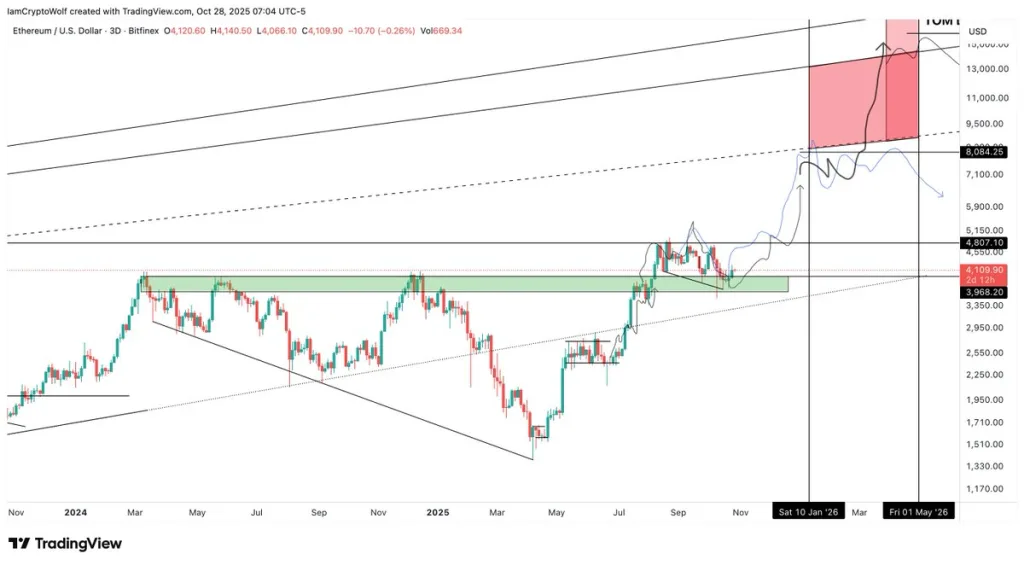
Current trading volume, standing near 669.34, suggests steady buying activity, implying that investors are accumulating positions rather than selling off.
Should Ethereum maintain its position above the $4,000 level, analysts anticipate an acceleration of liquidity-driven inflows, particularly from institutional investors and potential allocations into ETFs. However, a decisive break below this key range could trigger a short-term correction towards the $3,350–$2,950 levels before recovery efforts commence.
Technical Indicators Suggest Consolidation Phase
At the time of reporting, Ethereum was trading at $3,921, reflecting a 2.65% decrease over the past 24 hours. Its market capitalization stood at $473.15 billion, with a daily trading volume that saw a 3.96% increase to $39.35 billion, according to CoinMarketCap.
The Relative Strength Index (RSI) is positioned at 44.73, just below the neutral 50 mark. This indicates slight selling pressure without reaching oversold territory. A move above 50 would signal strengthening buyer momentum.
The Moving Average Convergence Divergence (MACD) is exhibiting a gentle shift between weak bullish and neutral signals, with narrowing bars suggesting a potential market stabilization.
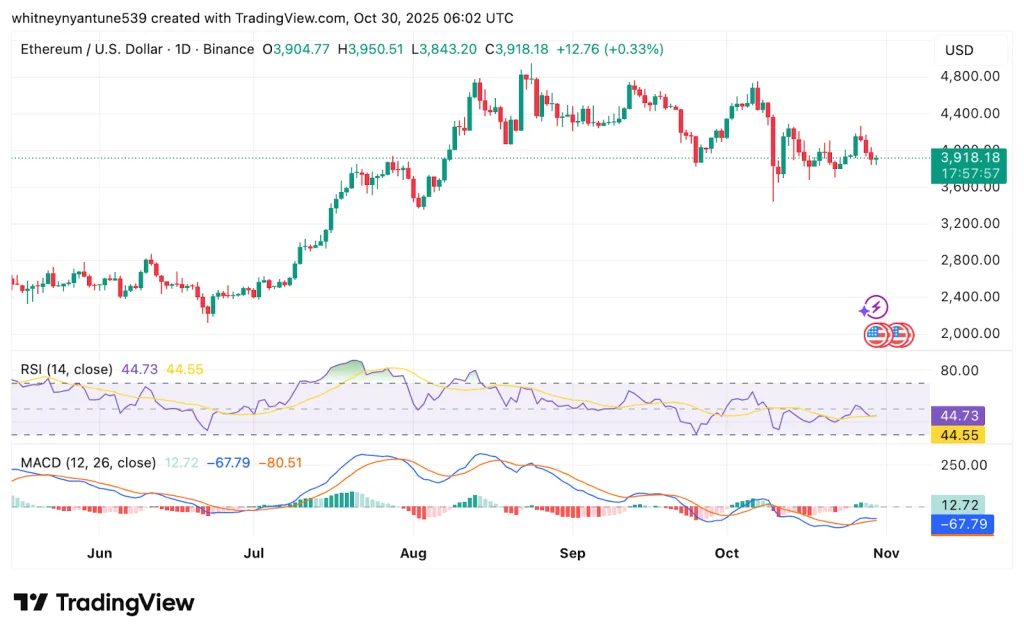
Ethereum has demonstrated resilience, holding steady between $3,600 and $3,800, but has yet to achieve a sustained close above $4,800. This price action indicates that traders are building positions while awaiting a clearer market direction. If the price remains above $3,850 and momentum improves, a rise towards the $4,200–$4,400 range is possible. Conversely, a drop below $3,800 could lead to further declines towards $3,400 or even $3,000 before buyer interest re-emerges.
Data from Coinalyze reveals that Ethereum experienced approximately $93.1 million in liquidations over the preceding day, with 80% originating from long positions. Bybit recorded the highest losses, nearing $50 million, followed by Binance. OKX saw moderate liquidations below $20 million, while Huobi, BitMEX, and Bitfinex reported less than $10 million each.
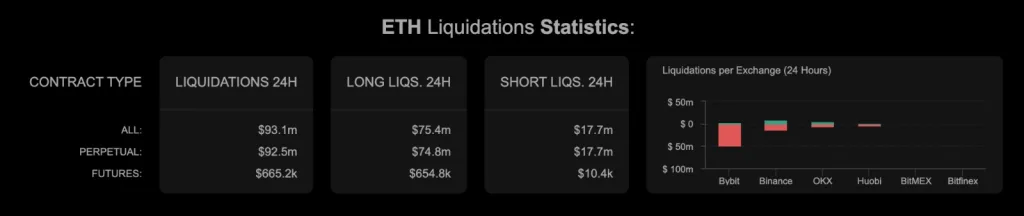
These recent market movements have liquidated traders who were heavily leveraged on long positions, potentially clearing the path for a price rebound. As liquidity is expected to flow back into the market and larger investors show increased interest, Ethereum's current period of consolidation could precede a significant upward move in December.
Ethereum's ability to maintain key support levels, coupled with improving overall market liquidity, underscores its growing stability. With the conclusion of quantitative tightening, an uptick in trading activity, and renewed investor accumulation, Ethereum may transition from its current quiet phase to a pronounced upward trend as December approaches.