



ASTER emerged as a prominent name in September following its debut on multiple exchanges. The ASTER token price experienced a rapid surge, reaching approximately $2.4 at its zenith. For a period, it appeared poised to sustain its initial momentum, a rare feat for newly listed assets.
At the time of its launch, many speculated that the price increase was driven by genuine utility rather than mere listing hype. This assumption was grounded in the fact that ASTER indeed serves a practical purpose within its ecosystem.
The Aster project is a decentralized exchange (DEX) that integrates spot and perpetual futures trading. Its design prioritizes both simplicity and power, aiming to attract novice traders with an intuitive interface while providing advanced tools for experienced professionals. The overarching objective is to bridge the gap between Decentralized Finance (DeFi) and traditional derivatives trading, a prospect that fueled considerable optimism at its launch.
For a time, the belief that the Aster price rally was utility-driven seemed well-founded. A token underpinning a functional DEX, offering benefits such as staking, fee discounts, and governance rights, often demonstrates greater value retention compared to purely speculative cryptocurrencies.
Why Aster Price Fell Sharply After Its Launch
Despite its promising start, the ASTER price failed to maintain its early gains. From its peak of around $2.4, the token has seen a decline of nearly 50%, trading near $1.14 at the time of this analysis.
It has become evident that a significant portion of the initial excitement was attributed to post-launch hype. As early investors realized profits and short-term traders exited their positions, the price underwent a sharp correction. This pattern is not uncommon for newly listed tokens, particularly in a volatile market where enthusiasm can dissipate quickly.
Nevertheless, ASTER retains long-term potential. It continues to operate as a functioning DEX with a clearly defined roadmap, and several upcoming features could potentially revitalize the token's momentum once implemented.
Current Technical Analysis of Aster Price
From a technical standpoint, the Aster price exhibits a cautious yet intriguing pattern. Following the correction, the token's movement has begun to form a descending trendline, which has consistently acted as a significant resistance barrier. The price has tested this line on at least three separate occasions, confirming its validity.
Each attempt by Aster to breach this trendline has resulted in rejection and a subsequent downward price movement. However, a positive development for short-term traders is the apparent establishment of a support zone for the token between $0.89 and $0.95. The price has already shown resilience by bouncing from this level and is currently trading around $1.14.
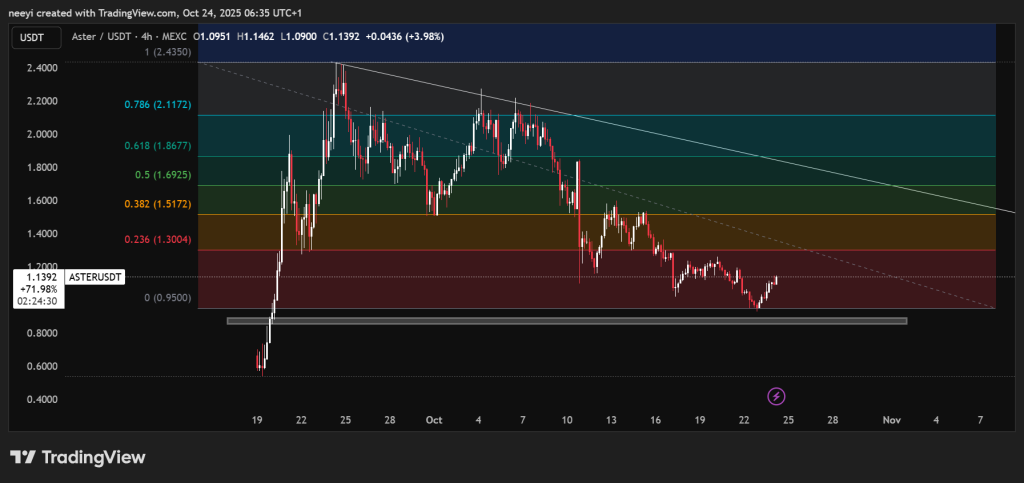
Should this support level continue to hold, a short-term rally could be anticipated. A move back towards the descending trendline resistance might translate into a price increase of 50–60% from current levels, potentially reaching between $1.6 and $1.8.
Notably, these projected levels align closely with the 0.5 and 0.618 Fibonacci retracement zones, which are widely recognized as key resistance points in technical analysis. The 0.236 ($1.3) and 0.382 ($1.5) levels also represent potential areas where selling pressure might emerge.
Therefore, while short-term upside potential exists, the broader downtrend remains in effect until Aster achieves a decisive breakout above its established trendline.
Reasons for Analyst Optimism Regarding Aster's Utility
While technical indicators suggest a degree of caution, several analysts maintain a positive outlook on the Aster ecosystem's potential. For instance, Panke (@Pankekkeku) shared insights on X (formerly Twitter) in early October regarding new token utilities slated for release in the near future.
According to Panke, the Aster CEO, Leonard_Aster, has confirmed the development of several features intended to enhance the token's long-term value:
- •Fee Discounts: Users who opt to pay trading fees with $ASTER will receive discounts.
- •Staking for VIP Tiers: Staking $ASTER will grant users higher VIP tiers on the DEX, offering benefits such as reduced fees and additional rewards, a model reminiscent of Binance's Launchpool.
- •Governance Voting: Token holders will be empowered to participate in platform decision-making through governance voting.
- •Aster Chain Rollout: The development of Aster Chain, a privacy-preserving Layer-1 network designed for high speed and scalability, capable of processing over 150,000 transactions per second (TPS).
- •Builder Compartments: Integration capabilities for popular wallets like Trust Wallet and SafePal.
- •Collateral Utility: Users will be able to utilize $ASTER as collateral within the "trade & earn" feature, analogous to how stablecoins can be minted using existing crypto assets.
Aster CEO @Leonard_Aster on NEW $ASTER token utility that will be ADDED in the coming WEEKS
— Panke (@Pankekkeku) October 1, 2025
Buy now or cry later, every single utility will pump the price.
1. Use it as fee for discount ✅
2. Staking > for higher vip tier levels on dex = reduced fees + rewards (think… pic.twitter.com/Basi87KfAw
If these planned features are successfully implemented, they could facilitate Aster's transition from a short-term trading asset to a token with substantial long-term utility within its burgeoning ecosystem.
Investment Considerations for Aster
The decision of whether to consider buying Aster at this juncture is contingent upon individual investment objectives. For short-term traders seeking rapid profits, there may be an opportunity if the price rebounds towards the descending trendline resistance. Such a movement could potentially yield a 50–60% gain before encountering significant resistance.
However, for long-term investors, maintaining a degree of caution remains advisable. The token has not yet confirmed a definitive trend reversal, and its current recovery phase could still be part of a larger downward trend. Waiting for a confirmed breakout above key resistance levels might represent a more secure entry point.
That being said, for those who believe in Aster's development roadmap and the potential impact of its upcoming utility features, accumulating the token gradually at lower price points could be a viable strategy. The combination of new use cases, enhanced liquidity, and a potentially strengthening technical structure might eventually contribute to a resurgence in investor confidence.