


In traditional blockchains, the transparency of data and smart contract execution, while ensuring verifiability, presents significant challenges for handling real-world private data. Information such as financial details, trading strategies, AI models, and medical records cannot be securely uploaded and utilized on-chain due to privacy concerns.
The Web3 project InitVerse has introduced a groundbreaking solution to this challenge with its TfhEVM (Torus Fully Homomorphic Encrypted EVM) technology.
Understanding TfhEVM
TfhEVM is an innovative execution environment that merges Fully Homomorphic Ring Encryption (TFHE) with the Ethereum Virtual Machine (EVM).
Key features of TfhEVM include:
- •Smart contracts can operate directly on encrypted data. From submission and storage to computation, data remains entirely encrypted, preventing nodes and observers from accessing the original content.
- •EVM compatibility allows developers to continue using familiar tools like Solidity, Remix, and Hardhat, while gaining access to a new blockchain with integrated privacy computing capabilities.
- •Quantum-Resistant Security: Utilizing a Ring-LWE (Ring Learning Error Problem) encryption mechanism, TfhEVM offers protection against future quantum computing attacks.
Essentially, TfhEVM achieves the simultaneous existence of privacy, security, verifiability, and EVM compatibility for the first time.
Addressing Traditional Blockchain Limitations with TfhEVM
TfhEVM resolves several critical issues inherent in traditional blockchains:
Privacy Leakage: Transparent Data and Transactions
Traditional blockchains expose transaction inputs, outputs, and account states, making them easily traceable and subject to analysis. TfhEVM enables smart contracts to function without accessing plaintext data, thereby fundamentally protecting data privacy.
Low Encrypted Computation Performance
While fully homomorphic encryption theory is potent, it is computationally intensive. InitVerse addresses this through a dual dynamic adjustment (DDA) mechanism, parallel block generation, and algorithm optimization, making encrypted computation practical, scalable, and seamless.
Enterprise Data On-Chain Obstacles
Industries like finance, healthcare, AI, and government cannot operate with publicly accessible data. TfhEVM allows for the circulation and computation of encrypted data, removing a major barrier to enterprise-level blockchain deployment.
Quantum Era Security Concerns
The Elliptic Curve Cryptography (ECC) used in traditional blockchains is vulnerable to future quantum computing attacks. TfhEVM incorporates quantum-resistant cryptography to ensure long-term security.
Practical Benefits of TfhEVM for Users
Users, institutions, and developers can all benefit from TfhEVM technology on the INIChian chain:
For Users:
- •Transactions, assets, and strategies remain private and undisclosed.
- •Enhanced data privacy ensures on-chain activities are not subject to analysis.
- •Quantum-resistant encryption provides greater security for assets.
For Enterprises:
- •Sensitive data can be processed securely on-chain.
- •Compliance with regulations like GDPR and medical privacy standards is facilitated.
- •Data can be shared collaboratively without revealing its original content.
For Developers:
- •Continued use of Solidity minimizes learning costs.
- •Opportunities to build future-aligned applications such as privacy-preserving DeFi, encrypted AI, and encrypted voting systems.
Applicable Scenarios for TfhEVM Technology
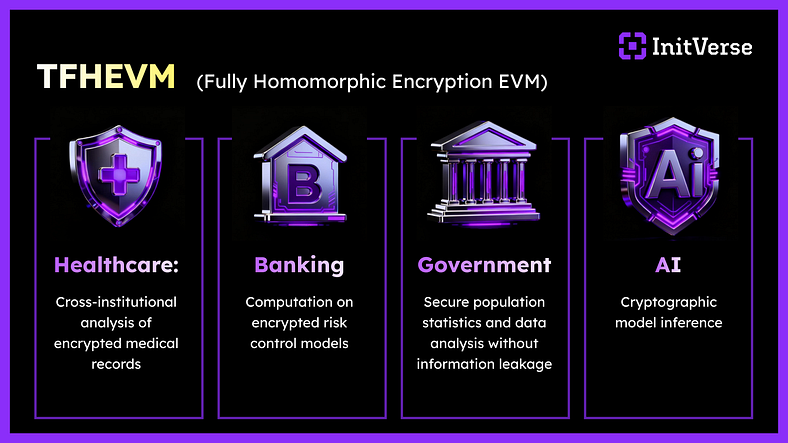
Privacy Finance (DeFi+)
- •Crypto Credit Scoring
- •Privacy Asset Management
- •Crypto Investment Strategy Execution
- •On-chain Bank-Grade Risk Control Models
AI + Blockchain
- •AI Inference on Crypto Data
- •AI Training with Shared Data from Multiple Parties
- •Encrypted Protection of AI Model Parameters
Medical Data
- •Medical Record Sharing
- •Encrypted Execution of Medical Algorithms
- •On-chain Privacy Monitoring Reports
Enterprise Data Collaboration
- •Multi-Party Secure Computation (MPC)
- •Business Secret Analysis
- •Crypto Supply Chain Information Flow
Privacy Governance and Voting
- •Full-Chain Anonymous Voting
- •DAO Privacy Governance
- •Voting and Governance Mechanisms That Do Not Expose Holdings
TfhEVM technology offers more than just a blockchain; it provides a privacy computing infrastructure capable of handling sensitive data.
Core Advantages of TfhEVM Over Traditional Blockchains
While traditional blockchains prioritize "openness and transparency," TfhEVM's core principles are "security and privacy." This fundamental difference in design philosophy leads to distinct capabilities. Traditional blockchains excel in transparent Web3 environments, whereas TfhEVM empowers blockchains to manage sensitive real-world data.
On conventional EVM chains, all data is publicly accessible in plaintext, allowing for the analysis of transactions, parameters, and account activities. While this transparency ensures verifiability, it is unsuitable for privacy-sensitive applications in finance, healthcare, and AI.
TfhEVM's innovation lies in its end-to-end homomorphic encryption of all data, from submission through computation. Nodes process ciphertext rather than plaintext when executing smart contracts. This ensures accurate computation results without compromising original information, enabling secure on-chain storage for sensitive data. Additionally, TfhEVM employs quantum-resistant encryption (Ring-LWE) for enhanced long-term security. Crucially, its full EVM compatibility allows developers to build privacy-enabled applications without altering their existing tools or languages.