


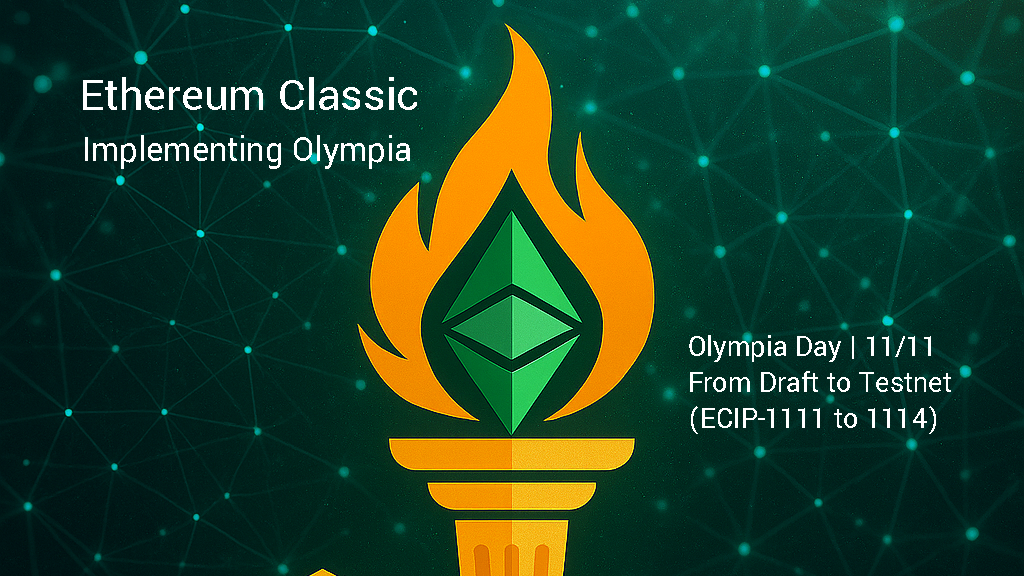
The Transition from Research to Reality
November 11, 2025, marks a significant moment for Ethereum Classic, a date mirroring the foundation of the Olympia upgrade: ECIP-1111. This day, often associated with alignment and renewal, signifies Ethereum Classic's move from years of dedicated research into the initial phase of implementation. After nearly a decade of extensive debate and experimentation, Ethereum Classic is entering a new era of maturity.
The Olympia upgrade suite, encompassing ECIPs 1111 through 1114, has evolved from conceptual drafts discussed between 2016 and 2024, and formally proposed in 2025, into a coordinated, step-by-step implementation plan ready for testnet deployment. This milestone is historically significant for Ethereum Classic, as it introduces the network's first opt-in, voluntary, protocol-native, and non-inflationary funding system directly integrated into its consensus logic.
Olympia represents the realization of a long-standing objective: the establishment of a sustainable, decentralized mechanism to fund client development, public infrastructure, and the ongoing maintenance of the ecosystem.
Why Olympia Matters
Proof-of-Work (PoW) networks face a persistent long-term challenge: as block subsidies diminish, miner incentives must increasingly rely on transaction fees to ensure network security. Ethereum Classic's current fee market does not yet provide the stable and predictable incentives necessary to foster alignment among miners, developers, and users regarding lasting network security.
Historically, in the absence of such alignment, donation-based funding has served as the fallback. However, this model has proven fragile, leading to the dissolution of major development teams periodically throughout ETC's history. Often, community volunteers have stepped in to maintain core infrastructure until new teams emerged.
Olympia introduces a framework designed to unite all participants—miners, developers, and ecosystem contributors—around a transparent, self-sustaining fee market. Simultaneously, it provides a clearer, more accountable pathway for the continuation of the traditional donation model. This system establishes an on-chain mechanism that clearly outlines the baseline funding requirements for Ethereum Classic to operate reliably for various stakeholders:
- •Miners: To secure the network and rely on stable clients, predictable income streams, and liquid markets for converting rewards into operating capital.
- •Core developers: To maintain clients and tooling, relying on open, auditable funding and proposal systems for effective contributions.
- •Donors and ecosystem sponsors: To support network growth, seeking a transparent, on-chain funding system that replaces costly, centralized grant models and prevents any single entity from becoming the network's de facto maintainer.
- •Off-chain services: To provide institutional and financial infrastructure through exchanges, custodians, and TradFi integrations, which depend on modern, well-maintained clients.
- •Application developers: To expand demand for blockspace and rely on a modern, actively maintained EVM that remains interoperable with upstream tooling and programmability, while depending on reliable public goods and infrastructure for production-grade user experiences.
- •End users: To depend on stable, secure systems for efficient transactions, self-custody of assets, and a first-class user experience.
Beyond Funding — Aligning Incentives in Proof-of-Work
Olympia's impact extends beyond funding; it also addresses the fundamental economic alignment problem inherent in Proof-of-Work itself—the long-term incentive structure that guarantees miner participation and network security. By introducing an opt-in transaction type that redirects BASEFEE revenue to both a network treasury and a smoothed payout system for miners, Olympia directly links the health of the fee market to the security of the chain.
Within ECIP-1111, a key design consideration under review is the L-curve distribution model. This mechanism smooths BASEFEE payouts across multiple blocks, creating steadier income for miners by spreading fee rewards over several blocks and ensuring predictable revenue. Concurrently, it channels a portion of the BASEFEE into sustainable core development funding.
In essence, Olympia introduces a single, elegant mechanism to address two of Proof-of-Work's most enduring challenges: securing miners' long-term incentives and ensuring continuous, decentralized development. The shared principle is that as on-chain activity grows, so do the incentives that sustain miners, fund development, and strengthen the network as a whole.
With the proposed smoothing model, miners benefit from steady fee flows even as block rewards decrease, reinforcing network security. Simultaneously, this BASEFEE revenue supports client maintenance, infrastructure, and ecosystem growth. Furthermore, Olympia's new transaction type maintains compatibility with modern wallet and exchange standards, ensuring Ethereum Classic remains fully integrated within the broader cryptocurrency ecosystem, from centralized exchanges to open-source browser wallets.
The Significance of 11 / 11
Olympia Day, November 11, 2025, marks the commencement of Ethereum Classic's implementation of the Olympia upgrade suite. Just as ECIP-1111 serves as the technical bedrock of Olympia, the date 11/11 now anchors its timeline, symbolizing the transition from theory to practice, and from drafts to deployment. On this date, Ethereum Classic reaffirms its commitment to being the programmable Proof-of-Work network built for longevity, integrating security, sustainability, and self-sovereignty within a single, immutable system.
The Four Pillars of Olympia
The Olympia upgrade suite is structured around four coordinated ECIPs, each addressing a specific aspect of Ethereum Classic's sustainability and governance model:
🔹 ECIP-1111 — BASEFEE Redirection & L-Curve Smoothing
This ECIP forms the foundation of Olympia. ECIP-1111 introduces the EIP-1559 fee mechanism to Ethereum Classic, redirecting the BASEFEE portion to a protocol-level treasury. The new transaction type is opt-in, voluntary, and fully additive, ensuring that legacy transaction types (Type-0 and Type-1) continue to function without alteration. This adaptation preserves full EVM compatibility, ensuring that every transaction contributes to ETC's sustainability rather than simply removing value from circulation. The L-curve smoothing model distributes redirected BASEFEE revenue across multiple blocks, stabilizing miner income and strengthening long-term security. This complements ECIP-1017's deflationary schedule and aligns incentives toward a healthy, fee-driven economy.
🔹 ECIP-1112 — The Immutable Treasury Contract
This ECIP defines a minimal, immutable, protocol-level smart contract that serves as the recipient for all redirected BASEFEE revenue. This contract functions as Ethereum Classic's inaugural on-chain funding vault, featuring transparent accounting and no administrative keys. Every coin received is auditable, visible, and governed exclusively by protocol logic.
🔹 ECIP-1113 — The Olympia DAO Governance Framework
This ECIP establishes the Olympia DAO, a modular governance framework designed to manage treasury disbursements through on-chain voting, quorum thresholds, and time-locked execution. It introduces the Olympia Improvement Proposal (OIP) process, a structured method for evolving governance, deploying new child-DAO pipelines, or modifying parameters without requiring new hard forks.
🔹 ECIP-1114 — The Funding Proposal and Disbursement System
This ECIP defines the Ethereum Classic Funding Proposal (ECFP) standard, establishing the interface between contributors and the treasury. Any developer, researcher, or organization can submit a proposal that includes milestones, budgets, and on-chain progress tracking. Approved proposals are executed automatically through the DAO, ensuring transparent, auditable, and milestone-based disbursements that eliminate the friction and opacity associated with manual grant programs.
🔁 Together, these four ECIPs form a closed-loop system: revenue generation through network activity, secure custody of funds, decentralized governance via the Olympia DAO, and transparent funding of public goods. This architecture transforms Ethereum Classic from a donor-dependent network into a self-funding, self-governing public utility, powered by on-chain activity and aligned incentives.
Pioneering PoW: A First Among Proof-of-Work Networks
While many PoW chains rely on centralized foundations or off-chain grants, Ethereum Classic will now be able to finance its own evolution through protocol logic. Olympia demonstrates the unique capabilities of a smart-contract-capable Proof-of-Work network—a sustainable economic loop that rewards security, development, and utility, all without inflation or trusted intermediaries. It preserves the core values that defined ETC in 2016—immutability, Proof-of-Work, and credible neutrality—while finally addressing the long-standing challenges of decentralized, durable funding and long-term network security.
The Road Ahead
This series, "Implementing Olympia: From Draft to Testnet," will chronicle the transition from concept to code. Over the coming months, the series will delve into:
- •The engineering of the ECIP-1111 BASEFEE and the proposed L-curve mechanism.
- •The design and audit of the ECIP-1112 Treasury Contract.
- •The structure and deployment of the ECIP-1113 DAO Framework.
- •The workflow and transparency of the ECIP-1114 Funding Process.
These explorations will document how Olympia progresses from draft to deployed code, setting the stage for mainnet activation. Each installment will provide readers with a deeper understanding of the contracts, logic, and governance systems moving toward ETC's testnets, illustrating how Olympia is being implemented to be auditable, adaptable, and permanently decentralized.
A Bright Future: The Olympia Implementation Era Begins
Olympia Day, November 11, 2025, signifies the beginning of Ethereum Classic's implementation of the Olympia upgrade suite. Olympia is not a singular hard fork but the inception of a living framework where on-chain activity directly fuels network longevity. For miners, developers, ecosystem sponsors, and long-time community members, this marks a return to Ethereum Classic's founding ethos: a credibly neutral, self-sustaining Proof-of-Work network built to last—secured by miners, maintained by builders, supported by institutions, and enforced by code.
Next in the Series
👉 Part 1 — Implementing ECIP-1111: BASEFEE Redirection and Miner Alignment