



HBAR price prediction discussions often arise when the market experiences volatility. Hedera is recognized for its elite technology, yet its price movement can be notably slow. While the network continues to expand, the HBAR token often feels sluggish, particularly in a market where investors seek faster, cleaner upside potential. Large-cap cryptocurrencies like HBAR tend to lag during uncertain market cycles, prompting many traders to shift their focus to lighter, early-stage assets that demonstrate more dynamic price action. This shift is currently drawing significant attention toward low-cap presales such as Noomez.
The Hedera Paradox – High-Quality Tech, Low-Impact Price
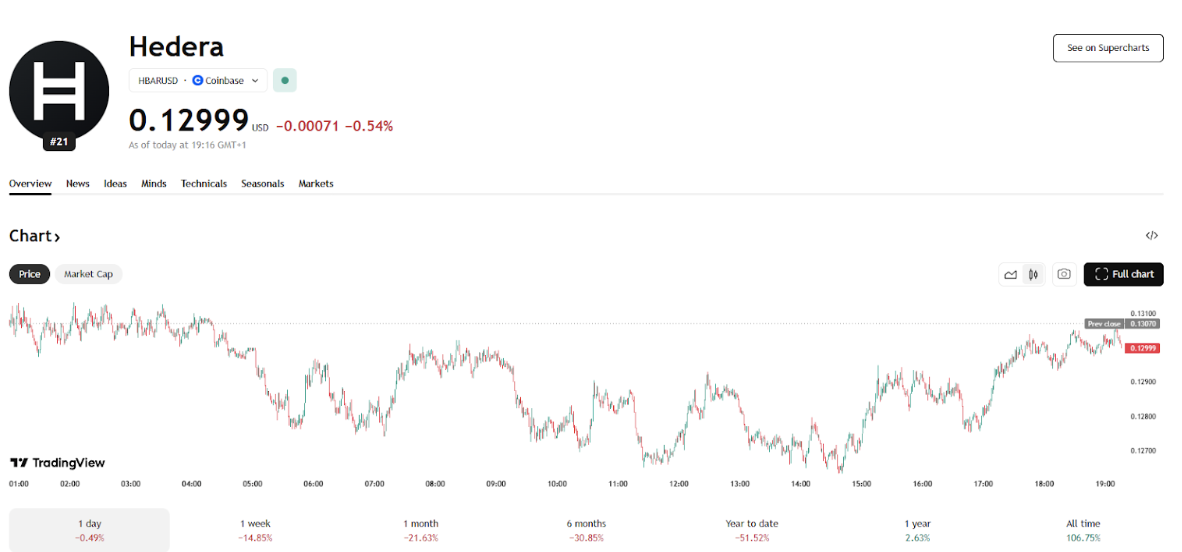
Hedera stands out as one of the most advanced networks in the cryptocurrency market. Its throughput capabilities, enterprise partnerships, and real-world integrations surpass those of most altcoins. Despite these strengths, the token's price action often fails to reflect its underlying value. After years of development, HBAR continues to trade around $0.1301. Market sentiment remains largely bearish, with 83% of sentiment indicators pointing downward, and the Fear & Greed Index registering at 11, indicating extreme fear. The project consistently improves, but the token's price movement remains subdued. This situation exemplifies the Hedera paradox: top-tier fundamentals are paired with a price chart that struggles to capture significant momentum.
HBAR Price Prediction 2025 – Mild Upside, No Breakout Signals
Current HBAR price prediction 2025 analyses suggest steady but limited growth, rather than explosive price increases. CoinCodex forecasts HBAR to reach $0.1751 by December 22, 2025, representing a +35.99% increase from its current price of $0.1301. However, this projection falls short of indicating a significant breakout. Short-term price projections fluctuate between $0.1288 and $0.1339, reflecting minimal momentum. Technical indicators are predominantly bearish; most Simple Moving Average (SMA) and Exponential Moving Average (EMA) timeframes signal a "SELL," while the Relative Strength Index (RSI) at 30.94 indicates weak buying pressure. Heading into 2025, Hedera continues to behave like a stable large-cap asset – reliable, but not engineered for rapid upward price movements.
HBAR Price Prediction 2030 – Strong Network, Slow Numbers
Examining the long-term outlook, the HBAR price prediction 2030 follows the same pattern: the network experiences steady growth, but the token's projected price remains modest. Extended forecasts indicate only gradual appreciation for HBAR's future price, with no signals of the aggressive upside often observed in smaller-cap assets. Hedera's supply structure and its enterprise-focused ecosystem tend to slow down retail-driven momentum. Furthermore, resistance levels at $0.1385, $0.1458, and $0.1536 continue to impede any sustained breakout. By 2030, HBAR is expected to be fundamentally stronger, but the price projections still suggest slow, controlled movement rather than exponential gains.
Will HBAR Move in the Next Bull Run?
Many investors seek an HBAR price prediction for the next bull run, but the available data consistently points towards cautious, moderate price action. Hedera's support levels, ranging from $0.1234 to $0.1082, remain firm. However, its resistance zones prove difficult to breach, even during periods of strong market sentiment. With 25 bearish indicators, weak momentum, and a price that reacts slowly to market shifts, HBAR is more likely to experience steady appreciation rather than explosive growth when the next bull cycle commences. It is a robust network, but not a high-velocity token designed for outsized returns.
Why Smart Traders Rotate Into Low-Caps When Heavy Tokens Stall
When large-cap tokens like HBAR exhibit slow price movement, traders often pivot to projects where early entry opportunities still hold significant value. Low-cap ecosystems provide this advantage because their price movement is primarily driven by growth mechanics rather than solely market sentiment. Noomez serves as a prime example of this strategy. Its architecture is built upon a five-arc progression system, where each arc governs the rollout of utility, the tightening of supply, and the entry of new demand into the ecosystem. This structure offers early buyers an advantage that heavy tokens cannot match: momentum generated by the project's internal roadmap, independent of external hype.
Noomez’s Engine Creates Built-In Acceleration – Something HBAR Can’t Replicate

What truly distinguishes Noomez from heavy assets like HBAR is how its presale economy amplifies its early stages. The Noom Gauge regulates progression by monitoring holder activity, triggered token burns, and liquidity flow. This mechanism makes each stage progressively harder to enter as demand increases. The 28-stage curve mechanically drives up the price. Stage 5 is already locked in a +23.02% climb from Stage 4, with 182 holders having contributed $40,935 so far. Noomez also incorporates unsold token burns, referral-driven expansion, and 6–12 month vesting periods, all of which apply pressure on the circulating supply. Combined with a 66% Annual Percentage Yield (APY) and a limited 250% BONUS250 multiplier, the token builds acceleration that is intrinsically coded into the presale economy itself.
Pro Tip: Look for tokens that strategically tighten their supply as they grow. Built-in scarcity tends to outperform speculative hype during volatile market cycles.