


The Digital Asset Market Clarity Act aims to define crypto regulation in the U.S., reduce uncertainty, and shape institutional access, ETFs, and market structure.
A recent CoinDesk report captures a familiar pattern in U.S. crypto policy: one headline claim sets off alarms, and the industry then scrambles to correct the record. After Coinbase’s CEO argued that a draft market-structure proposal would “effectively ban” tokenized stocks, several firms in the tokenization space pushed back. Executives from companies such as Securitize, Dinari, and Superstate countered that the current direction is not a kill switch for tokenized equities. Instead, they described it as a reaffirmation that tokenized stocks remain securities—and therefore should operate under existing securities rules rather than float in a regulatory gray zone.
That disagreement may sound technical, but it cuts straight to the real question: is Washington building a workable legal bridge between blockchains and capital markets, or simply re-labeling old constraints in new language? The debate also explains why the Digital Asset Market Clarity Act has become a constant reference point in institutional conversations. For many market participants, this bill is not just another “crypto headline.” It is a proposed framework that, if enacted, could reduce the single biggest barrier to broad institutional participation: uncertainty over which regulator governs which asset—and under what conditions.
This first article focuses on the Clarity Act itself: what it tries to define, why that definition matters, and where the bill sits in the legislative process today. A second piece will turn to the prediction market question—because there is, in fact, an active Polymarket contract tied to whether this exact bill becomes law by the end of 2026—and explore what signals would meaningfully shift the odds.
Why the Clarity Act is at the Center of the Institutional Conversation
Over the past few years, the U.S. has regulated large parts of crypto through enforcement and patchwork interpretations. That approach can punish bad actors, but it also leaves compliant institutions guessing. A fund, a broker, or a public company can live with volatility; what it cannot easily underwrite is ambiguity about whether an asset is a security today, a commodity tomorrow, or both depending on who you ask. As a result, many institutions have approached crypto with a narrow posture: they can buy Bitcoin with high confidence, but beyond that they often wait, limit exposure, or demand heavy discounts for legal risk.
This is where the Digital Asset Market Clarity Act is frequently positioned as a watershed. The argument is not that the bill would make crypto “risk-free.” Rather, it would make crypto legible to the existing U.S. compliance machine. If the rules are stable enough, institutions can price risk, build products, and allocate capital without fearing that the governing framework will flip mid-cycle.
Asset managers like Bitwise have repeatedly emphasized this point in their commentary: the highest-impact feature of a market-structure bill is not marketing-friendly language about innovation, but the practical reduction of uncertainty that blocks large pools of capital from stepping in. In other words, the Clarity Act is often treated as less of a “crypto bill” and more of a market-access bill.
What the Bill Tries to Do: A Three-Bucket Model
At a high level, supporters describe the Clarity Act as drawing clearer lines by categorizing crypto-related instruments into three broad buckets:
1) Digital Commodities (CFTC Oversight)
These are generally framed as assets that are sufficiently decentralized—meaning there is no single “core team” or centralized entity whose ongoing managerial efforts primarily determine the asset’s value. In this framing, the more an asset resembles a neutral, open network rather than a corporate fundraising vehicle, the more plausible it becomes to treat it like a commodity under CFTC jurisdiction.
Advocates often cite major networks such as Bitcoin—and sometimes Ethereum or Solana, depending on how decentralization is assessed—as the types of assets they believe could meet this threshold over time. That said, it is important to be precise: the act of calling something a “digital commodity” is not a vibe check. It is a legal conclusion that would hinge on definitions, standards, and—crucially—how the bill’s tests are implemented by regulators.
Still, the institutional relevance is obvious. If an asset is treated as a commodity in a clear statutory framework, the compliance perimeter becomes easier to map. Many market participants also link this clarity to the pace of spot ETF approvals, since product feasibility is deeply affected by whether an underlying asset is expected to be regulated as a commodity with a more straightforward market-oversight model, rather than as a security with more extensive issuer-style obligations.
2) Investment Contract Assets (SEC Oversight)
This category is commonly explained as covering tokens whose value is heavily dependent on the efforts of a specific team, foundation, or company—often associated with fundraising structures like ICOs or IEOs. Put bluntly, if a token’s economic story is “buy now because our team will build,” it starts to look like an investment contract.
In that case, the SEC’s role becomes central, and compliance expectations change dramatically. Disclosure, sales practices, exchange registration, broker-dealer requirements, and secondary trading constraints can all come into play. For institutions, that usually means higher friction, slower timelines, and a stronger preference for assets that can be clearly placed outside this bucket.
3) Payment Stablecoins
Stablecoins are often discussed as their own lane because their use case is closer to payments and settlement than capital formation. The Clarity Act’s three-bucket framing treats “payment stablecoins” as distinct from both digital commodities and investment contract assets. That distinction matters because stablecoins sit at the intersection of banking concerns, consumer protection, and systemic risk—areas where lawmakers tend to be far less willing to tolerate ambiguity.
Even if you disagree with the bill’s taxonomy, the intent is clear: the framework tries to make “who regulates what” less of a political argument and more of a defined process.
Why This Matters for Markets: Uncertainty is the Tax
Crypto markets tend to talk in narratives, but institutions talk in constraints. A portfolio manager can debate whether an asset is undervalued; the legal department debates whether holding it creates an unbounded regulatory tail risk. In the U.S., that tail risk has been one of the biggest reasons capital has concentrated in Bitcoin rather than dispersing across the broader market.
So when industry research frames the Clarity Act as “the most important legal framework of the second half of 2025,” it is essentially saying: this is the proposal that could determine whether the next wave of institutional adoption remains Bitcoin-centric or broadens into a wider set of networks.
That is also why the token classification question becomes tied—sometimes too casually—to spot ETF expectations. Market participants often interpret the “digital commodity” bucket as a potential fast track to institutional-grade products, while the “investment contract asset” bucket implies a more complex path.
Of course, reality is rarely that clean. Even a commodity classification does not automatically guarantee easy product approval; conversely, security classification does not necessarily mean an asset is “uninvestable.” But clarity changes the default posture. It turns a hard “no” into a structured “maybe,” which is often enough to unlock experimentation at scale.
The Tokenized Stocks Controversy: Why “Still a Security” is a Flashpoint
The CoinDesk dispute over tokenized equities illustrates how different parts of the industry want clarity for different reasons.
Tokenization-focused firms that have been building regulated pathways—often working with broker-dealers, transfer agents, and securities law constraints—tend to argue that reaffirming tokenized stocks as securities is not a ban. From their perspective, it is the opposite: it is an invitation to integrate blockchains into traditional market plumbing in a way that regulators can accept. They are effectively saying, “We can make tokenization work, but it has to fit the existing securities perimeter.”
Coinbase’s concern, as presented in the public debate, is more about functional outcomes than labels. If the practical effect of the draft language is that tokenized stocks must comply with every layer of the traditional securities stack, then tokenized equities may struggle to achieve the speed, composability, and broad distribution that crypto-native platforms envision. In that sense, calling something “not banned” may miss the point: if the compliance path is so heavy that few can operate at scale, the outcome can feel like a de facto prohibition even without an explicit ban.
This is why the issue keeps reappearing. It is not just a question of what tokenized stocks “are.” It is a question of what kind of market lawmakers want tokenization to become: a regulated extension of today’s securities system, or a new crypto-like market structure with lighter rails.
How a Bill Becomes Law: The Practical Steps That Matter
To understand why prediction markets can swing on seemingly small headlines, it helps to walk through the standard U.S. legislative path. In simplified form, a bill must typically clear the following stages:
Introduction and Referral
A bill is introduced in either the House or Senate and then referred to the relevant committees with jurisdiction.
Committee Process (Hearings, Drafting, and Markup)
Committees may hold hearings, negotiate amendments, and then conduct a markup—a formal session where members debate, revise, and vote on whether to advance the bill.
Committee Vote to Report the Bill to the Full Chamber
If the committee approves it, the bill is “reported” out of committee to be scheduled for a floor vote.
Floor Consideration and Vote
The full House or Senate debates and votes. Amendments can still happen here, and political dynamics can shift quickly.
Reconciling House and Senate Versions
If both chambers pass different versions, they must align the text—either through a conference process or other coordination mechanisms.
Final Passage and Presidential Signature
Once both chambers pass the same text, it goes to the President to be signed into law (or vetoed).
This sequence sounds procedural, but it is where most bills die: in committee bottlenecks, in scheduling delays, or in the reconciliation gap between chambers.
Where the Clarity Act Stands Now: Passed the House, Stalled in the Senate
Based on the information you provided and the public reporting around the recent delay, the Clarity Act’s situation can be described plainly:
- •It has already passed the House of Representatives.
- •It is now in the Senate, where it has been referred to the relevant committee process.
- •The immediate next critical step—committee markup and advancement—has faced delays, especially after Coinbase’s shift in posture and the political friction that followed.
In other words, the bill has crossed one major gate (the House) but remains at the most failure-prone gate (the Senate committee stage). This is also why the market narrative you described—“committee review in January, with a realistic path to a second-half outcome”—exists at all. People are not inventing drama; they are reacting to the calendar math. Once committee momentum slips, everything compresses, and the bill becomes more vulnerable to election-year politics, competing legislative priorities, and fatigue from stakeholders who do not want to keep renegotiating the same text.
At the same time, it would be a mistake to treat a delay as a death sentence. U.S. financial legislation often moves in bursts: long stretches of negotiation punctuated by sudden progress when the last group of holdouts is satisfied—or when a political bargain makes the trade-offs tolerable.
Why a Prediction Market Has Formed Around It—and Why That Matters
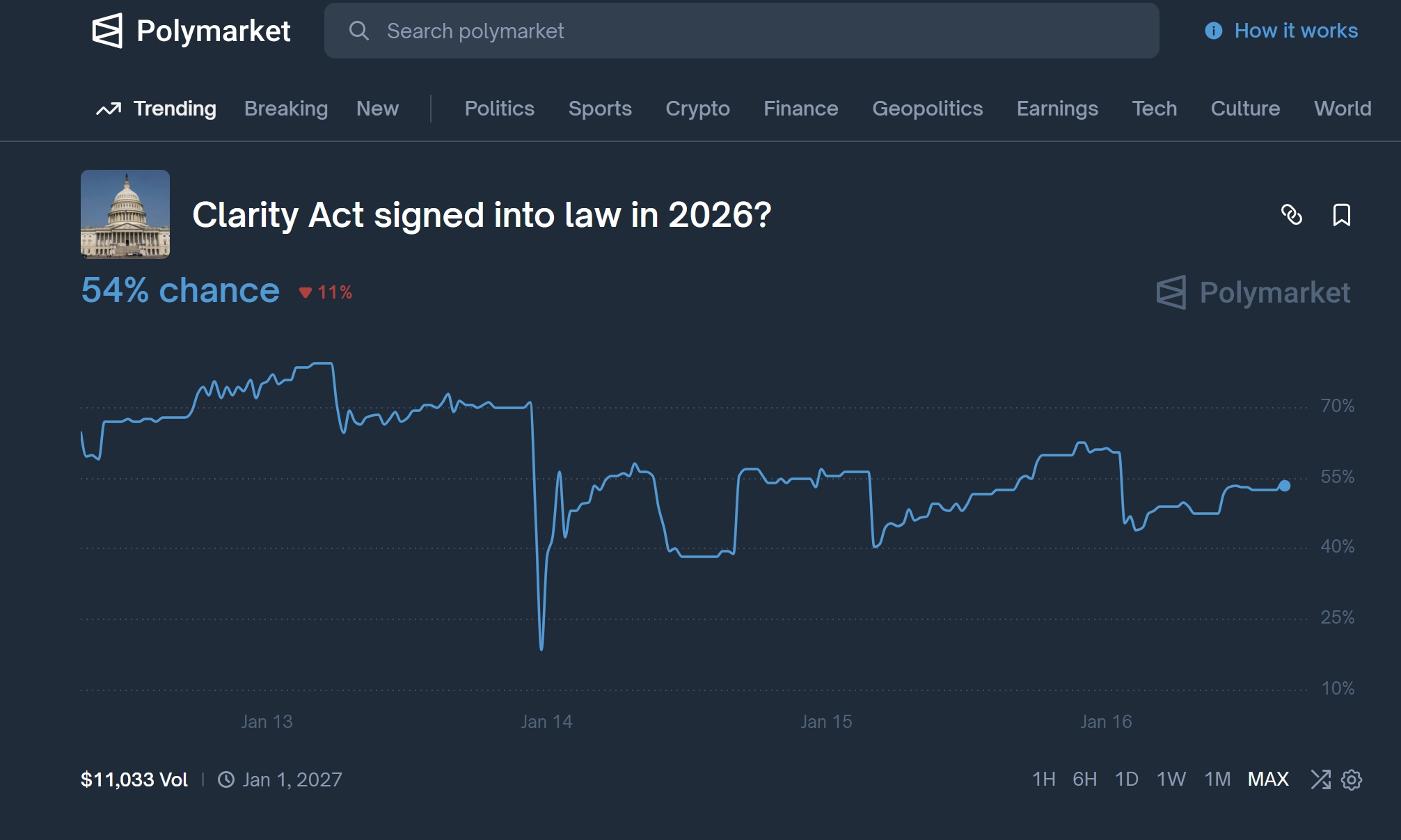
One reason this bill has become such a live market narrative is that the question is now explicitly tradable. Polymarket lists a contract tied to whether the Digital Asset Market Clarity Act of 2025 (H.R. 3633) becomes law by the end of 2026. That matters because prediction markets force a kind of brutal clarity: not “is regulation improving,” but “will this specific bill, with this specific identifier, be passed by both chambers and signed by the President by a fixed deadline.”
This distinction is important, and it is exactly why a second article is necessary. A bill can “have momentum” in the press and still fail the contract’s resolution criteria. Conversely, a bill can look stuck and then suddenly advance if committee leadership reschedules markup and the amendment package becomes acceptable to enough votes.
For now, the point is simply this: the Clarity Act has become the reference frame for institutional expectations because it tries to define the asset categories that shape everything downstream—ETF feasibility, exchange compliance, issuer obligations, and the pace at which capital can move beyond Bitcoin and into a broader set of networks. Whether it succeeds is still an open question. But the fact that the market is now pricing that question, in real time, tells you how much is riding on the answer.
In the next piece, we’ll treat the Polymarket contract as the anchor: what the resolution rules imply, what milestones would materially change the odds, and how to think about the market impact if 2026 begins to look like a genuine path to passage rather than another round of delay.