


Key Insights
- •The U.S. dollar has weakened due to expectations of Federal Reserve rate cuts.
- •This weakening dollar may lead to increased capital inflows into cryptocurrency markets.
- •Historical data suggests a correlation between Federal Reserve rate cuts and surges in cryptocurrency prices.
Federal Reserve Signals Potential December Rate Cuts
The U.S. dollar has experienced a decline, reaching a five-week low. This weakening is attributed to disappointing economic data and growing expectations that the Federal Reserve may implement interest rate cuts in December. A weakened dollar typically stimulates interest in cryptocurrencies, potentially influencing investment trends in Bitcoin and Ethereum amidst anticipated looser monetary policy.
The Federal Reserve's indications towards potential rate cuts, influenced by weaker U.S. employment and services data, have prompted the dollar's decline. Federal Reserve Chair Jerome H. Powell's announcement suggests a possibility of rate reductions to the 3.75%-4.0% range, which could impact the overall economic outlook. As Jerome H. Powell stated, "The Federal Reserve is committed to assessing economic conditions and adjusting policy as necessary to support maximum employment and stable prices."
While most crypto industry leaders have remained silent on this development, historical precedents indicate an increased demand for digital assets in similar economic contexts. The market is currently adjusting to potential liquidity shifts that could impact Bitcoin (BTC) and Ethereum (ETH).
Rate Cuts Historically Boost Bitcoin Prices
Historically, periods of Federal Reserve rate cuts have often coincided with significant price increases for Bitcoin. This pattern reflects a trend of investors moving towards digital assets in search of higher potential returns.
Bitcoin (BTC) is currently trading at $93,395.10 with a market capitalization of $1.86 trillion. Recent data shows a 0.42% increase over the past 24 hours and a 2.17% rise over the last week. Despite these short-term gains, longer-term trends indicate a 10.58% drop over the past 30 days. Bitcoin's circulating supply is reported to be near its maximum limit of 21 million.
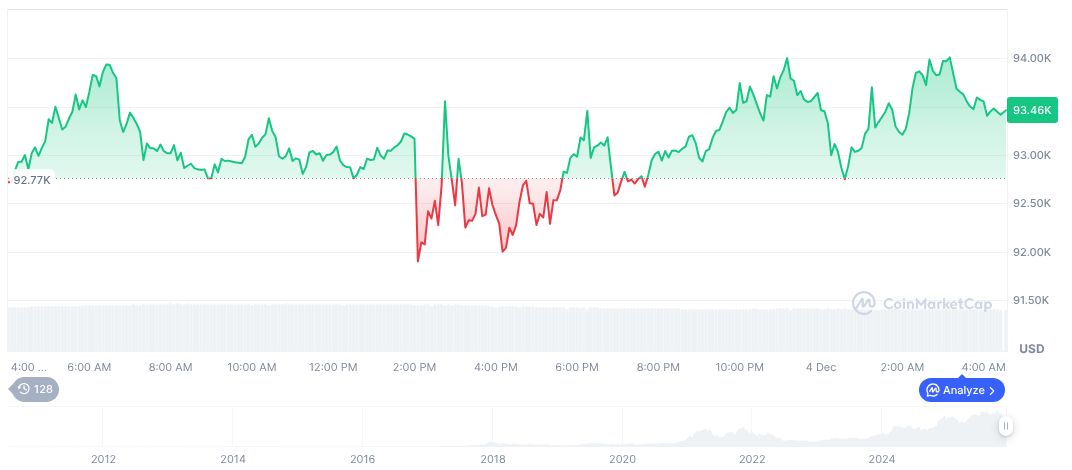
Insights suggest a potential increase in cryptocurrency investments, aligning with anticipated regulatory and monetary policy changes. Historical data demonstrates that cryptocurrencies frequently respond positively during periods of interest rate cuts, showcasing increased adoption and usage of decentralized technologies. The market will closely monitor Federal Reserve decisions and their subsequent impact on crypto assets.