


A Sudden Shift in Leadership Prospects
In mid-January 2026, the succession race for the next chair of the U.S. Federal Reserve entered a markedly different phase after public comments from Donald Trump cast doubt on the candidacy of Kevin Hassett, long viewed by many observers as a leading contender. This triggered an immediate repricing in market expectations that elevated Kevin Warsh to the front of the field, with market-implied probabilities for his appointment rising to roughly 60% according to derivatives-based and prediction-market indicators tracked by global trading desks.
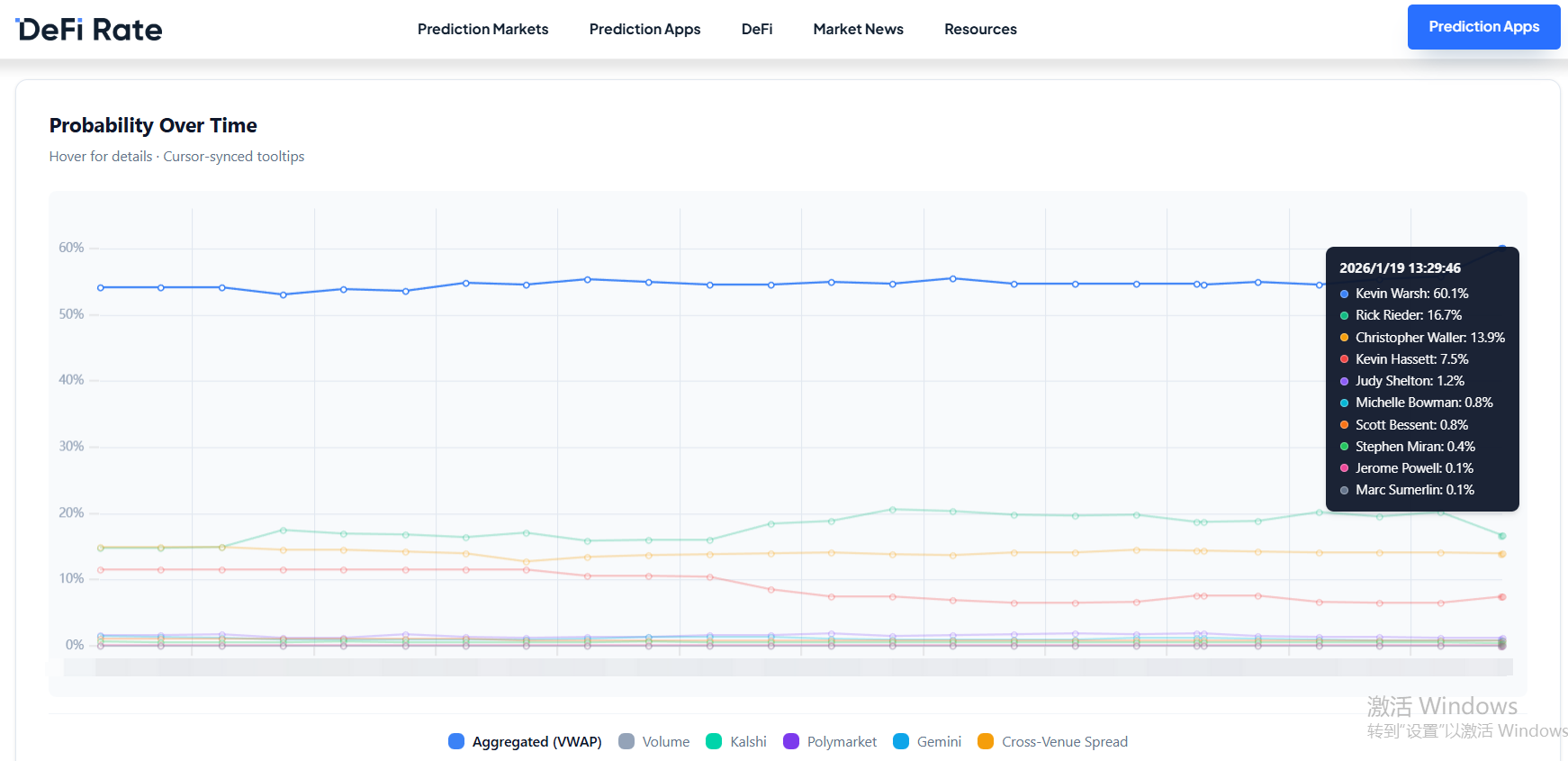
The catalyst was not a formal nomination or withdrawal, but rather Trump’s explicit hesitation about moving Hassett from his role as director of the National Economic Council, arguing that such a shift would deprive the administration of a highly influential economic voice at a politically sensitive moment. This statement was interpreted by investors as a strong signal rather than mere rhetorical ambiguity.
Understanding Kevin Warsh's Profile
Kevin Warsh is not an unknown quantity to markets. A former member of the Board of Governors of the Federal Reserve from 2006 to 2011, he played a visible role during the 2008 global financial crisis. He frequently aligned himself with concerns over long-term inflation risk, balance-sheet expansion, and the erosion of central-bank independence. These positions have earned him a reputation as structurally more hawkish than many recent Fed leaders.
Since leaving the Fed, Warsh has remained an active commentator on monetary policy. He has often argued in speeches and op-eds that prolonged accommodation risks distorting capital allocation and undermining the credibility of inflation-targeting frameworks. These views stand in contrast to the more flexible, labor-market-centric approach that has characterized the post-pandemic Federal Reserve.
Reasons for the Shift in Probabilities
The sharp rise in Warsh’s implied odds reflects less a sudden endorsement and more a reassessment of political constraints. With Hassett’s odds reportedly falling to the mid-teens immediately after Trump’s remarks, traders effectively repriced the race to favor a candidate who satisfies two simultaneous criteria: ideological alignment with the administration’s emphasis on inflation vigilance and institutional credibility with markets wary of overt political interference in monetary policy.
Warsh’s profile fits that intersection more cleanly than many alternatives, allowing markets to assign higher probability to his confirmation even in the absence of formal signals from the Senate or the White House. This illustrates how expectation-setting in monetary policy leadership often begins well before official announcements.
Macroeconomic Context of the Shift
The timing of this shift matters. The latest U.S. inflation data showed core inflation rising 0.2% month-on-month in December, below consensus expectations of 0.3%. While this figure on its own might have supported a more dovish policy outlook, it now sits uneasily alongside rising geopolitical risk, renewed trade tensions, and growing fiscal uncertainty. These factors complicate the policy calculus for the next Fed chair.
In this environment, markets are increasingly sensitive not only to near-term rate decisions but also to the strategic posture of the central bank over the next cycle. This includes how aggressively it would respond to a resurgence of inflation or how willing it would be to tolerate economic slowdown in defense of price stability.
Market Implications of a Warsh Chairmanship
The possibility of a Warsh-led Federal Reserve has already begun to subtly influence market pricing. U.S. Treasury yields at the long end have shown signs of firming, reflecting expectations that a more hawkish chair could place greater emphasis on inflation risk premia. Rate-cut expectations embedded in futures markets have become marginally less aggressive, suggesting that investors are recalibrating the path of policy normalization rather than abandoning it outright.
Equity markets, meanwhile, face a more complex signal. While policy credibility and inflation discipline are generally supportive of long-term valuation stability, the prospect of tighter financial conditions under a hawkish chair can compress multiples in the short run. This is particularly true for rate-sensitive growth sectors that have benefited most from the post-crisis era of abundant liquidity.
Impact on Crypto and Risk Assets
For crypto markets, leadership uncertainty at the Federal Reserve adds another layer to an already volatile macro backdrop. A chair perceived as less tolerant of inflation overshoots and balance-sheet expansion would likely reinforce the narrative of structurally tighter dollar liquidity. This condition historically pressures speculative excess but can, paradoxically, strengthen the appeal of fixed-supply assets like Bitcoin over longer horizons if monetary restraint coincides with fiscal expansion or geopolitical stress.
This duality helps explain why crypto prices often react unevenly to central-bank developments. Short-term liquidity expectations drive volatility, while longer-term narratives around monetary credibility and currency debasement shape strategic allocation.
The Significance of Institutional Signaling
Beyond immediate market moves, the Warsh repricing underscores how much weight investors place on institutional signaling. Central-bank leadership is not merely a personnel decision; it is a statement about policy philosophy, tolerance for risk, and the boundaries between political authority and monetary independence. All of these factors feed directly into expectations across rates, currencies, equities, and alternative assets.
The fact that probabilities shifted so dramatically on the basis of a single political statement highlights the fragility of consensus in an environment where credibility, rather than formal guidance, often anchors expectations.
Concluding Thoughts
The surge in Kevin Warsh’s perceived likelihood of becoming the next Federal Reserve chair reflects a broader re-evaluation of political realities and macro risks rather than a definitive outcome. Nevertheless, it has already begun to reshape market expectations around inflation discipline, rate trajectories, and institutional independence. This serves as a reminder to investors that in periods of transition, leadership signals can matter as much as data, and sometimes far more than official decisions themselves.