



Key Developments in Digital Asset Regulation
Federal Reserve Vice Chairman Philip Jefferson reaffirmed the institution's neutral stance on cryptocurrencies, emphasizing that the regulation of digital assets primarily rests with the private sector, while the Federal Reserve's focus remains on ensuring banking safety and soundness.
This approach from the Fed is intended to support financial innovation by reducing compliance uncertainties within the digital asset markets. It reflects a broader regulatory shift aimed at accommodating emerging technologies within established risk management frameworks.
Fed's Neutrality Spurs Crypto and Stablecoin Market Dynamics
Federal Reserve Vice Chairman Philip Jefferson's recent statements indicate a reaffirmation of the institution's neutral approach towards digital assets, emphasizing the role of innovation within the U.S. financial system. This announcement follows significant regulatory adjustments made by the Fed, FDIC, and OCC, intended to foster a more innovation-supportive environment while maintaining a safety framework within banking practices.
Regulatory adjustments include the rescinding of restrictive guidance, such as the 2023 supervisory letter from the Fed, which now allows banks to proceed with crypto-related activities without prior notification. Additionally, the introduction of the GENIUS Act marks a pivotal step towards comprehensive federal regulation of stablecoins, which legislators believe will enhance market confidence and provide a consistent regulatory environment. Stakeholders such as national banks and fintech institutions may see more aligned compliance expectations, ultimately supporting broader digital asset adoption.
Market reactions have been varied, but largely constructive. Experts have noted the potential for increased stablecoin issuance and liquidity in U.S. markets as banking rails for crypto become more reliable. The sentiment within the industry suggests that reduced compliance uncertainty could foster further innovation and expand market participation. Official statements highlight a strategic alignment in works, with the U.S. poised to navigate the evolving landscape of digital finance cautiously.
GENIUS Act and ETH Performance Reflect Regulatory Shifts
Did you know? The GENIUS Act is the first federal stablecoin regulation, signed in July 2025, reflecting a significant shift towards policy alignment and innovation in the U.S. digital asset framework.
Ethereum (ETH) currently trades at $3,124.57 with a market cap of 377,124,289,781.58. Despite recent declines—19.21% in 30 days—the 24-hour trading volume soared by 74.78%, reaching 38,533,112,067.75 according to data from CoinMarketCap as of November 17, 2025.
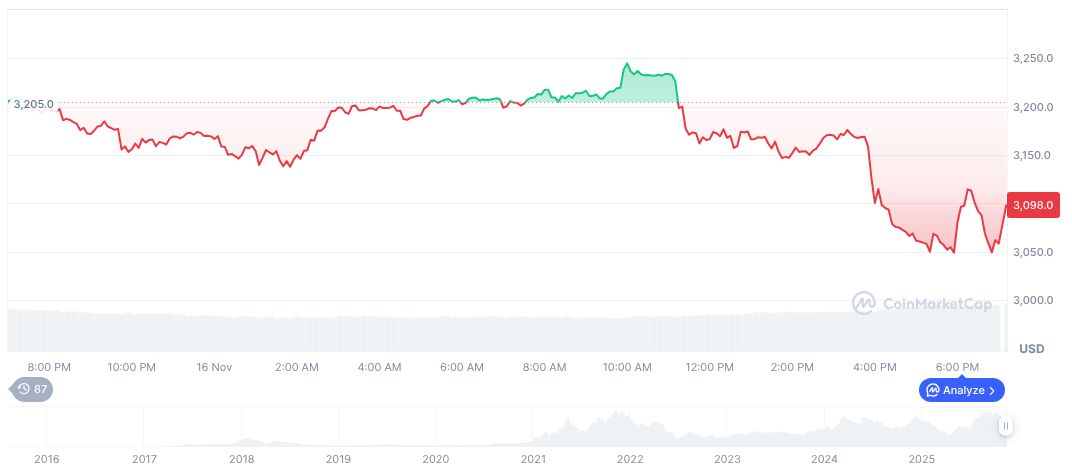
Insights from Coincu's research team suggest that these regulatory changes could lower compliance barriers for DeFi protocols and Layer 1/2 assets, potentially increasing Total Value Locked (TVL) and liquidity in decentralized financial markets nationwide, supporting U.S.-based fintech growth.