


DOJ Investigation and Federal Reserve Autonomy
On January 16, White House National Economic Council Director Hassett downplayed a federal investigation into Federal Reserve Chair Jerome Powell, following concerns over renovation cost overruns at Fed headquarters.
This investigation highlights tensions surrounding Fed independence and interest rate policy, with potential impacts on financial stability and broader government oversight of economic institutions.
The investigation's focus is not only on Chair Jerome Powell’s congressional testimony regarding renovations but also on broader issues concerning Fed policy. Kevin Hassett expressed confidence in a smooth resolution, while Powell maintains the subpoenas threaten the Fed’s independence, allegedly serving as a pretext for rate manipulation.
Changes arising from this event center primarily on the transparency of operational financing at the Federal Reserve. The DOJ’s involvement has prompted increased scrutiny, potentially reshaping how the central bank discloses financial operations. Major policy shifts hinge on maintaining or challenging the Fed’s autonomy, impacting future financial governance.
"The threat of criminal charges is a consequence of the Federal Reserve setting interest rates based on our best assessment of what will serve the public, rather than following the preferences of the President." - Jerome Powell, Chair, Federal Reserve.
Market Sentiment and Historical Context
In 1951, the Fed-Treasury Accord marked a significant precedent in Fed independence, establishing its autonomy from government fiscal policies—a historical note echoed in today's Powell inquiry.
Bitcoin currently trades at $95,417.28 with a market capitalization of $1.91 trillion. Dominating the market at 59.08%, Bitcoin’s trading volume reached $45.92 billion, reflecting a 23.12% decline over 24 hours. Recent movements show a 5.33% 7-day price increase following a 9.46% rise over 30 days.
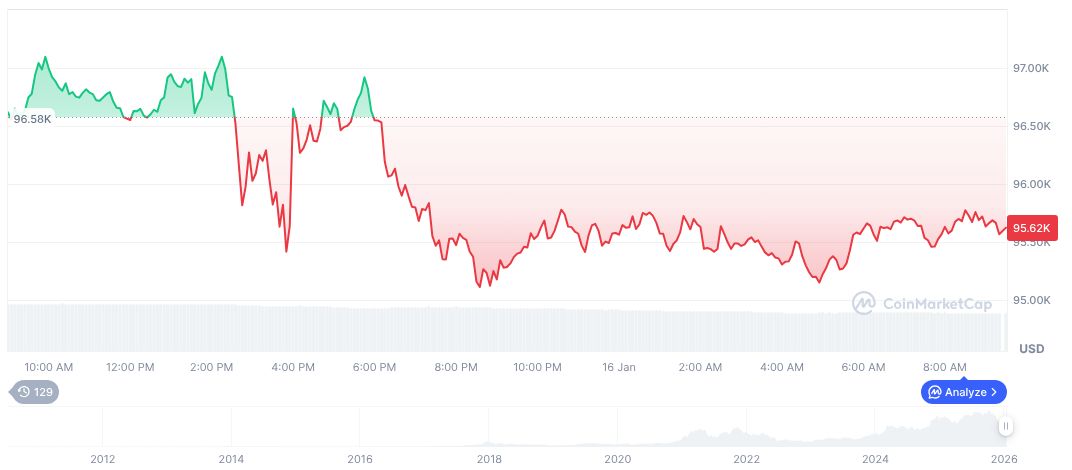
Coincu research analysts suggest potential implications on financial and regulatory practices should a shift occur in the Federal Reserve's dynamic. A historical reluctance to alter the Fed's core autonomy points to possible resiliency against regulatory pressures, underscoring its foundational robust structure.