



Key Takeaways
- •Ethereum's Fusaka upgrade implemented EIP-7918, changing fee dynamics.
- •The upgrade is expected to significantly increase ETH burning rates.
- •This impacts Layer 2 economics, promoting sustainable growth.
Eric Yaohua, founder of Liquid Capital, has shared critical details regarding Ethereum's Fusaka upgrade, specifically noting a substantial increase in blob base fees following the implementation of EIP-7918.
This upgrade recalibrates Ethereum's fee structure, which in turn affects ETH supply dynamics and Layer 2 protocols. A notable consequence is the potential for significantly increased ETH burn rates.
Ethereum Fusaka Upgrade Reshapes Blob Fee Dynamics
The Ethereum Fusaka upgrade, which included EIP-7918, was implemented on December 5th, fundamentally altering the blob fee structure. Eric Yaohua of Liquid Capital explained that this upgrade transitions blob fees from being nearly free to a market-driven mechanism. This change is anticipated to have a considerable impact on Ethereum's fee and burn structure, which are vital components of the ecosystem's overall dynamics.
Analysis suggests that while the Fusaka upgrade introduces additional challenges for Layer 2 economics, it also provides necessary adjustments to Ethereum's throughput and pricing. This strategic move is designed to bolster the protocol's sustainable growth and ensure that ETH validators can capture greater economic value.
Eric Yaohua, Founder of Liquid Capital, highlighted that "Fusaka’s EIP-7918 introduces a blob 'base fee' anchored to L1 execution gas, lifting blob prices from effectively 1 wei to a floor tied to actual network costs."
Potential Boosts to Ethereum Price and Validator Revenues
The Fusaka upgrade has the potential to escalate ETH burning rates significantly, possibly up to eightfold. This could account for 30-50% of the total ETH burn by 2026, contributing to increased ETH scarcity.
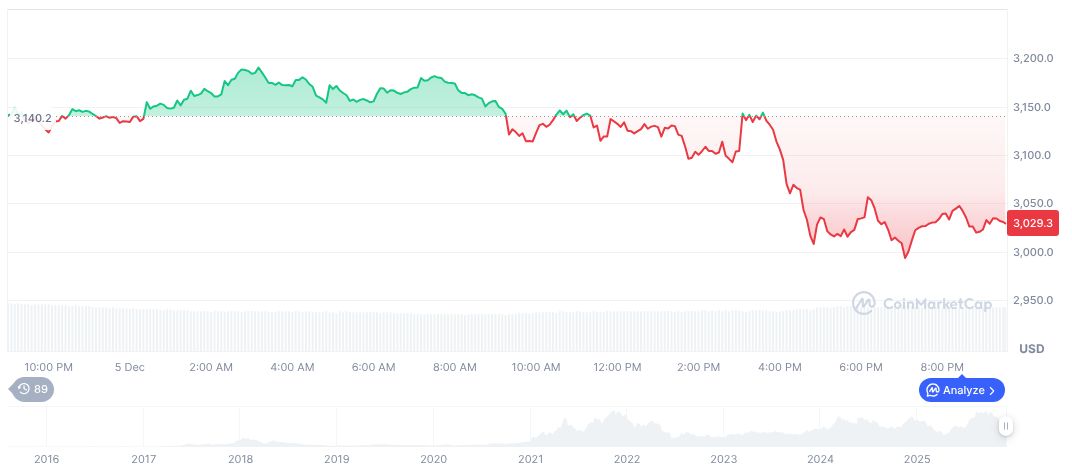
Current market data indicates Ethereum (ETH) is priced at $3,019.41, with a market capitalization of $364.43 billion, representing 12.01% of the overall crypto market. Recent price movements have shown notable fluctuations, including a 3.33% decrease in the past 24 hours and a significant 35.68% drop over the last 60 days. Trading volume has also seen a decline of 6.01% in the last day, suggesting a period of market caution. These figures illustrate the inherent volatility and momentum within the Ethereum ecosystem.
Further analysis suggests that the Fusaka upgrade, despite placing additional strain on Layer 2 economics, offers crucial corrections to Ethereum's throughput and pricing mechanisms. This initiative aims to enhance the protocol's sustainable growth and improve the economic value captured by ETH validators.