



The Ethereum price experienced a 3% increase in the last 24 hours, trading at $3,160 as of 3:52 a.m. This surge was accompanied by a 165% rise in trading volume, reaching $26.3 billion.
The uptick in ETH's price coincides with a new proposal by Vitalik Buterin for an on-chain futures market for gas fees. This innovative market would enable users to lock in transaction costs for future periods, mitigating the uncertainty associated with fluctuating network congestion.
We need a good trustless onchain gas futures market.
(Like, a prediction market on the BASEFEE)
I've heard people ask: "today fees are low, but what about in 2 years? You say they'll stay low because of increasing gaslimit from BAL + ePBS + later ZK-EVM, but do I believe you?"…
— vitalik.eth (@VitalikButerin) December 6, 2025
The core objective of this proposal is to enhance the stability and transparency of gas prices for traders, developers, and institutional investors.
Under the proposed model, high-volume users would have the ability to purchase contracts that secure a predetermined base fee for blockspace in advance. This mechanism draws parallels to how futures contracts for commodities like oil or grain operate in traditional finance. Proponents suggest this could transform gas fees into a more predictable operational cost.
This predictability may serve as a significant incentive for larger enterprises and decentralized finance (DeFi) protocols to develop and scale their operations on Ethereum, with reduced apprehension regarding sudden spikes in transaction fees.
The average Ethereum fees have generally trended lower throughout 2025, although they have exhibited continued volatility. Currently, basic transfers incur costs of approximately one cent, while more complex transactions can range from a few cents to under a dollar.
Buterin posits that a futures market would not only equip users with a tool to hedge against this volatility but also provide clear indicators of long-term expectations for network fees.
Ethereum Price Signals Rising Confidence
On-chain data indicates that the Ethereum network continues to sustain steady activity, and gas fees remain relatively low when compared to previous bull market periods. Analytics platforms report that average transaction fees this year have fluctuated between approximately $0.18 at their lowest points and around $2.60 at their highs, before recently settling closer to $0.30.
Concurrently, the availability of cheaper and more predictable fees has contributed to the sustained health of DeFi, NFT, and layer-2 activities. Many traders and application users are dynamically shifting between the mainnet and various rollups based on factors such as cost and transaction speed.
The potential future capability to lock in gas prices could further bolster this trend by simplifying the planning process for protocols undertaking major launches, token distributions, or experiencing periods of heavy trading, without the concern of unexpected fee increases.
Exchange data also suggests a trend of ETH moving from centralized platforms into self-custody or staking arrangements. This pattern is often associated with a longer-term holding strategy rather than short-term speculative selling.
Ethereum Consolidates Below Resistance At Key Fib Accumulation Zone
Ethereum price is currently trading around the $3,160 mark. Following a rebound from late-November lows near $2,700, it now sits below both the 50-day and 200-day simple moving averages. These key moving averages are clustered just above the current price, within the $3,350–$3,550 range.
This price zone, in conjunction with a descending resistance line originating from the March peak, forms a significant overhead barrier that bullish sentiment must overcome to signal a more robust uptrend.
The Fibonacci retracement levels, calculated from the cycle low of approximately $1,378 to the recent high of nearly $4,957, show the price hovering just above the 0.5–0.618 zone of the prior rally. This suggests that this region is currently acting as a medium-term accumulation band.
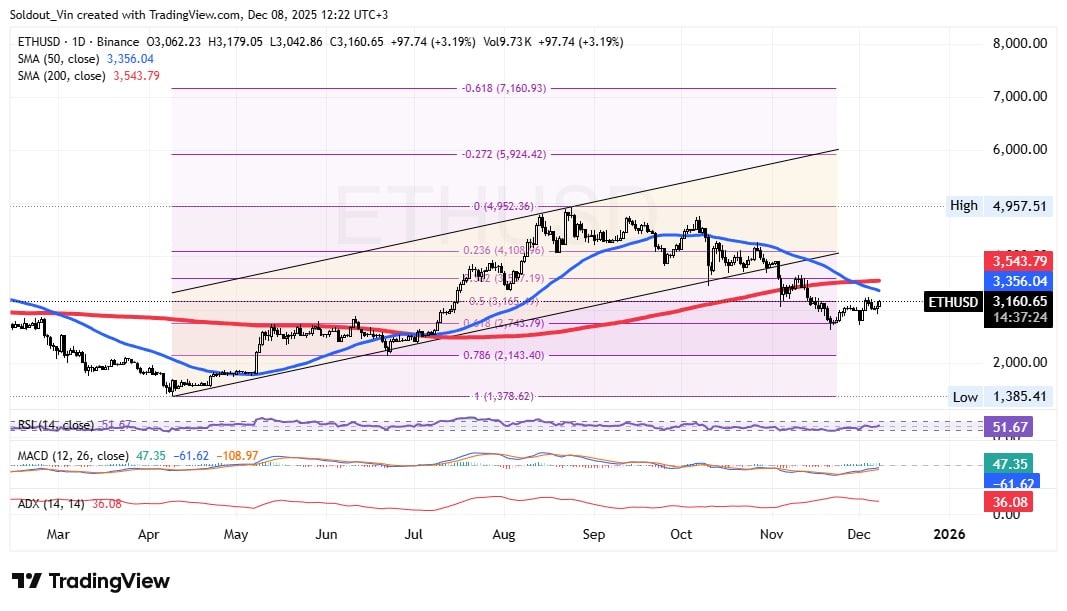
Should buyers successfully drive ETH above the 50-day SMA, currently near $3,356, and subsequently reclaim the 200-day SMA around $3,544, the path would then be cleared for a potential move towards the mid-channel resistance zone near $3,950, and subsequently towards the prior high area around $4,950.
The daily Relative Strength Index (RSI) is positioned just above 50, indicating that the recent 3% price increase has slightly shifted momentum back in favor of the bulls without pushing the market into overbought territory.
The Moving Average Convergence Divergence (MACD) line is attempting to cross upwards from negative territory. If this crossover is confirmed, it would lend support to the argument for a gradual trend reversal. Meanwhile, the Average Directional Index (ADX), currently around the mid-30s, suggests that a new directional move may be gaining strength.
Key Supports Hold as Bulls Target $3,500–$4,000
In the immediate term, significant support is identified around the $3,000 level, where recent consolidation and a minor horizontal price level align. This is followed by stronger backing around the $2,740 mark, situated near the lower boundary of the ascending channel and the 0.618 Fibonacci region.
As long as the ETH price maintains its position above this support band, any dips may attract renewed buying interest. Investors may view the gas futures proposal and ongoing network enhancements as compelling reasons to position themselves for a potential resurgence towards $3,500 and possibly $4,000 in the coming weeks.