



Ethereum has significantly expanded its base-layer block capacity by 33%, increasing the block gas allowance to 60 million. This marks the network's most substantial base-layer expansion since 2021 and was implemented through validator coordination, avoiding a hard fork. The upgrade comes just ahead of the planned Fusaka upgrade in December, which is expected to introduce further performance enhancements.
This increase in block gas allowance is made feasible by client improvements, such as EIP-7623, which act as safeguards. These improvements prevent the need for node operators to acquire higher-end hardware, ensuring the network's stability and accessibility.
Just a year after the community started pushing for higher gas limits, Ethereum is now running with a 60M block gas limit.
That’s a 2× increase in a single year — and it’s only the beginning.
H/t to all client teams, the researchers involved, and to @nanexcool and @econoar for… pic.twitter.com/5JB8FoiACP
— Toni Wahrstätter ⟠ (@nero_eth) November 26, 2025
Layer-2 Activity Reaches Unprecedented Highs
The timing of Ethereum's block capacity expansion coincides with a notable surge in Layer-2 (L2) network activity. The collective throughput of L2 networks has recently surpassed 31,000 transactions per second (TPS). This highlights a significant shift of execution activity off the mainnet.
Among the L2 solutions, Lighter, a ZK rollup focused on perpetual trading, has emerged as a top performer, achieving over 5,400 TPS. Other rollups, including Base, have also contributed consistent transaction volume. Developers emphasize that while L2s are effectively managing transaction loads, the enhanced capacity of Ethereum's base layer now provides greater comfort for settling proofs and state updates without leading to congestion.
Traders Eye Charts as Technical Posture Improves
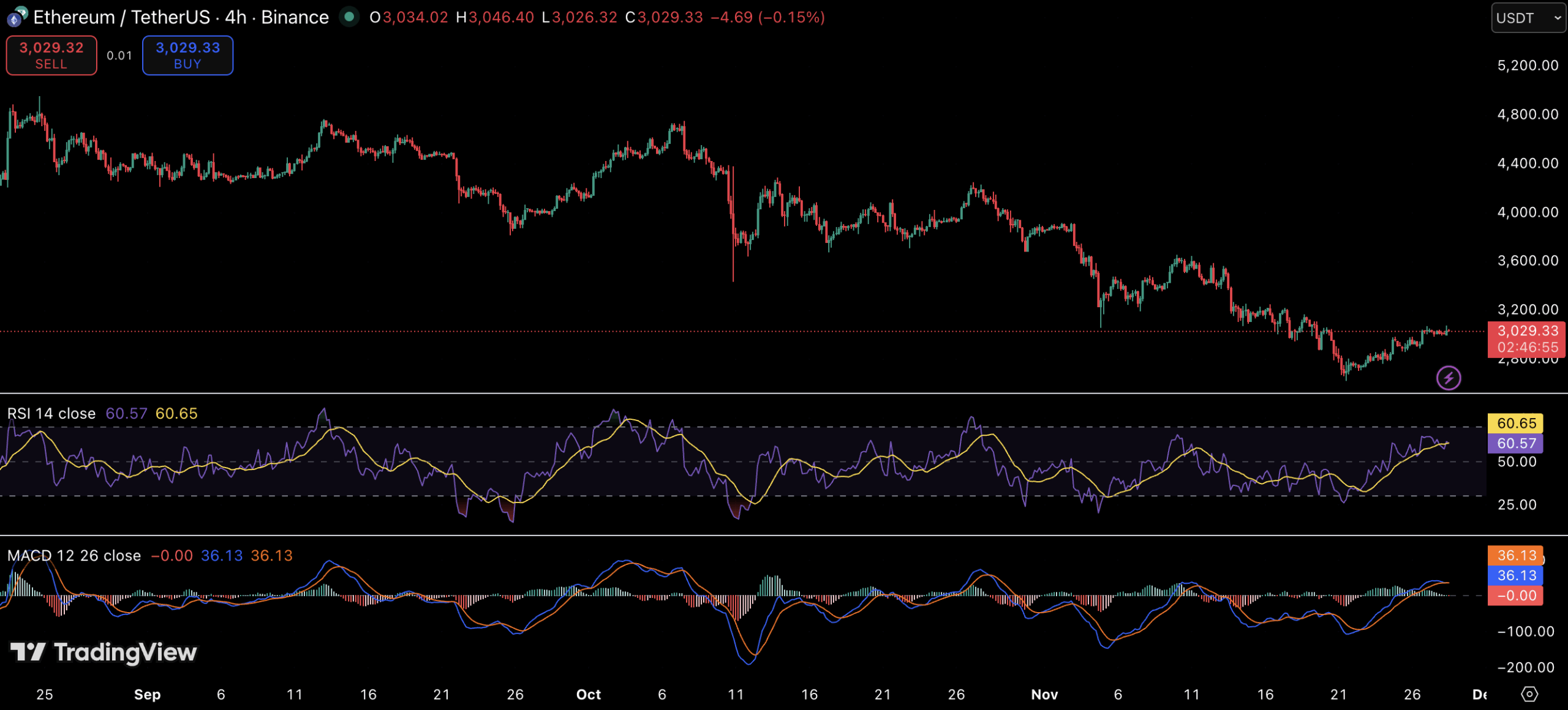
The market's reaction to these developments has been calm yet constructive. Ethereum is currently trading around the $3,029 mark. Emerging on-chain and chart data indicates improving underlying trends.
- •The Relative Strength Index (RSI) on the 4-hour timeframe has risen to the low 60s. This suggests increasing bullish momentum without entering an overheated territory.
- •The Moving Average Convergence Divergence (MACD) indicator shows a positive cross, which is gradually widening. Traders commonly interpret this structure as a sign of trend continuation rather than a temporary relief bounce.
Market analyst Michaël van de Poppe has observed that Ethereum's price is currently situated within what he terms a "favorable demand zone." He suggests that ETH may be poised for its next upward movement, provided that current support levels are maintained.
$ETH looks primed for the next leg upwards. pic.twitter.com/efZBu1FywG
— Michaël van de Poppe (@CryptoMichNL) November 28, 2025
What Comes Next
The upcoming weeks are anticipated to be influenced by two key factors. Firstly, the technical implementation of the Fusaka upgrade and subsequent fine-tuning of the network. Secondly, price action will determine whether the current bullish momentum continues or stalls.
If Ethereum manages to hold above its current support levels while network activity continues to grow, analysts expect market confidence to solidify around the scaling roadmap. This approach is seen as a departure from the speculative rallies that characterized earlier market cycles.