


Increased Blockspace for Enhanced Scalability
Ethereum has significantly increased its block gas limit from 45 million to 60 million, a move implemented just days before the upcoming Fusaka hard fork. This expansion of blockspace is designed to accommodate more transactions, rollup data, and higher overall network activity. Developers have prepared the base layer for increased loads, with a substantial number of validators signaling their support for the change. This enhancement to blockspace capacity is a foundational step towards the deeper scalability improvements anticipated with the Fusaka upgrade.
Preparing the Network for Higher Throughput
The block gas limit dictates the computational capacity within each block, thereby influencing the number of transactions and smart contract operations that validators can include. The recent increase effectively expands blockspace, providing the Ethereum network with greater throughput headroom, especially during periods of peak demand.
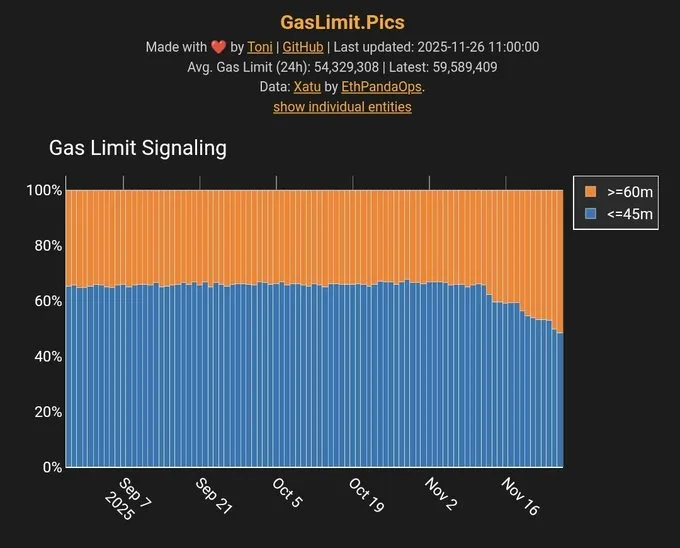
Validators activated the new 60 million gas limit threshold through Ethereum’s established gas-limit drift mechanism. This process allows validators to signal their readiness for changes without necessitating a formal hard fork. Once a majority of the network expressed support, the higher limit became operational. This transition saw the participation of over 513,000 validators, reflecting widespread technical preparedness across the ecosystem.
Throughout the past year, the Ethereum community actively engaged in the "Pump The Gas" initiative. This collaborative effort aimed to increase throughput safely, enhance network efficiency, and prepare validators for managing larger blocks. The initiative involved extensive experimentation and testing on test networks to determine the practical limits of the system.
The successful implementation of this gas limit increase was facilitated by three key improvements. EIP-7623 introduced crucial protections that were instrumental in enabling the processing of larger blocks. Concurrently, client teams upgraded their node software to reduce block propagation times.
The consistent performance observed on testnet environments bolstered developers' confidence in the mainnet rollout. These engineering advancements demonstrate the power of collaborative efforts in pushing system limits without negatively impacting user experience. Ethereum Foundation researcher Toni Wahrstätter noted that the network has effectively doubled its block capacity within the last year, signaling the beginning of a prolonged phase of execution-layer improvements.
Fusaka Upgrade and PeerDAS Driving the Next Scaling Phase
The elevated gas limit is a precursor to the Fusaka upgrade, which is slated for December 3. A significant feature of Fusaka is the introduction of PeerDAS, a novel system for data availability sampling. PeerDAS is engineered to streamline the efficient and reliable publication of data by rollups, a critical function as an increasing number of applications migrate to Layer-2 solutions. Fusaka has already undergone multiple testnet deployments, and a $2 million audit contest has been initiated to enhance review coverage and encourage comprehensive testing.
In addition to PeerDAS, the Fusaka upgrade incorporates client refinements, consensus adjustments, and various security enhancements. These updates are designed to optimize Ethereum’s core systems for its next phase of scaling. Vitalik Buterin commented on the gas limit increase, observing that a network's capacity can continuously expand, but only through very incremental changes.
Buterin also suggested that increasing the costs associated with certain resource-intensive activities, such as complex contract operations and specific precompiles, could effectively reduce their frequency. This strategy aims to boost overall system throughput while maintaining network health. This perspective raises a fundamental question for both developers and users: how can Ethereum scale effectively without introducing new performance bottlenecks?
Facilitating Rollup Growth with Expanded Blockspace
The augmentation of the gas limit has a direct and positive impact on the relationship between rollups and the Ethereum mainnet. The increased blockspace not only provides rollups with more room to publish data and settle transactions but also mitigates congestion during periods of high rollup activity, leading to improved transaction finality for users. Furthermore, this expansion supports the development of more sophisticated rollup designs that require frequent settlements or the handling of larger data batches.
With the advent of the Fusaka era, Ethereum is poised to enter a new phase characterized by enhanced scalability and a stronger focus on rollups. The recent increase in the gas limit represents a crucial initial step in this direction, preparing the network for the more substantial transformations scheduled for December and the future.