


Ethereum, one of the most prominent blockchain networks, is on the cusp of a significant transformation with its upcoming Fusaka upgrade. Scheduled to go live on December 3, 2025, this highly anticipated update is designed by its builders to enhance network speed and reduce costs for Layer-2 solutions. This development has sparked considerable interest among traders regarding its potential to influence the price of ETH.
The core question on many minds is: what exactly does the Fusaka Upgrade entail, and how will it reshape the Ethereum landscape?
Understanding the Ethereum Fusaka Upgrade
The Fusaka upgrade represents Ethereum's next major network evolution. A key innovation within this upgrade is Peer Data Availability Sampling (PeerDAS). This feature allows validators to verify blockchain data by sampling only small portions, rather than downloading the entire dataset. Consequently, PeerDAS is projected to decrease validator bandwidth and data load by as much as 85%, thereby lowering the technical requirements and cost associated with operating nodes.
1/ The Fusaka upgrade is coming December 3rd.
— Ethereum (@ethereum) December 1, 2025
Ethereum is securely scaling.
Are you ready to support the changes?
Here’s what developers across the ecosystem need to do to prepare 🧵 pic.twitter.com/aHArhmJWnX
Furthermore, Fusaka will increase Ethereum's block gas limit, raising it from approximately 36 million to 60 million. This expansion means that each block will have the capacity to accommodate a substantially larger volume of transactions. In essence, the Fusaka upgrade is engineered to make Ethereum faster, more cost-effective, and better equipped to handle the growing demands of its users and developers.
Benefits of the Fusaka Upgrade for the Ethereum Network
The Fusaka upgrade is poised to introduce several critical improvements that will bolster the Ethereum ecosystem.
Firstly, it is expected to significantly reduce costs for Layer-2 networks, including Arbitrum, Optimism, and Base. This reduction is achieved by expanding the storage capacity for "blobs" and decreasing the expense of posting data. Industry developers anticipate that transaction costs on these Layer-2 solutions could decrease by 40% to 60%, making applications built on Ethereum more affordable for end-users.
Secondly, the enhanced network capacity will lead to reduced congestion during peak activity periods, allowing for more transactions without triggering sharp increases in gas prices.
Thirdly, the implementation of PeerDAS will alleviate the need for validators to maintain extensive storage and bandwidth, thereby lowering the barrier to entry for running a node.
Finally, by improving speed, scalability, and cost efficiency, Fusaka will enhance Ethereum's appeal to developers working on decentralized finance (DeFi), gaming, and real-world asset applications, fostering long-term growth across the entire ecosystem.
Potential Impact of the Upgrade on the ETH Token Price
The anticipated technical enhancements from the Fusaka upgrade are widely expected to provide a supportive foundation for ETH's price in the coming months. An increase in Layer-2 network usage, potentially ranging from 30% to 50%, could lead to higher network fees, increased demand for staking, and a reduction in selling pressure.
However, crypto trader TED has cautioned that ETH has already dipped below its critical support zone, which lies between $2,800 and $2,850. If the token fails to reclaim this level in the near future, it might see a decline towards the next significant support area near $2,500, where buyer interest is expected to re-emerge.
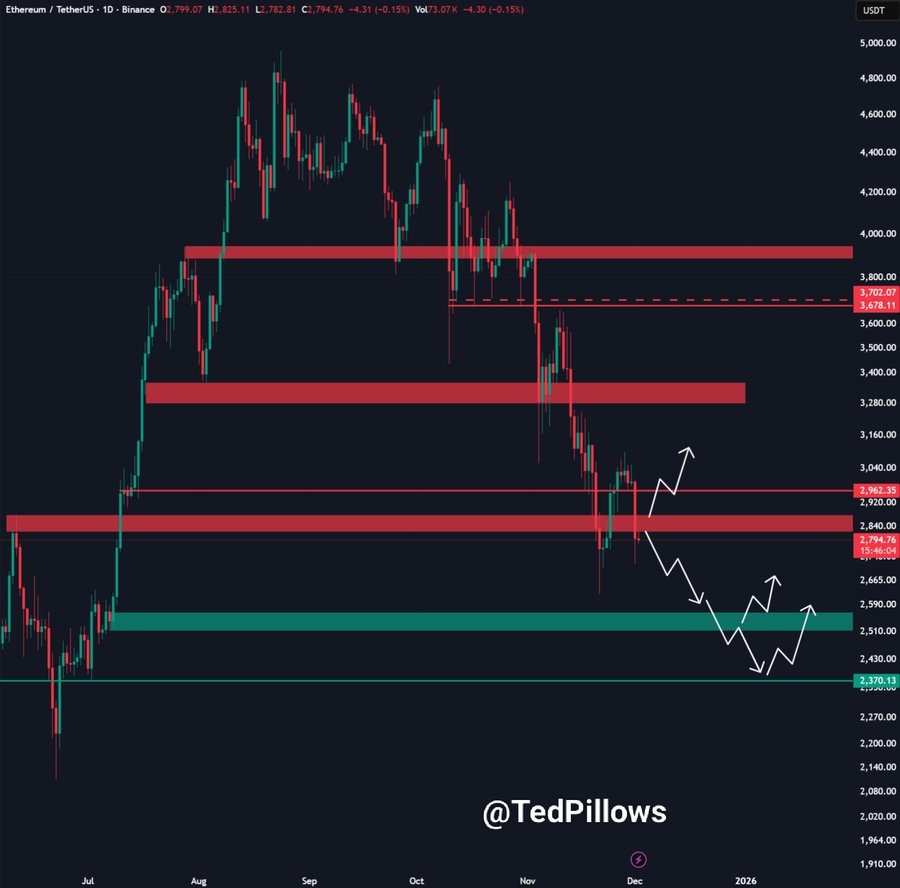
Conversely, a successful recovery above $2,800 could propel ETH back above the $3,000 mark, particularly if the upgrade stimulates robust activity on Layer-2 networks. A significant post-upgrade surge might even enable ETH to retest the $3,500 price region.