



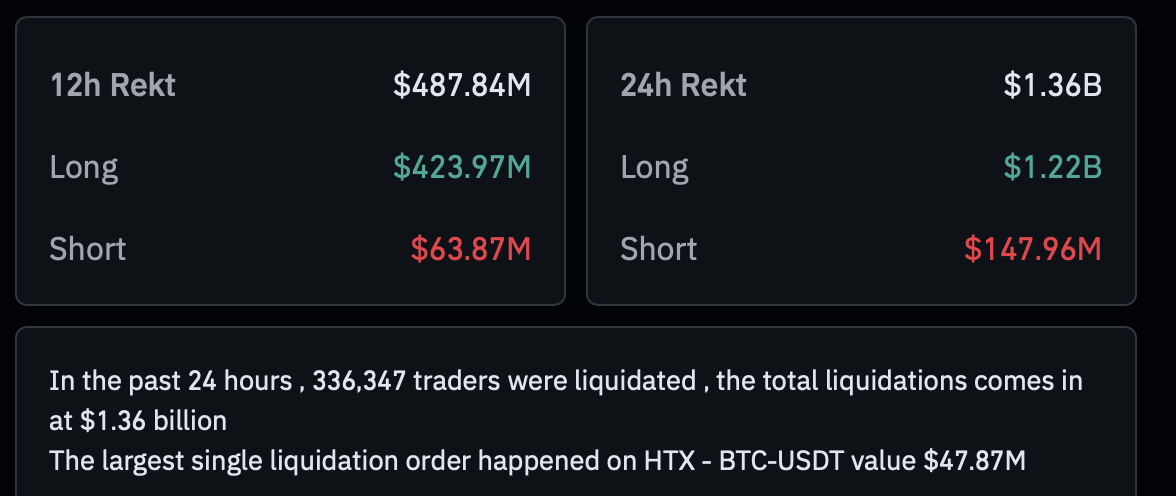
Ethereum (ETH) experienced a significant downturn, falling below the $3,500 mark early Tuesday. The cryptocurrency shed 5.9% of its value over the preceding 24 hours, driven by a wave of liquidations and macroeconomic headwinds that have rippled across the broader cryptocurrency market. This decline occurred as over $1.36 billion in leveraged positions were liquidated within the last 24 hours, with Coinglass data indicating that $1.22 billion of this total comprised long positions.
Macroeconomic Factors Intensify Selling Pressure
The recent market downturn followed hawkish remarks made by Federal Reserve Chair Jerome Powell on November 3. These statements dampened expectations for a potential interest rate cut in December. The subsequent strengthening of the U.S. dollar triggered a broad sell-off across risk assets, impacting major cryptocurrencies such as Bitcoin, which fell below $104,000, and Ethereum, which dropped to $3,496.

Investor sentiment has deteriorated significantly, as evidenced by the Crypto Fear & Greed Index sliding to a reading of 27, categorized as "Extreme Fear." This indicates widespread risk aversion within the market. Ethereum's 24-hour trading volume surged by 63.7% to $55.7 billion, suggesting accelerated exit activity rather than accumulation.
Analysts caution that a U.S. Consumer Price Index (CPI) report that proves hotter than expected on November 7 could further extend the losses. Such a report would intensify inflation fears, potentially delaying the Federal Reserve's easing cycle and reducing liquidity inflows into digital assets.
DeFi Security Incidents Exacerbate Market Weakness
Ethereum's decentralized finance (DeFi) sector faced significant challenges this week. A $128 million exploit on Balancer and a $93 million loss at Stream Finance have shaken investor confidence, highlighting ongoing vulnerabilities within DeFi infrastructure. Following the exploit, Balancer's total value locked (TVL) saw a substantial collapse, falling from $442 million to $214 million.
These security breaches have reignited concerns about smart contract security and the centralization of validators, particularly as developers work to deploy emergency patches. The emergency hard fork being implemented by Berachain to address related vulnerabilities is being closely monitored as a potential blueprint for other DeFi protocols facing similar risks.
A previous analysis highlighted the potential for significant liquidations across altcoins, warning of a brutal market downturn. This context is crucial for understanding the current pressures impacting Ethereum and the broader crypto market.
Liquidation Cascade Fuels the Decline
The broader market sell-off was amplified by a cascading effect of leveraged liquidations, impacting over 336,000 traders within a 24-hour period. The single largest liquidation recorded was on HTX, involving the BTC-USDT pair, valued at $47.87 million. Ethereum long positions constituted a significant portion of these liquidations, contributing to further downward momentum as traders were automatically liquidated at progressively lower price levels.
Market Outlook
With the market structure exhibiting technical breakdowns and macroeconomic sentiment continuing to deteriorate, analysts anticipate sustained volatility through mid-November. Ethereum is currently facing key support levels around $3,420, with resistance identified at $3,650.
Unless upcoming CPI data indicates a moderation in inflation pressures, Ethereum may remain under considerable selling pressure. This situation underscores the rapid erosion of confidence that can occur when macroeconomic uncertainty, DeFi instability, and leveraged trading positions converge.