


The Future of Currency and Bitcoin's Role
Elon Musk, in a recent podcast discussion, articulated a vision where traditional currency will eventually become obsolete as humanity's material needs are increasingly met. He posited that energy will emerge as the ultimate standard of value in such a future.
This perspective has significant implications for Bitcoin, which is increasingly being viewed as an energy-backed digital asset. This perception is influencing investor sentiment and the broader cryptocurrency markets, amidst ongoing speculation about value and economic paradigms.
Musk's Argument for Energy as the True Currency
Elon Musk stated that "currency will become obsolete" as energy's prominence grows. He elaborated that Bitcoin exemplifies an energy-backed asset, distinguishing it from fiat currencies by its reliance on energy consumption rather than governmental control. This fundamental difference, Musk suggests, makes Bitcoin inherently resistant to inflation, as governments can print money but not energy.
Musk's emphasis on energy as an economic bedrock positions Bitcoin as a potentially resilient store of value and an effective hedge against inflation. This narrative has fostered positive sentiment within cryptocurrency markets, attracting renewed interest from institutional investors who see Bitcoin as a stable asset in an unpredictable economic climate.
"Energy remains the true currency, and Bitcoin reflects that idea. Governments can print money, but they cannot print energy. This creates a natural barrier strengthening Bitcoin’s foundation."
Elon Musk, CEO, Tesla and SpaceX
In the wake of Musk's remarks, Bitcoin has experienced heightened attention and increased institutional interest, leading to greater market activity. However, skepticism persists, with figures like Peter Schiff continuing to label Bitcoin a "fake asset" as debates surrounding its legitimacy continue. Social media platforms have become hubs for extensive discussions regarding the future implications of Bitcoin being recognized as an energy-based currency.
Bitcoin's Market Trajectory Amidst the Energy Narrative
The conceptual link between energy and monetary systems, highlighted by Musk, draws upon historical economic theories that recognize the deep interrelation between energy resources and monetary frameworks. This perspective underscores the value dynamics within macroeconomic contexts and offers a historical lens through which to view modern digital assets.
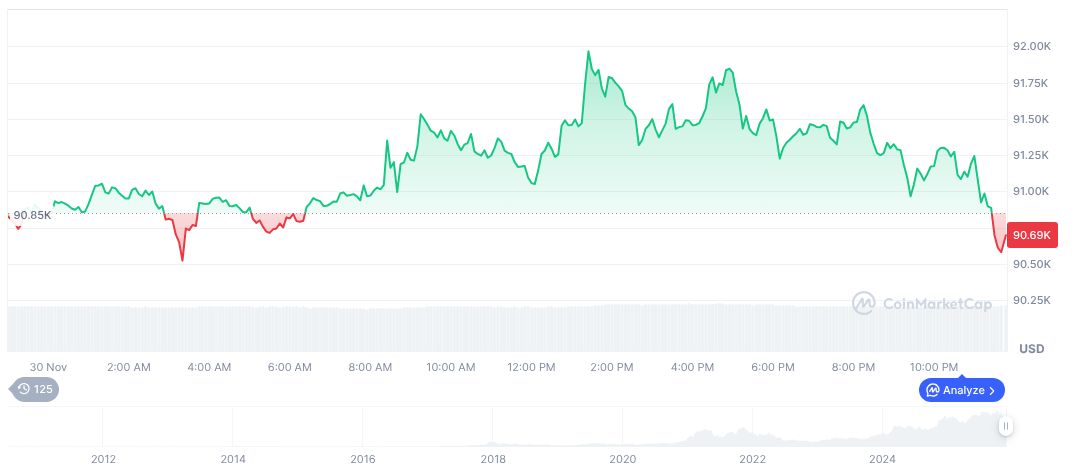
As of December 1, Bitcoin was trading at $86,458.96, with a market capitalization of $1.73 trillion USD, representing a market dominance of 58.78%. The 24-hour trading volume reached $53.42 billion. The asset's price movements are closely watched, particularly in light of Musk's energy-centric narrative, within the context of a volatile cryptocurrency market.
Research from Coincu suggests that Musk's vision could lead to increased utilization and integration of Bitcoin into mainstream financial portfolios. This trend aligns with ongoing regulatory discussions concerning cryptocurrency valuation, which may be influenced by Bitcoin's unique association with energy. Such developments could significantly shape future frameworks for digital asset adoption.