


AllUnity’s EURAU stablecoin is expanding its reach across several major blockchains. The token is backed by the euro and developed by Deutsche Bank and asset manager DWS. It now operates using Chainlink’s Cross-Chain Interoperability Protocol (CCIP) for seamless connectivity. This development enhances EURAU’s position in Europe’s growing regulated digital finance market.
EURAU Stablecoin Expands to Multiple Blockchains
On Thursday, AllUnity announced that the EURAU stablecoin will operate on Ethereum, Arbitrum, Base, Optimism, Polygon, and Solana. The company also plans to extend the stablecoin to the Canton Network, a blockchain built for institutional finance.
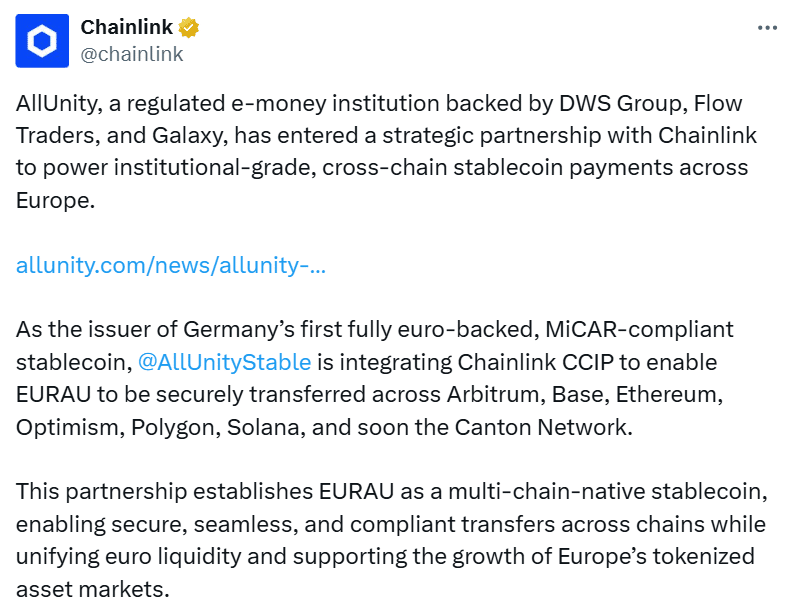
CEO Alexander Höptner stated that CCIP will allow EURAU to move smoothly between networks, making the token easier to use for businesses and developers. Chainlink Labs executive Fernando Vazquez added that the integration sets the foundation for the next stage of tokenized finance in Europe.
EURAU Stablecoin Gains Multi-Chain Reach
With Chainlink CCIP, the EURAU stablecoin becomes a cross-chain digital euro, connecting with multiple blockchains while maintaining its compliance. The system enables secure transfers of tokens and data between different chains. This helps EURAU serve as a bridge for users needing stable, euro-based payments and settlements. The new expansion also means lower barriers for enterprise adoption, allowing companies to send and receive EURAU across several blockchains.
Regulatory Compliance Under MiCA
The EURAU stablecoin adheres to the European Union’s Markets in Crypto-Assets Regulation, known as MiCA. This framework ensures that stablecoins are transparent and fully backed by reserves. AllUnity obtained its license from Germany’s financial regulator, BaFin, in July. MiCA compliance makes EURAU a trusted asset for banks, asset managers, and businesses, distinguishing it from unregulated alternatives that face more risk and scrutiny.
The Institutions Behind AllUnity
AllUnity is a partnership between two major German financial institutions: Deutsche Bank and DWS Group. They combined their resources to create a regulated digital asset platform. DWS manages over one trillion euros in assets, and Deutsche Bank’s balance sheet exceeds 1.6 trillion euros. Their involvement provides EURAU stablecoin with strong backing, blending traditional banking stability with blockchain innovation to support AllUnity’s goal of bringing regulated finance onto decentralized networks.
Chainlink’s Cross-Chain Protocol
Chainlink’s CCIP enables smart contracts on one blockchain to interact with another, acting as a communication bridge for data, tokens, and messages. For the EURAU stablecoin, this means smooth and secure transfers across chains. CCIP also helps reduce risks associated with multi-chain transactions by offering protection against hacks and errors through a decentralized oracle system. This increases confidence for institutions exploring blockchain-based settlements.
Strengthening Europe’s Tokenized Economy
The EURAU stablecoin is part of a broader movement in Europe’s financial system focused on tokenization—the process of turning real-world assets into blockchain-based tokens. Its approach aligns with this shift by providing a regulated euro asset that functions across multiple blockchains. This expansion helps Europe close the gap with other regions leading in digital finance, promoting blockchain use in payments, treasury, and settlement systems while remaining within legal frameworks.
The Future of EURAU Stablecoin
AllUnity plans to continue expanding the EURAU stablecoin's network, with the Canton Network being the next planned step. This network focuses on enterprise-grade applications and aims to support regulated institutions. With its multi-chain presence, EURAU has the potential to become a foundational element for euro liquidity in decentralized finance. The token also offers a model for how traditional banks can safely and effectively adopt blockchain technology.
Conclusion
The launch of the EURAU stablecoin across multiple blockchains marks a significant development for Europe’s digital asset market. The collaboration between Deutsche Bank, DWS, and Chainlink effectively merges traditional finance with modern blockchain tools. The EURAU stablecoin now stands as a regulated, interoperable, and practical digital euro, demonstrating how compliance, technology, and finance can converge to shape the future of tokenized money in Europe.
Appendix: Glossary of Key Terms
EURAU Stablecoin – A euro-backed digital token issued by AllUnity for regulated blockchain transactions.
AllUnity – A joint venture between Deutsche Bank and DWS responsible for developing and managing EURAU.
Chainlink CCIP – A protocol that allows secure interoperability and data exchange between different blockchains.
MiCA Regulation – The European Union’s framework governing crypto-assets and stablecoins to ensure transparency and compliance.
BaFin – Germany’s Federal Financial Supervisory Authority, responsible for financial licensing and oversight.
Canton Network – A blockchain network focused on institutional and financial applications.
Tokenization – The process of converting real-world or digital assets into blockchain-based tokens.
Frequently Asked Questions EURAU stablecoin
1- What is EURAU stablecoin?
EURAU is a euro-backed digital token developed by AllUnity, a joint venture between Deutsche Bank and DWS.
2- How is EURAU stablecoin regulated?
It is fully compliant with the Markets in Crypto-Assets Regulation (MiCA) and licensed by Germany’s BaFin.
3- Which blockchains support EURAU stablecoin?
It connects Ethereum, Arbitrum, Base, Optimism, Polygon, and Solana, with plans for Canton Network.
4- What does Chainlink CCIP do?
Chainlink’s CCIP lets EURAU move securely between different blockchains, improving usability and safety.