



Impact of Delayed US Payroll Data on Federal Reserve Decisions
Deutsche Bank analysts are raising concerns about the delayed September US nonfarm payroll report, noting its potential to influence the Federal Reserve's decisions in December. The delay in this crucial economic data point could significantly affect market sentiment and the trajectory of cryptocurrencies like Bitcoin and Ethereum, primarily due to potential shifts in U.S. monetary policy.
Deutsche Bank's Analysis of Payroll Data Delays
Deutsche Bank analysts have voiced apprehension regarding the delayed release of the September US nonfarm payroll report. While typically, outdated data might have a minimal market impact, this specific situation is considered different. Market expectations for the Federal Reserve's rate decision in December may well depend on these forthcoming numbers. The potential implications of weaker-than-expected employment data could lead to notable shifts in financial markets. Given that employment growth rates are already at low levels, analysts believe that any discernible weakness in the report could prompt the Fed to consider a rate cut, thereby intensifying focus among financial stakeholders.
Matthew Luzzetti, US Chief Economist at Deutsche Bank, stated, "The delay in labor market data may not only breed uncertainty but could prompt the Fed to reconsider its rate-cut timeline, potentially affecting broader market confidence."
Market reactions have been varied, but there is a discernible increase in the emphasis placed on the importance of this data. As of the current moment, no significant official reactions or statements from prominent market figures have emerged. This scenario is being closely monitored by both investors and policymakers.
Historical Impact of Delayed Payrolls on Market Volatility
Historically, delays in US macroeconomic data, such as those experienced during government shutdowns, have led to heightened market volatility once the data was eventually released. This volatility often impacted economic forecasts and subsequent rate decisions. The current situation with the delayed September nonfarm payroll report could follow a similar pattern, creating uncertainty and potential price swings in financial markets.
As of November 20th, Bitcoin (BTC) was trading at $91,751.15, with a market capitalization of $1.83 trillion and holding a market dominance of 58.60%. The trading volume was reported at $83.58 billion, marking a 15.48% change over the past 24 hours. Over the last 90 days, BTC prices have seen a decrease of 18.53%. The circulating supply stands at 19,950,600 coins out of a maximum supply of 21,000,000 coins.
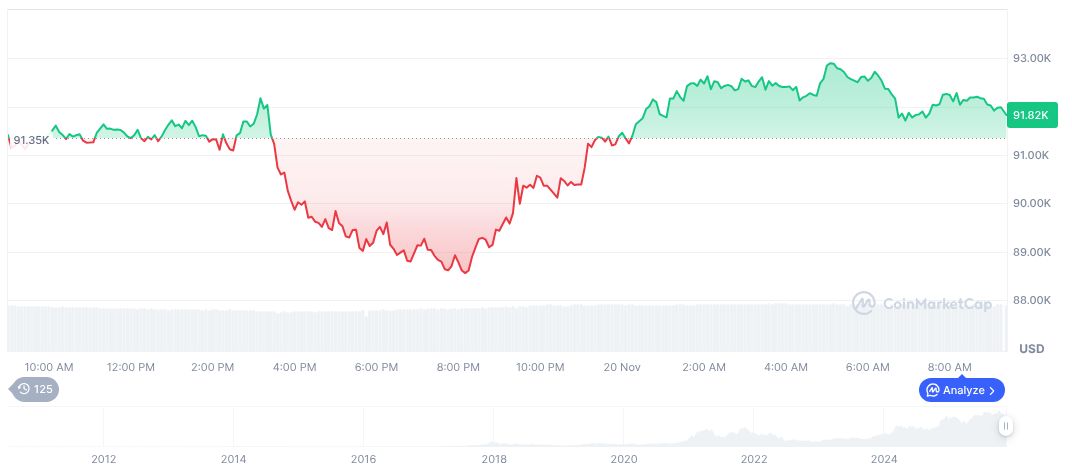
Researchers suggest that economic events, such as delayed payroll reports, possess the capacity to influence both regulatory actions and investment strategies. Historical trends consistently underscore volatile reactions within crypto markets, notably affecting Bitcoin (BTC) and Ethereum (ETH), when macroeconomic uncertainties loom. These events can trigger significant price movements as investors adjust their positions based on evolving economic outlooks and potential policy responses.