



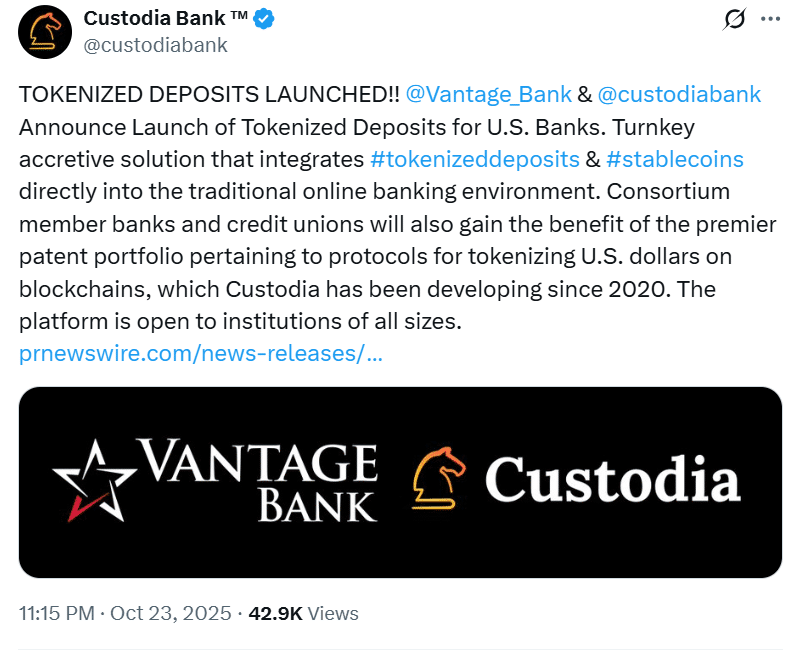
Custodia and Vantage Bank have launched a new blockchain platform specifically designed for issuing tokenized deposits. This innovative system aims to facilitate faster and more cost-effective transactions while ensuring that banks retain full control over their operations.
This development represents a significant advancement for traditional financial institutions, bringing the banking industry closer to the adoption of digital innovation and modern technological solutions.
Partnership Powers Blockchain Banking
Custodia and Vantage Bank have collaborated to establish an interoperable network for tokenization. This platform integrates Custodia’s established blockchain framework with Vantage’s Interlace network, creating a robust and unified system.
The system is designed to allow banks of all sizes to issue, manage, and redeem tokenized deposits. Crucially, it operates under strict regulatory compliance. Both Custodia and Vantage Bank are currently testing the platform through pilot programs to explore its real-world applications.
These pilot programs are investigating various use cases, including cross-border payments, supply chain settlements, and milestone-based payments within the construction industry. Initial findings from these tests indicate that tokenization can significantly enhance the speed, reduce the cost, and increase the transparency of banking operations.
What Tokenized Deposits Mean for Banks
Tokenized deposits are essentially digital representations of traditional bank deposits. These digital assets are recorded on a blockchain and are fully backed, on a one-to-one basis, by U.S. dollars held in reserve by regulated banks. This distinguishes them from private stablecoins, as they are directly issued by established banking institutions.
This structure provides banks with the necessary flexibility to serve their customers effectively, catering to both traditional financial systems and emerging digital platforms. Furthermore, it helps to build confidence among regulators and investors who have expressed concerns regarding the oversight of private stablecoins.
Why Banks Are Turning to Blockchain
The increasing popularity of stablecoins has presented a challenge to traditional banking models, as many customers are moving funds into digital assets to take advantage of faster transaction speeds. Tokenization offers banks a strategic way to remain competitive by providing similar benefits within a secure and regulated framework.
By embracing blockchain technology, banks can achieve significant reductions in transaction costs, accelerate the speed of fund transfers, and maintain the trust of their customers. Tokenization also addresses the critical concern of deposit flight, which is becoming more prevalent as digital assets gain traction.
Meeting Regulation and Risk Head-On
The platform developed by Custodia and Vantage operates in accordance with the principles of the GENIUS Act, which provides regulatory guidelines for secure financial services linked to stablecoins. A key feature of the platform is its guarantee that every tokenized deposit is fully collateralized by fiat currency held in a dedicated bank account.
This robust arrangement significantly mitigates the risks often associated with private stablecoins, while simultaneously providing regulators with the transparency and oversight they require. For banks, this means they can confidently pursue innovation without the fear of violating compliance rules.
Pilot Programs Deliver Real Results
The ongoing pilot programs conducted by Custodia and Vantage are already demonstrating tangible benefits. In cross-border transactions, the use of tokenized deposits has dramatically reduced processing times, shortening them from days to mere minutes. Within the construction sector, milestone-based disbursements are proving effective in aligning payments with project progress.
The efficiency of supply chain settlements has also been improved through faster payment processing and enhanced record-keeping capabilities. These practical tests highlight the transformative potential of tokenization in streamlining global finance and boosting efficiency across a variety of industries.
The Road Ahead for Tokenized Banking
Industry experts anticipate that tokenized deposits could represent the next major evolution in financial services. With the stablecoin market projected to reach $2 trillion by 2028, it is imperative for banks to adapt and remain relevant. Tokenization serves as a crucial bridge connecting established financial systems with the growing digital economy.
For banks, this advancement offers the opportunity to leverage blockchain technology without relinquishing control to external regulators. For consumers, it promises faster transactions, lower fees, and increased confidence in digital payment methods.
Conclusion
The introduction of tokenized deposits by Custodia Bank and Vantage Bank signifies a pivotal moment for traditional finance. By integrating blockchain technology with stringent regulatory compliance, both institutions have successfully created a secure and efficient pathway for digital transformation.
As testing expands and adoption grows, tokenization holds the potential to fundamentally alter how banks process transactions, manage liquidity, and compete in the evolving digital landscape. This alliance demonstrates that rather than being replaced, banks may be rebuilt and reimagined for the future of finance.
Appendix: Glossary of Key Terms
Tokenized Deposits – Digital versions of traditional bank deposits recorded on a blockchain and backed by real fiat currency.
Blockchain – A decentralized digital ledger that securely records and verifies transactions across multiple computers.
Stablecoin – A digital asset pegged to a stable value, such as the U.S. dollar, designed to reduce price volatility.
GENIUS Act – U.S. legislation that provides regulatory guidance for stablecoins and blockchain-based financial products.
Interlace Network – Vantage Bank’s blockchain system designed to connect banks for issuing and managing tokenized deposits.
Fiat Currency – Government-issued money, such as the U.S. dollar, used to back digital or tokenized assets.
Frequently Asked Questions About Tokenized Deposits
1- What are tokenized deposits?
Tokenized deposits are digital versions of bank deposits recorded on a blockchain and backed by real U.S. dollars.
2- How do tokenized deposits differ from stablecoins?
They are issued by regulated banks, not private firms, ensuring compliance and transparency.
3- Why are banks adopting tokenized deposits?
Banks want to offer fast, low-cost digital transactions while keeping control over customer deposits.
4- What role does regulation play?
The platform follows U.S. laws like the GENIUS Act, ensuring every deposit is fully backed and compliant.