



Key Market Insights
CryptoQuant analyst Axel Adler Jr. has updated Bitcoin's bear market support levels, setting them between $87,000 and $74,000. This revision comes amidst evolving market dynamics, including significant ETF outflows and technical signals that suggest a potential for deeper market corrections.
Bitcoin Support Levels Revised Amid Bear Market
CryptoQuant analyst Axel Adler Jr. has declared Bitcoin's new support levels at $87,000 and $74,000. These levels are derived from his analysis using the epoch cycle valuation model, which suggests potential market fluctuations and provides a cautious framework for investors based on historical market trends.
Technical indicators have shifted, with previous support levels now potentially acting as resistance, reflecting changes characteristic of a bear market. This adjustment, combined with ongoing ETF outflows, highlights the dynamic nature of the current market environment. Axel Adler Jr. of CryptoQuant stated, "I've identified two critical levels: Level 1 = $87K, Level 2 = $74K... There is no support left in the market, with all key metrics now acting as resistance."
Despite these bearish technical indicators, CryptoQuant CEO Ki Young Ju has advised caution and suggested that reconsiderations might be necessary. Market reactions to this update have amplified investor anxiety, particularly in light of continued ETF outflows and a notable decrease in the CryptoQuant Bull Score Index.
Bitcoin Trades at $94K Amid Volatile Market Conditions
Did you know? Historical patterns indicate that previous death crosses, significant bearish signals, occurred in 2014, 2017, and 2021, marking the start of substantial downtrends for Bitcoin.
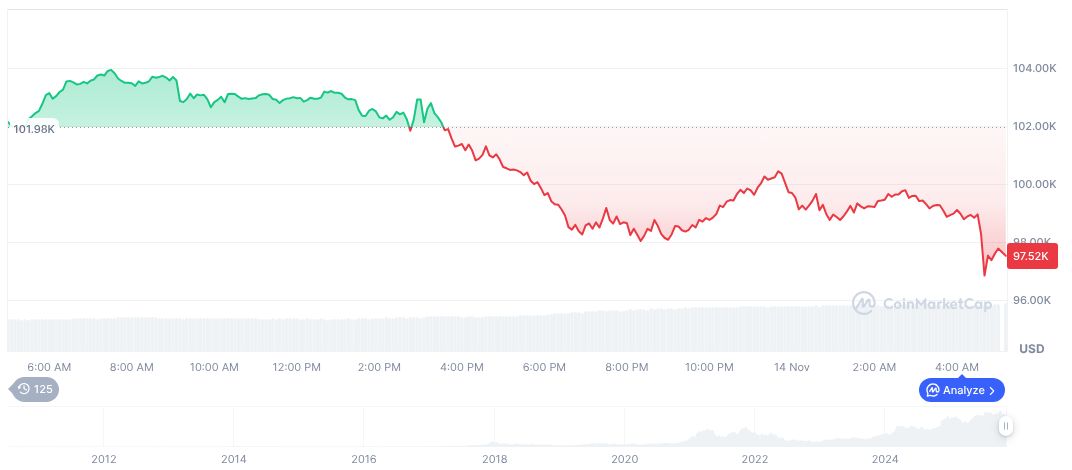
Bitcoin (BTC) is currently trading at $94,148.24, with a market capitalization of $1.88 trillion. The fully diluted market capitalization stands at $1.98 trillion, and the 24-hour trading volume is $114.47 billion. The price has seen declines of 5.66% across various durations, contributing to ongoing volatility concerns.
Continued market corrections could lead to increased regulatory scrutiny and the development of innovative financial solutions. Historical analysis suggests that such periods may prompt strategic shifts within key financial institutions, emphasizing the importance of adapting to evolving fiscal environments.