



After a sharp sell-off last week, crypto markets are showing tentative signs of recovery. Bitcoin (BTC) has climbed back near $111K and Ether (ETH) is holding above $4,000 — key support levels that ease fears of further downside. Many altcoins are rebounding as well, but sentiment remains cautious. The Crypto Fear & Greed Index sits around 30 (Fear), reflecting lingering wariness despite the bounce. Notably, options market data paints a cautiously bullish picture: recent sessions saw call option interest outweigh put interest on most top tokens, indicating traders are positioning for upside while still hedging their bets.
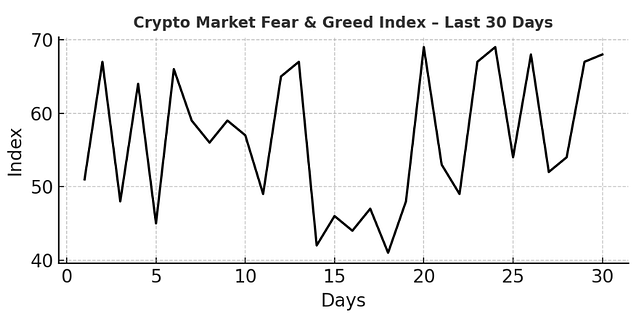
For instance, XRP and ETH saw heavy call buying, whereas BNB — despite its price rally — actually had roughly 4× more puts than calls open as traders locked in gains and protection. In short, the market is recovering, but with one eye on risk. This sets the stage for our technical analysis of five noteworthy assets — Hyperliquid (HYPE), Binance Coin (BNB), Ethereum (ETH), Solana (SOL), and Cardano (ADA) — and how traders can navigate the week ahead.
Hyperliquid (HYPE) — Stabilizing After a Dip
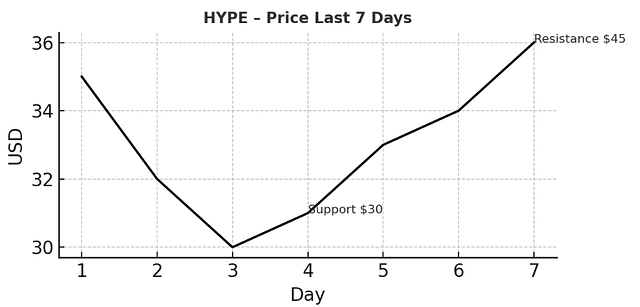
Hyperliquid (HYPE), a newcomer in the top 20 crypto rankings, is currently trading around $38–$39 per token. The token endured a pullback recently, dropping roughly 7% in 24 hours to about $34 before finding support. Analysts pinpoint the $30 level as a critical support area that buyers are defending; a decisive break below could signal further weakness, but so far bulls have held the line. On the upside, HYPE has room to recover if momentum returns. A relief rally toward the $45–$50 zone is feasible “if buying volume returns,” according to market observers. For now, however, short-term momentum remains unclear — traders appear to be waiting for confirmation of a trend reversal before piling back in.
Given Hyperliquid’s rapid rise and recent dip, it’s a coin to watch closely. Improved network activity or positive project news could be the catalyst needed to push HYPE out of its consolidation range. Until then, expect it to oscillate between support near $30 and overhead resistance in the low-$40s as the market gauges its next direction.
Binance Coin (BNB) — Rally Pauses Amid Hedging Activity
Binance Coin (BNB) has been on a rollercoaster, now trading around $1,115 after a volatile trading stretch. In the past day, BNB climbed ~1.4% as part of a broader crypto rally, opening near $1,077 and surging to about $1,144 at its peak before paring gains. This high-volume move (~7% intraday range) showed bulls stepping in aggressively; trading volume spiked to nearly double the 24h average during the run-up. However, the rally hit resistance around $1,140–$1,150 and BNB retraced to the low $1,120s, suggesting a bit of profit-taking and waning momentum at those highs.
Technically, the $1,100 level now sits as immediate support, with stronger support around the $1,050 area (recent dip). On the upside, BNB would need to clear the $1,200 zone convincingly to revive its uptrend — a feat that may require a new catalyst.
Despite its price being up significantly in recent weeks (BNB briefly hit a new all-time high near $1,280 last week), sentiment around BNB is mixed. On-chain fundamentals remain solid — Binance’s ongoing token burn (about 1.2% of supply removed in October) has contributed to its deflationary tokenomics, and Binance Smart Chain’s DeFi ecosystem still boasts a hefty $6+ billion TVL. But many traders are tactically cautious. Derivatives data shows an unusual hedge bias on BNB, with roughly four puts open for every call — significantly more puts than calls — even as the coin’s spot price rallied. This implies that big holders have been buying protective puts to insure their BNB gains (likely prudent after the coin’s strong run-up). In practice, BNB’s near-term outlook will depend on whether it can break above the $1,150–$1,200 resistance band on strong volume. A move through that ceiling could target the mid-$1,300s next, whereas failure to hold the $1,100 area may invite further consolidation or a pullback. Given the current “fearful” market mood, it’s no surprise traders are hedging — but if broader sentiment improves, BNB’s fundamentally driven uptrend could resume in force.

Ethereum (ETH) — Holding $4K as Bulls Eye Higher Levels
Ethereum (ETH) enters the week on relatively firm footing, changing hands around $4,030 at the time of writing. This marks a recovery above the psychological $4,000 level after last week’s turbulence, when ETH (like BTC) briefly plunged but then bounced off support. Maintaining $4K is crucial — analysts note that ETH needs to remain above ~$4,000 to avoid reigniting a downtrend. So far so good: Ether’s resilience at this support has eased immediate downside fears, and focus has turned to the upside potential.
On the technical chart, $4,400 looms as a notable resistance. ETH has been grinding upward, and recently it tested a key ceiling near $4,400 — just shy of its 2021 all-time high (~$4,950). Traders are watching that level closely; a breakout above $4.4K could put Ethereum on track to retest its all-time high, according to market analysts. In the near term, ETH appears to be consolidating in a range, with support at $4K and resistance around $4.3–$4.4K. A period of consolidation here could be healthy before any attempt to push higher.
Under the surface, Ethereum’s sentiment is optimistic. Options positioning remains firmly bullish — there’s a heavy concentration of call open interest at strikes around $4,000–$4,500, mirroring the bullish bets seen on Bitcoin. In fact, Ether’s call/put open interest skew suggests traders are positioning for a continued uptrend into year-end, possibly eyeing catalysts like macro improvements or an ETF approval. It’s also worth noting Ethereum’s network fundamentals (usage, fees, staking metrics) are robust, which provides a tailwind for price. All told, ETH traders will be looking for a high-volume move through $4,400 as a signal of the next leg up. If instead the $4K floor gives way, expect swift defensive action — including put option hedges — to kick in to protect against any deeper decline. For now, ETH’s uptrend intact above $4K keeps bulls firmly in control of the narrative.
Solana (SOL) — Surge Toward $200 with Event Catalyst Ahead
Solana (SOL) has been a standout performer lately, with its price currently around $192 after an impressive recovery rally. SOL started the week on a strong note, extending a weekend surge that saw it rebound from the mid-$180s back into the $190+ range. This bounce came after Solana successfully retested an ascending trendline support (~$186) during last week’s market dip and held firm. The quick resurgence in price — now putting SOL within sight of the psychologically important $200 level — has been fueled by surging trading volumes and growing optimism around Solana’s ecosystem.
A big confidence booster for Solana bulls is the upcoming Accelerate APAC event (kicking off this Friday in China), which is expected to highlight Solana’s expanding role in the region’s decentralized infrastructure initiatives. Anticipation of this event has added to positive sentiment, as investors speculate that major announcements or partnerships could be unveiled. On-chain data backs up the excitement: Solana’s network-wide trading volume hit its highest levels since January over the weekend, indicating a rush of activity and liquidity flowing into Solana’s DeFi and DEX platforms. In short, momentum and buzz are clearly on Solana’s side right now.
From a technical perspective, Solana has broken above its previous resistance around $155 (a level that was pinpointed as a hurdle just a week ago). Having cleared that, the charts suggest SOL could target the low $200s next. Analysts project a short-term range of $180–$220 for Solana if its fundamental catalysts play out as expected. In fact, SOL is already at the upper end of that range (~$192), so the next test will be whether it can decisively close above $200. The 50-day EMA around $206 may act as an interim resistance on this path. Beyond the event hype, there’s a significant technical upgrade on the horizon: Solana’s “Alpenglow” network upgrade, slated for Q4 2025, is expected to boost the blockchain’s throughput by roughly 40% — a potential game-changer for its scalability. If that upgrade stays on track, it could further strengthen the bullish case for SOL and justify its hefty year-to-date gains.
Traders should keep an eye on volatility around Friday’s event. A positive surprise (new projects, increased adoption in Asia, etc.) could blast SOL through the $200 barrier. Conversely, a “sell-the-news” dip or broader market pullback could see SOL revisit support zones around $180 or the high-$170s, which would need to hold to keep the uptrend intact. For now, Solana’s chart looks constructive, and the mix of technical strength + fundamental catalysts is making it one of the week’s most intriguing trades.
Cardano (ADA) — Rebounding Off Lows, Big News on the Horizon
Cardano (ADA) has been quietly rebuilding strength after a rough patch. The price is currently about $0.67, up from the lows near $0.55–$0.60 seen during last week’s shakeout. In fact, ADA has rebounded roughly 14% since holding that $0.60 support zone, which proved to be a robust floor as buyers consistently stepped in to defend it. This area — $0.55 to $0.62 — has a history of acting as an accumulation zone, and it held true again, sparking a relief rally. Cardano quickly regained the $0.66 level (a roughly 4% daily jump at one point) as trading volume and investor confidence began creeping back. On-chain metrics are reinforcing the bullish undertone: the Chaikin Money Flow indicator for ADA recently hit a three-month high, signaling strong capital inflows into Cardano during the bounce. In other words, whales or long-term believers may have used the dip to accumulate ADA at a relative discount.
From a chartist perspective, ADA’s short-term price action is forming what looks like a falling wedge breakout attempt. After the rebound, the coin has been stabilizing in the upper-$0.60s, potentially coiling for a move higher. Traders are eyeing a breakout above roughly $0.70 as confirmation of a bullish reversal. If ADA can close above $0.70 with conviction, it would likely target the next resistance band around $0.75–$0.78 (recent highs and the 100-day EMA). Above that, the $0.80-$0.85 region comes into play. On the downside, $0.60 remains the key support — so long as ADA stays above that, the base-building narrative holds. The fact that ADA is currently holding around $0.67–$0.68 suggests it’s midway between support and the immediate ceiling, waiting for a catalyst.
That catalyst might be imminent. A major fundamental event for Cardano is looming this week: the U.S. SEC is expected to rule on a spot Cardano ETF proposal by October 26. This is part of a broader wave of crypto ETF decisions (the SEC is also considering ETFs for Solana, XRP, and others around the same time) — and it’s a true binary event for ADA’s price. A favorable decision (or even optimistic speculation ahead of it) could send ADA soaring, as an ETF would potentially open the floodgates for institutional investment in Cardano’s ecosystem. Bulls have “projected a jump to $2.80” in a blue-sky scenario of ETF approval, one analysis noted — an ambitious target that underscores how significant an approval would be. On the flip side, if the SEC delays or denies the ADA ETF, Cardano could see a letdown dip, possibly back toward that $0.60 support if disappointment is severe. For now, ADA traders seem to be cautiously optimistic, with open interest data indicating many had closed out short bets as ADA held $0.60 (open interest dropped to yearly lows during the volatility, flushing out leverage). Keep a close watch on news wires around the week’s end. In the meantime, ADA’s technical health looks improved and its long-term prospects — bolstered by steady development and a growing user base — remain intact.
Why Savvy Traders Prefer Options Over Spot/Perps
With the market at an inflection point and big events on the calendar, more traders are turning to options trading on platforms like PowerTrade and Polaris to gain an edge. The appeal? Options offer unique advantages over regular spot trading or perpetual futures:
- •Defined Risk, No Liquidations: Unlike trading on margin or perps, where a sudden drop can liquidate your position, buying options comes with built-in risk limits — the maximum loss is just the premium you paid. Option buyers cannot be liquidated; even if the market moves against you, you simply lose that upfront premium. This provides peace of mind and allows traders to use leverage in a safer way. For example, instead of spending $10,000 to buy 1 ETH outright, a trader might spend a few hundred dollars on an ETH call option. If ETH’s price rockets, the call option can deliver outsized percentage gains, and if ETH tanks, the trader’s loss is capped at the small premium — no margin calls, no negative balance.
- •Flexibility to Profit in Any Market: Options open up strategies to profit from up, down or sideways markets. If you’re bullish on a coin, you can buy call options; bearish, buy puts — straightforward. But you can also bet on volatility itself. Strategies like straddles or strangles (buying both a call and a put) let you profit if a coin makes a big move in either direction, which is great for events like Fed meetings or ETF decisions where you expect volatility but aren’t sure of the outcome. This kind of flexibility is hard to replicate with spot or perps. In essence, options give you a whole toolbox for trading any market scenario that goes beyond the simple “buy low, sell high” or short-sell approach.
- •Cost Efficiency & No Funding Fees: Trading options can be capital-efficient. You pay a premium once to control a larger notional value of the asset, rather than putting up the full collateral as in spot trading. Moreover, unlike perpetual futures, options have no ongoing funding fees that eat into your P&L. Perps often charge a funding rate every 8 hours which can add up over time — especially if you hold a position for weeks. With options, you can hold a position through a major event (say an earnings report or a network upgrade announcement) without worrying about paying funding or getting liquidated by a wick. This makes options ideal for swing trading around news catalysts: for instance, buying calls ahead of a rumored ETF approval, or buying puts as insurance before a hard fork, and holding through the news without stress.
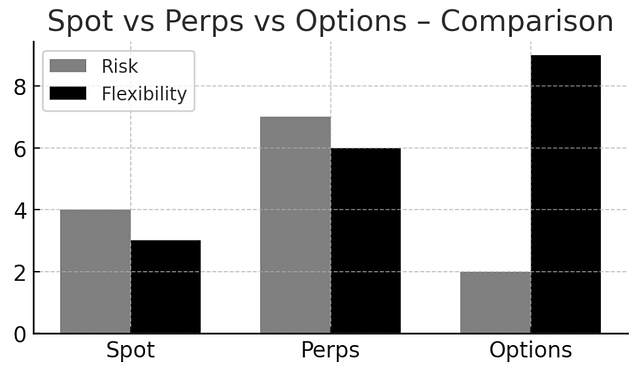
- •Hedging and Income Opportunities: Options aren’t just for speculation; they’re also excellent for hedging existing portfolios. Suppose you hold a basket of altcoins (BTC, ETH, SOL, etc.) and you’re nervous about a short-term downturn — you can buy put options on those assets to protect against losses. If the market drops, your puts rise in value to offset some of the damage. It’s like buying insurance for your crypto. On the flip side, if markets are flat, you can even earn yield by selling options (e.g. writing covered calls on your holdings to earn premium income during sideways periods). Advanced platforms are starting to offer automated vaults for these strategies. This is something spot trading alone can’t provide.
Given these benefits, it’s clear why crypto options volume has been surging over the past year. Now, with platforms like PowerTrade and Polaris, traders have accessible venues to harness options. PowerTrade is a centralized crypto derivatives exchange known as “the altcoin options exchange” — it offers over 100 markets, including options on major altcoins like Solana and Cardano, not just BTC and ETH. This broad selection means you can express almost any market view — whether it’s taking a bullish flyer on a DeFi token or hedging a meme coin position. PowerTrade also provides a professional-grade interface with deep liquidity (liquidity pools are unified with their sister platform), so even larger orders get filled at fair prices.
Polaris, on the other hand, brings the power of options to DeFi. Built by the PowerTrade team, Polaris is a next-gen on-chain options platform operating across multiple blockchains (currently Base, Ethereum, and Solana). With Polaris, traders simply connect a Web3 wallet and can trade without any sign-up or KYC, tapping into the same deep liquidity that feeds PowerTrade. Polaris covers 80+ altcoins plus BTC, ETH and even tokenized stocks (called “xStocks”), all in a permissionless environment. This means you could, for example, trade options on Hyperliquid (HYPE) or other trending tokens on-chain, directly from your wallet. Both platforms emphasize no liquidation risk (since all positions are fully collateralized options, your max loss is known upfront), and Polaris is even innovating with zero-fee perpetuals and hybrid “turbo perps” to complement its options markets. In short, whether you prefer a centralized venue or a DeFi approach, you have tools at your disposal to trade the coming market moves with options.
Outlook for the Week — Catalysts and Strategies
Looking ahead to the rest of this week, traders should be prepared for potential volatility spikes. Several high-impact events are on the docket.
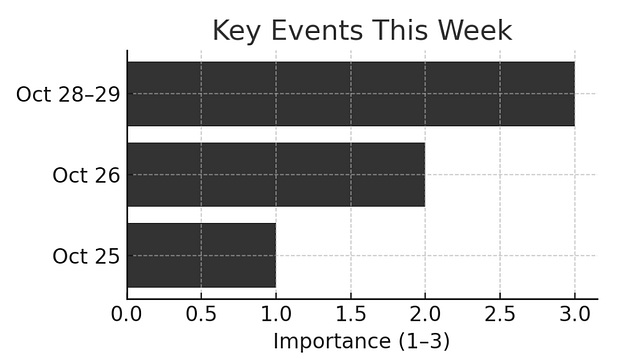
As mentioned, the SEC’s decisions on crypto ETFs (for Cardano, Solana, XRP, and others) are expected around Oct. 26 — any surprise approvals or delays will move markets. We also have ongoing macro influences: a Fed meeting is just around the corner (Oct. 28–29), and any signals of policy shifts could whipsaw crypto sentiment given Bitcoin’s increasing correlation with macro trends. Additionally, watch for Solana’s Accelerate APAC event on Friday — positive developments there could further boost SOL and related ecosystems. On the flipside, be mindful of any large token unlocks or idiosyncratic risks (for example, smaller cap projects releasing vested tokens can sometimes put sell pressure — none of the assets we covered have major unlocks this week, but it’s always good to stay informed on your specific holdings).
In terms of trading strategy, expect the unexpected. Markets are currently pricing in a lot of good news (many altcoins have run up in anticipation of ETF approvals and tech upgrades). If the news delivers, we could see euphoric spikes — a scenario where having some call options could yield significant gains. If the news disappoints, a swift correction could ensue — validating the case for those protective puts or stop-losses on leveraged longs. Options trading shines in this kind of environment: you might consider straddles around big announcements, or simply use options to hedge while keeping your upside open. Remember, when volatility is on the menu, the goal is to stay flexible and protected.
In summary, the crypto market in late October 2025 is at a crucial juncture. HYPE, BNB, ETH, SOL, and ADA each have their own narratives — from Hyperliquid’s recovery efforts to Cardano’s make-or-break ETF moment — but all share a backdrop of improving sentiment tempered by cautious risk management. By combining sound technical analysis with savvy use of options on platforms like PowerTrade and Polaris, traders can tactically position themselves to benefit from the trends while mitigating downside. As always, thorough research and disciplined risk management are key. This week promises to be an exciting one in crypto; whether prices break out or break down, you now have the insights and tools to navigate the action like a pro. Happy trading!