


Market Dynamics and Liquidity Contraction
Major cryptocurrencies lost momentum on December 1, 2025, as liquidity thinned and leveraged positions unwound. Cryptowave, a commentary and reporting X account operating under the handle @cryptsnews, issued early alerts. The post stated that Bitcoin, Ethereum, Binance Coin (BNB), and XRP declined as liquidity contracted. The same update estimated that markets liquidated nearly $600 million in positions, data that derivatives tracking platforms later echoed.
The tweet framed the movement as a liquidity-driven wave event, a pattern frequent in low-depth order books. The post delivered cautionary context but avoided price direction. Market participants reacted with reduced leverage appetite in BTC and ETH pairs, shaping the day's news flow without defining broader trend shifts. The event pushed the term crypto news into heightened search frequency across trading and social platforms.
Market Conditions and Liquidation Breakdown
Asset contraction initiated trading instability across major spot and perpetual markets. BTC trades lost altitude after consistent demand support weakened near key intraday levels. ETH markets mirrored similar order-book thinning, showing compressed bid stacks during peak volatility windows.
On-chain analytics firms recorded exchange netflows that failed to offset derivative pressure. Liquidation engines activated rapidly as margin thresholds triggered automated exits. Futures contracts denominated in BTC and ETH drove most of the total liquidations. Platforms reported an outsized share of long-position closures.
Infrastructure teams noted overloading in matching engines during volatility surges, but exchanges kept full uptime. Order latency widened during the fastest drawdown minutes. The liquidations reduced open interest across BTC and ETH-linked perpetual swaps. Funding rates normalized after positions cleared.
Social Commentary and Market Messaging
Cryptowave operates as a non-official commentary source, not an exchange or protocol team. The December 1 post spread quickly due to its timing. The update reached audiences searching for real-time derivative risk signals and liquidation estimates.
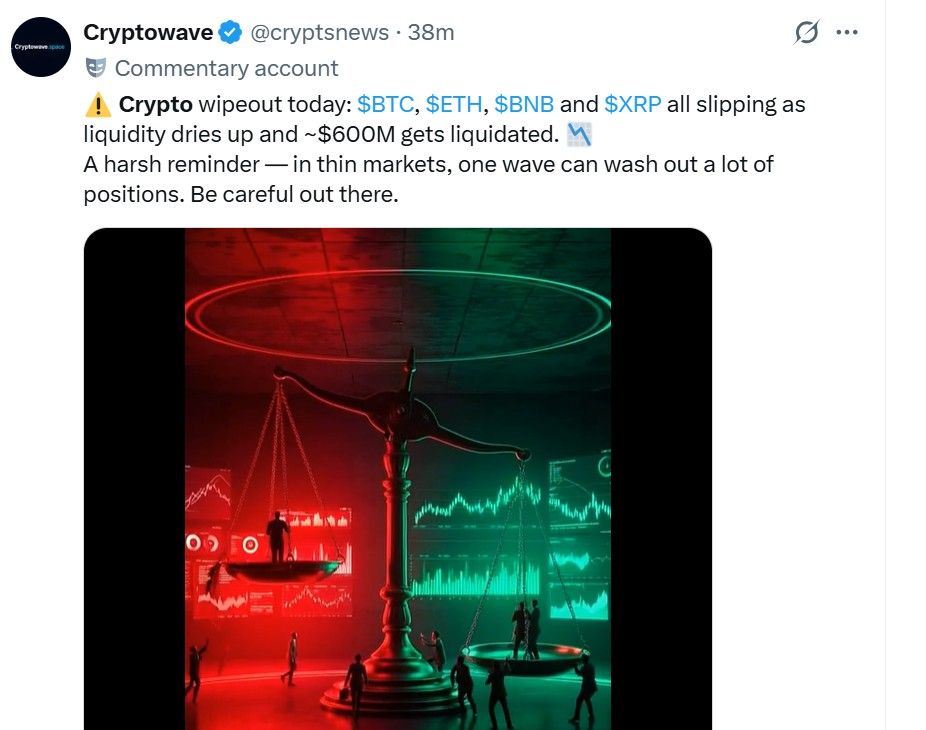
Other social accounts amplified the same figures but avoided attributing direct market causes beyond asset depth. No exchange published emergency notices or blamed counterparties. Participants referenced "thin markets" and "liquidity pockets" in follow-up messages. The original tweet included metaphorical phrasing but no projections.
Third-party data providers confirmed similar liquidation totals, aligning with the social report. Search activity for the phrasing "crypto news" spiked in the hours after the tweet circulated. Social monitoring dashboards recorded trend pressure on related terms, including trending crypto presale and crypto news concurrently, based on query heatmaps.
BTC and ETH Spot Structure Post-Drawdown
Bitcoin’s spot structure shifted into lower leverage and shorter trade cycles after liquidations cleared. Market makers rebuilt bids in measured increments. Ethereum liquidity providers followed similar order-book stacking behavior.
Spot volumes stayed elevated but demonstrated shorter average trade duration. BTC and ETH markets entered a volatility digestion phase with tighter position sizing. No protocol-level vulnerabilities surfaced. Blockchain settlement continued as normal.
Price ranges for BTC and ETH compressed after the flush. Bitcoin order books displayed symmetric depth rebuilding. ETH liquidity rebuilt with similar pacing. Network fees on both chains responded to momentary trading demand but stabilized quickly. The news narrative focused on leverage and liquidity behavior for the remainder of the trading day.